Thailand rice exports likely to ease in CY'26 on strong baht
...
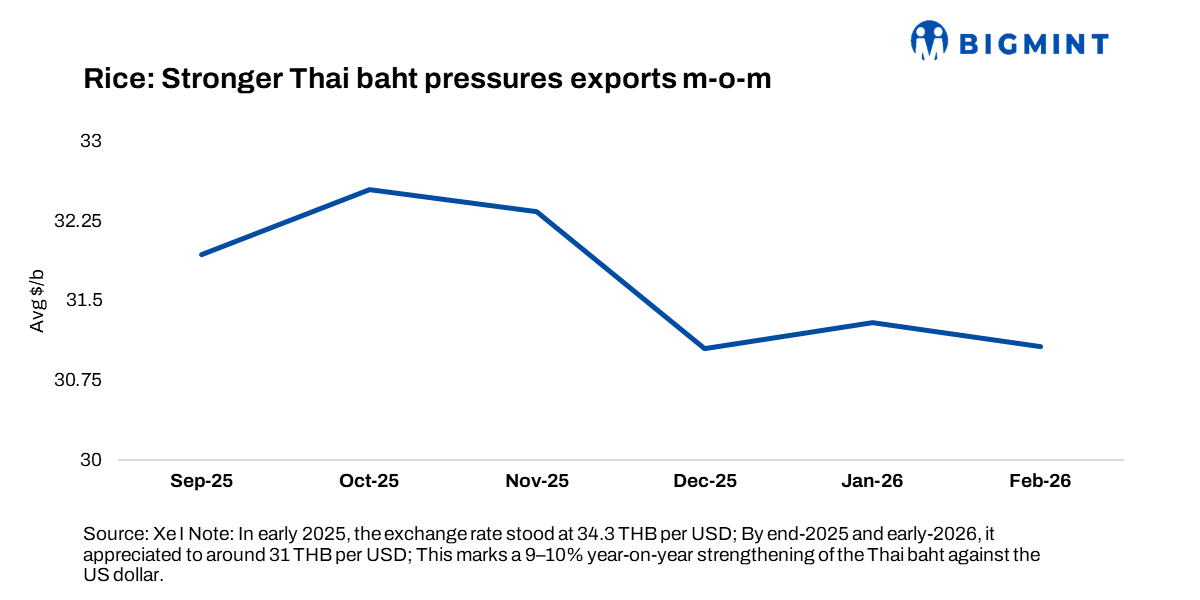

- Strong baht weighs on Thai rice exports
- Currency gains erode price competitiveness
Thailand remains one of the world's leading rice exporters, alongside India, Vietnam, Pakistan, and Myanmar. In CY25, Thailand exported around 7.27 million tonnes, with major shipments directed to Iraq, South Africa, United States, China, Senegal, Angola, and Malaysia.
However, exports in CY26 are expected to decline due to the strengthening Thai baht, which has made Thai rice relatively expensive in global markets. The President of the Thai Rice Exporters Association indicated that in the absence of fresh demand triggers, exports may decline to 7 million tonnes, marking a 3.71% year-on-year drop, as per data maintained by BigMint.
A slowdown in exports could weigh on domestic paddy prices. Historically, when Thai farmers face price pressure, government intervention through support schemes becomes likely, adding fiscal pressure.
Currency Impact Explained with Current Prices
At the current exchange rate of 1 THB 0.03 USD, Thai 5% broken rice is quoted at $379-383 per tonne, which translates to approximately THB 11,829 per tonne. Importantly, the domestic price in Thailand remains unchanged in baht terms. However, currency movement significantly alters the dollar realization.
For instance, when the exchange rate was weaker at 1 USD is equal to 35 THB, the same THB 11,829 per tonne would translate to around $338 per tonne. If the baht strengthens to 1 USD is equal to 31 THB, the dollar equivalent rises to approximately $381 per tonne. This represents nearly a 13% increase in dollar terms, purely due to currency appreciation, despite no change in the local Thai price.
On a month-on-month basis, Vietnam's 5% white rice has increased by roughly 20-23%, moving into the $400-415 per tonne range from the low-$330s previously. In contrast, India's 5% white rice has remained largely stable month-on-month, showing negligible movement (within 0-1%).
In a highly price-sensitive global market, even a 5-7% price difference can shift bulk procurement decisions. A currency-driven increase of over 10% significantly impacts competitiveness, particularly in large-volume tenders across Africa and Asia.
Outlook:
Industry leaders from the Thai Rice Exporters Association have cautioned that if global demand stays muted, Thailand's exports could fall to around 7 million tonnes, which would be a year-on-year decline of about 4%. This is a meaningful shift from the previous year and suggests weaker demand traction under current pricing dynamics.
