India: Expected rice export vessel line-up for Feb'26
...
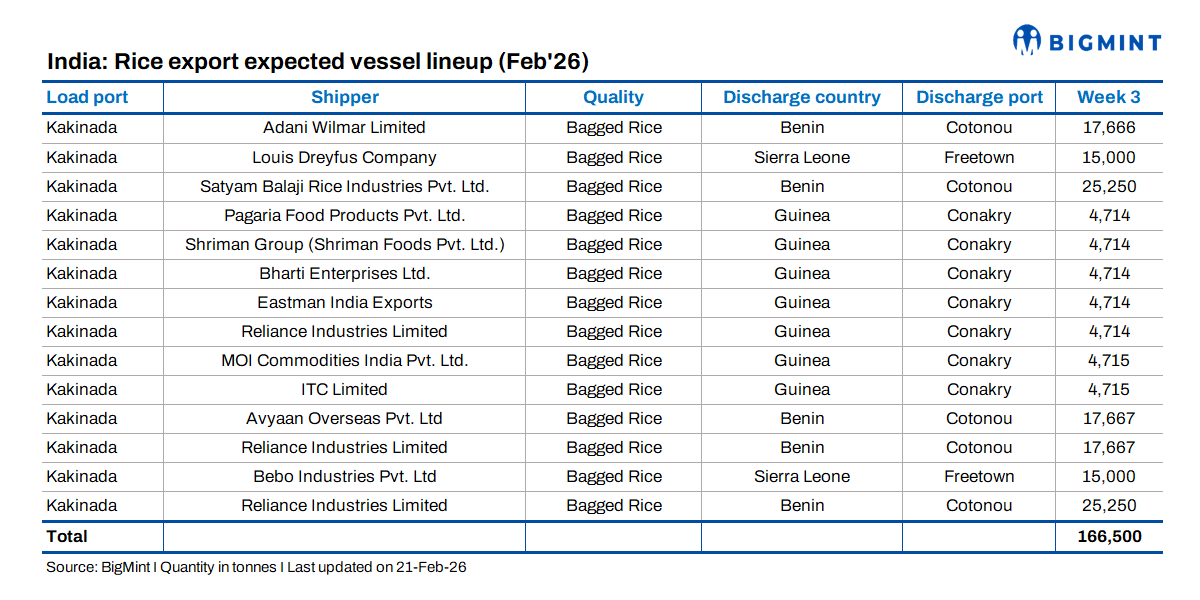

- Week three loadings estimated at 166,500 tonnes from Kakinada
- West Africa absorbs entire scheduled dispatch programme
India's expected rice export vessel line-up for week three of February 2026 totals 166,500 tonnes, with all cargoes scheduled to load from Kakinada. The programme is entirely directed toward West Africa, reinforcing the region's position as the primary outlet for Indian-origin rice during the period under review.
All shipments comprise bagged rice, highlighting sustained demand for retail-ready and branded cargoes in African markets. The exclusive routing through Kakinada points to logistical consolidation on the east coast, likely reflecting vessel availability, cargo aggregation efficiency and freight optimisation.
Benin: Benin accounts for the largest share of scheduled volumes, with multiple consignments bound for Cotonou. The scale of allocations indicates ongoing replenishment demand and structured trade flows, as Cotonou continues to function as a key distribution hub for inland and neighbouring markets. The presence of both mid-sized and larger parcel lots suggests coordinated vessel planning rather than spot-driven fragmentation.
Guinea: Guinea ranks next in volume allocation, with several similarly sized consignments slated for Conakry. The near-uniform parcel sizes indicate systematic cargo parcelisation, potentially under a single or closely timed vessel programme. This pattern reflects disciplined shipment planning and sustained offtake from the Guinean market despite broader regional currency and liquidity sensitivities.
Sierra Leone: Sierra Leone is also scheduled to receive sizeable volumes at Freetown. The allocation structure suggests steady demand rather than opportunistic buying, aligning with established consumption trends and routine restocking cycles.
Structured programme signals stable export flow
The concentration of 100% of expected week three shipments toward West Africa underlines the region's continued dependence on Indian rice supplies. The consolidated loading plan from a single port, combined with parcelised cargo structuring across destinations, signals a calibrated export programme rather than aggressive volume expansion.
Overall, the February week three vessel line-up reflects stable trade flows, focused destination exposure and continued traction for Indian bagged rice in West African markets.
