India: Rice exports gather pace; West Africa dominates vessel line-up
...

- Shipments increase by 60% w-o-w after late-Jan slowdown
- Over 200,000 t scheduled for loading, Kakinada leads ports
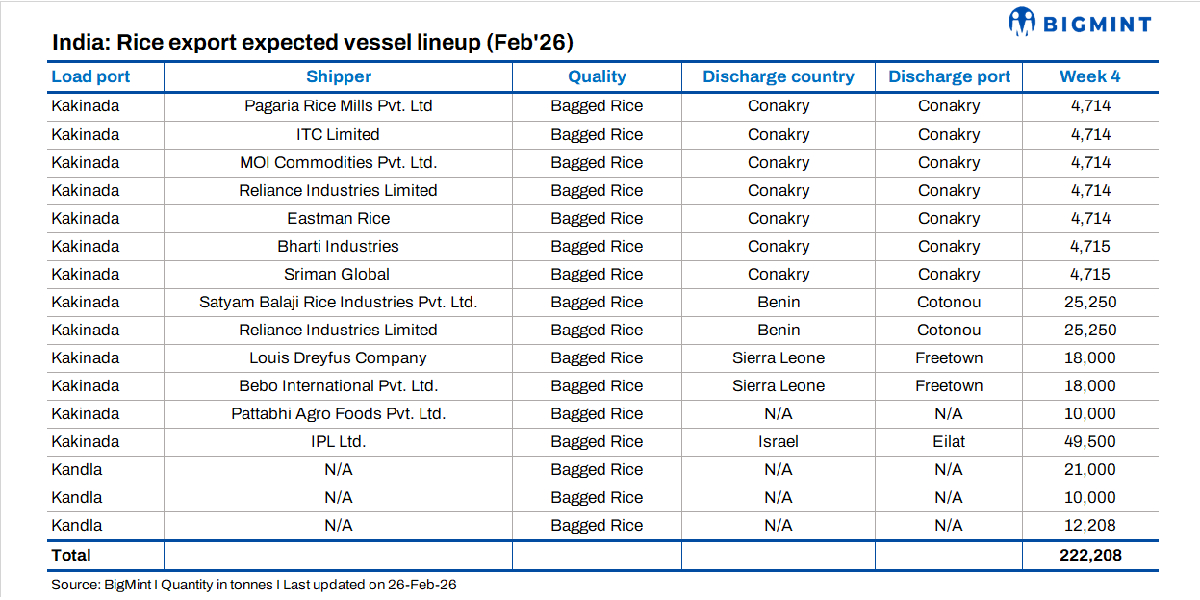
India's rice export programme for February is showing renewed momentum, with an estimated 222,208 tonnes (t) lined up for loading, led overwhelmingly by Kakinada on the east coast as of 20 February. The vessel lineup underscores strong West African demand, particularly from Guinea, Benin and Sierra Leone, while isolated cargoes are also destined for Israel.
West Africa anchors February loading schedule
Kakinada accounts for the bulk of scheduled shipments, with multiple parcels of bagged rice earmarked for Conakry, Guinea, each in the range of about 4,714-4,715 t, reflecting steady breakbulk movements. Larger consolidated cargoes are directed toward Cotonou, Benin, totalling 50,500 t across two shippers, while Sierra Leone-bound volumes to Freetown stand at 36,000 t.
A notable outlier is a 49,500-t consignment scheduled for Eilat, Israel, signalling opportunistic trade outside India's core African corridor. Additional volumes from Kandla, aggregating over 43,000 t with destinations yet to be declared, suggest pending fixture confirmations or flexible routing depending on freight economics.
East coast activity lifts weekly shipment data
The shipment data for the week ended 20 February reflects a sharp rebound from the previous week. Total exports rose 61% from 137,700 t in the 7-13 February window, while India shipped 12,350 t in the previous week and 18,700 t in mid-January. The spike was driven primarily by 104,300 t loaded at Kakinada, indicating accelerated vessel operations and improved evacuation.
Kandla, which recorded a substantial 206,500 t in late January, moderated to 25,400 t in the latest week, pointing to front-loaded dispatches earlier in the cycle. Dhamra contributed 8,000 t, while Kolkata activity remained intermittent.
The evolving shipment pattern suggests exporters are actively clearing February positions, with east coast ports regaining prominence amid sustained African demand and fluid freight dynamics.
