India: Non-basmati rice export activity slows significantly; vessel pipeline remains strong
...

- Kakinada continues to dominate export handling
- Nearly 70% of vessel line-up cargo remains at anchorage
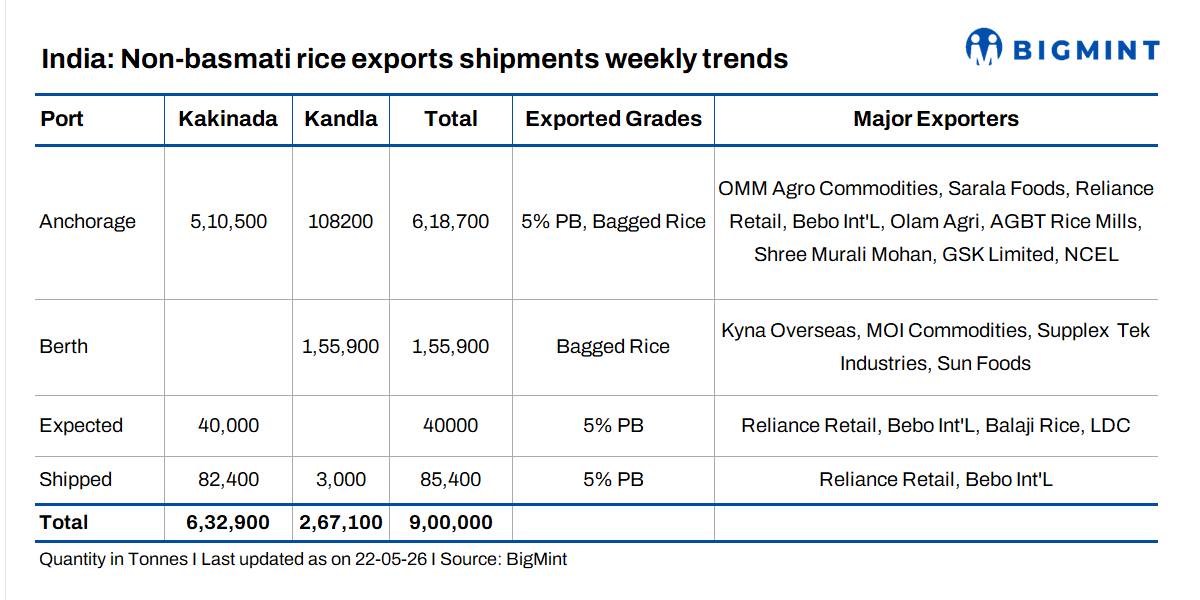
Indias non-basmati rice export shipment activity slowed during 16th-22nd Maywith total dispatched volumes falling significantly to 85,400 tonnes (t), compared with 207,405 t recorded in the previous week. The decline indicates slower vessel clearances across major export hubs despite continued cargo availability in the system. Kakinada accounted for the majority of current shipments at 82,400 t, while Kandla contributed 3,000 t.
The slower movement may be linked to port congestion and delayed vessel clearances, as a large share of cargo remains stranded at anchorage. In addition, slower buying interest from key African destinations following recent import policy changes, along with higher freight and insurance costs, may also be contributing to cautious shipment execution.
Anchorage cargo remains elevated
Despite the slowdown in shipments, a substantial volume of cargo remains positioned at anchorage, keeping the export pipeline firm. Total anchorage cargo stood at 618,700 t, accounting for nearly 69% of the overall vessel line-up. Among ports, Kakinada accounted for 510,500 t of anchored cargo, while Kandla held 108,200 t. The anchored volumes mainly comprise 5% broken parboiled and bagged rice, indicating these continue to dominate Indias ongoing export programme.
Berth cargo concentrated at Kandla
In addition to anchorage volumes, around 1,55,900 t are currently positioned at berth, at Kandla. Most of the berth cargo consists of bagged rice, which may support shipment recovery once loading and vessel clearance processes progress.
Fresh cargo expected at Kakinada
An additional 40,000 t are listed under expected arrivals, all at Kakinada, primarily comprising 5% broken parboiled rice. The fresh cargo inflow indicates continued export readiness and suggests that vessel pipeline levels may remain supported in the coming reporting periods.
Kakinada continues to dominate export handling
With a cumulative 632,900 t in the current vessel line-up, Kakinada accounted for nearly 70% of Indias total non-basmati rice export pipeline, maintaining its position as the leading shipment hub. Meanwhile, Kandla handled 267,100 t, with cargoes largely concentrated in bagged rice shipments.
Outlook
While the overall vessel pipeline remains sizeable, the sharp decline in shipped volumes indicates slower cargo movement compared with the previous period. Export momentum in the near term will likely depend on faster vessel clearances, easing port congestion, and improvement in buyer participation across key destination markets.
