India: Maharashtra monsoon deficit stalls kharif sowing; acreage at one-third of last year's pace
...
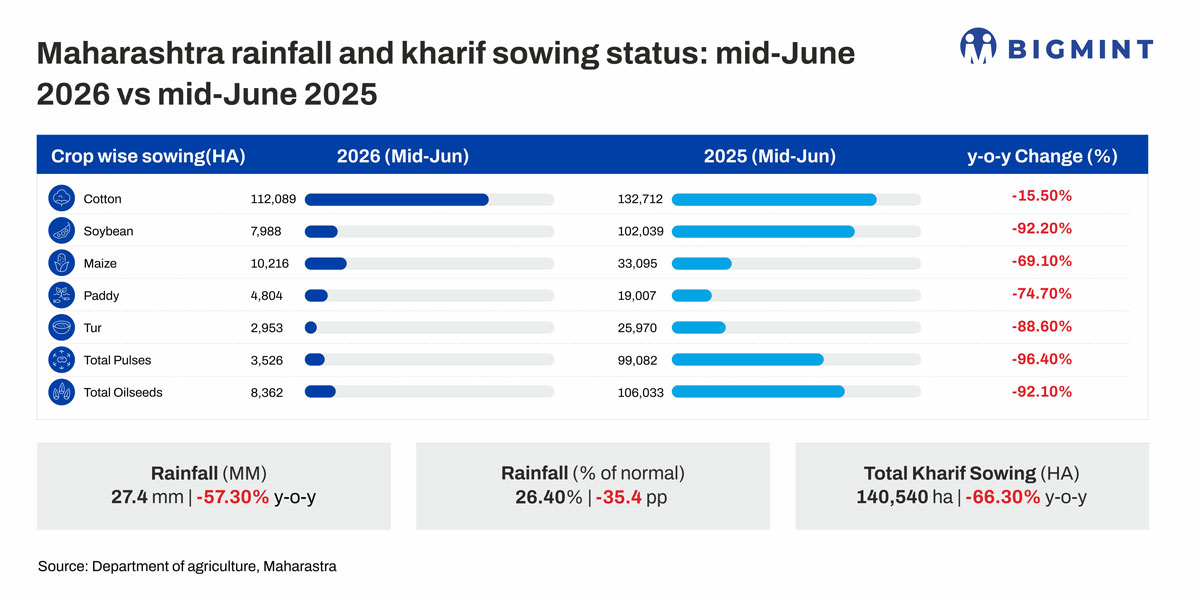

- Rainfall at 26.4% of normal versus 61.8% a year ago
- Cotton dominates early planting as soybean and pulse growers await widespread rains
Maharashtra's kharif season has begun on a subdued note, with below-normal monsoon rainfall slowing sowing activity across major agricultural regions. Between 1 and 15 June 2026, the state received 27.4 mm of rainfall, equivalent to only 26.4% of the long-period average. During the corresponding period last year, rainfall stood at 64.2 mm, or 61.8% of normal. The delayed and uneven monsoon has limited soil moisture availability, forcing farmers in several districts to postpone planting decisions.
The rainfall distribution highlights the extent of the challenge. Nineteen districts received less than 25% of normal rainfall, while 194 of Maharashtra's 355 talukas remained in the 0-25% rainfall category. Only Sangli and Dharashiv recorded rainfall above normal levels, whereas Beed and Solapur received 75-100% of normal precipitation. Most districts in North Maharashtra, Marathwada and Vidarbha continued to report rainfall deficits, keeping farmers cautious despite the official onset of the monsoon.
Sowing progress trails last year
The weak rainfall pattern has translated directly into slower kharif sowing. As of 15 June, total sowing excluding sugarcane reached 140,540 hectares, representing just 1% of Maharashtra's normal kharif acreage of 14.44 million hectares. By comparison, sowing had already covered 417,267 hectares during the same period last year. Current progress is therefore only 34% of last year's level.
Including sugarcane, total planted area stood at 143,940 hectares, compared with 423,875 hectares a year earlier. State agriculture authorities have advised farmers against hurried sowing until rainfall becomes more widespread and consistent, a recommendation that has further contributed to the slower pace of field operations.
Regional disparities emerge
Sowing progress varied significantly across regions. Nashik division emerged as the leading contributor, with 103,438 hectares planted, exceeding last year's level by 13%. Jalgaon and Dhule accounted for the bulk of the acreage, supported by relatively better rainfall and field conditions.
Amravati division also outperformed last year, recording 16,968 hectares of sowing, driven mainly by cotton planting in Yavatmal district. In contrast, major producing belts in western Maharashtra and Marathwada remained far behind. Pune division reported only 603 hectares of sowing compared with 178,626 hectares a year ago, while Latur division managed just 2,409 hectares against 70,913 hectares last season. Chhatrapati Sambhajinagar division also lagged, covering only 6,201 hectares.
Cotton leads acreage growth
Cotton remained the dominant crop during the early phase of the season, accounting for 112,089 hectares, or nearly 80% of the state's total sown area. Cotton acreage has already reached 84% of last year's level, reflecting planting in areas that received pre-monsoon showers.
Soybean sowing, however, stood at only 7,988 hectares compared with more than 102,000 hectares during the same period last year. Total pulse acreage reached just 3,526 hectares, while maize covered 10,216 hectares. The slow progress in soybean and pulses indicates that growers are largely waiting for sustained rainfall before committing significant acreage.
Outlook
The next fortnight will be crucial for Maharashtra's kharif season. Field preparation activities are underway across most districts, but large-scale sowing of soybean, pulses and coarse cereals remains dependent on improved rainfall. A broad-based revival of monsoon activity during the second half of June could accelerate planting and narrow the gap with last year's acreage. Conversely, prolonged rainfall deficits may further delay crop establishment and increase uncertainty around production prospects for the 2026-27 kharif season.
