Global ferrous scrap market remains under pressure; Muharram weighs on regional buying
...
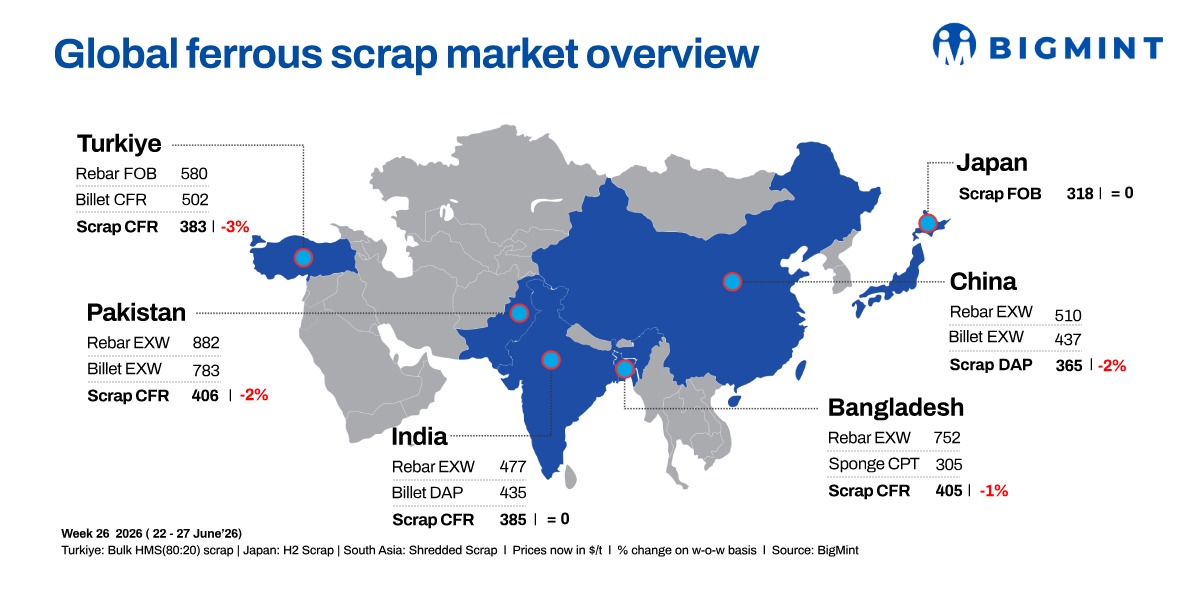

- Turkiye prices decline further as mills resist higher scrap offers.
- UAE: Export ban yet to lift domestic scrap prices.
Global ferrous scrap markets remained subdued in the week ended 27 June, with weak steel demand and need-based procurement limiting trading activity across major markets. Trading in parts of South Asia slowed further due to the Muharram holiday, while seasonal factors and policy developments shaped regional price trends.
Turkiye: Deep-sea imported ferrous scrap market remained under pressure this week as weak rebar demand and poor mill margins continued to weigh on buying activity. EU-origin HMS 80:20 deals were concluded at $379-381/t CFR, while workable levels were heard at $370-375/t CFR for Europe- and Baltic-origin material and up to $380-385/t CFR for US-origin cargoes. With ex-works rebar at around $565/t, Turkish mills sought HMS 80:20 at $370-375/t CFR to restore scrap-to-rebar margins.
India: Imported ferrous scrap market remained subdued during the week, with buying activity continuing to weaken as mills preferred domestic scrap and sponge iron amid better cost competitiveness. Weak steel demand and poor import economics kept procurement largely need-based.
Offer indications were heard at $325-330/t CFR for UK-origin HMS 80:20 and $380-385/t CFR for UK-origin shredded scrap. Market participants reported that containerised shredded scrap prices remained largely unchanged despite persistently weak buying sentiment. Domestic scrap remained the preferred raw material due to better cost competitiveness, limiting import demand.
During the week, around 3,500-4,000 t of imported scrap arrived in India, comprising 1,300-1,500 t of HMS and 1,500-2,000 t of LMS, with buying largely limited to containerised, need-based cargoes.
Freight to Inda: Container freight rates decreased on the MelbourneChennai route to around $1,400-1450/FCL amid subdued Australian scrap exports. Rates also declined to around $1,350-1,400/FCL from London Gateway to Chennai due to weaker demand and lower container utilisation, while freight to JNPT fell to around $1,250-1,300/FCL on sluggish imports, lower booking volumes, and increased carrier competition.
Pakistan: Imported shredded scrap market remained under pressure during the week, as weak steel demand and the Muharram holiday kept mills on the sidelines, limiting fresh bookings despite ample offer availability.
Bids for UK-origin shredded scrap were heard at around $405/t CFR Qasim against offers of approximately $410/t CFR. Buyers continued to seek lower workable levels, while sufficient supply and competitive domestic scrap prices kept import sentiment weak.
Bangladesh: Imported ferrous scrap market remained subdued during the week, with weak finished steel demand and poor import viability keeping mills on a cautious, need-based procurement strategy. UK-origin HMS 80:20 was offered at around $365/t CFR Chittagong, shredded scrap at $405/t CFR, while Australia-origin HMS 80:20 was offered at $370-375/t CFR against bids at $360-365/t CFR.
Expectations of softer freight rates, the Muharram holiday, and a Brazil-origin containerised HMS 80:20 deal at $362/t CFR further reinforced buyers' lower price expectations.
Japan: H2 ferrous scrap export prices declined by JPY 300/t w-o-w to JPY 51,400/t in the week ended 27 June, as buying interest remained subdued. Although a weaker yen against the US dollar supported export competitiveness, sentiment weakened after Tokyo Steel cut its scrap purchase price at the Tokyo Bay plant by JPY 500/t to JPY 53,500/t, effective 26 June. However, export offers remained largely unchanged despite the mill's price cut.
China: Scrap market remained under pressure after Shagang Group cut its benchmark heavy scrap purchase price by RMB 30/t to RMB 2,480/t, effective 24 June. The cut reflected weak seasonal steel demand and scrap's declining cost competitiveness against hot metal, reducing mill scrap consumption.
US: Scrap prices remained largely stable in June, with shredded scrap edging up $1/t to $433/t, HMS rising $3/t to $382/t, and prompt industrial scrap increasing $1/t to $471/t. Stable domestic demand supported prices, while weak export demand from Turkiye capped gains.
UAE: Domestic ferrous scrap prices edged down in the week ended 26 June, with processed HMS (80:20) assessed at AED 1,035/t DAP Abu Dhabi, down AED 3/t w-o-w, as mills continued need-based procurement.
Despite the four-month ferrous scrap export ban, the policy had little immediate impact on domestic prices, with benefits expected to emerge gradually.