Russian coal production declines in Jan-May'26 despite strong Asian demand
...
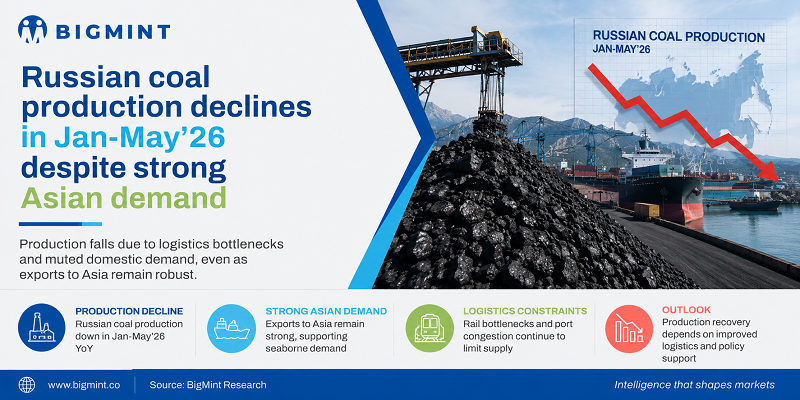

- Logistics issues, sanctions pressure, weaker profitability pressure producers
- Supply constraints may limit export growth, supporting seaborne coal prices
Russia's coal industry continues to face mounting challenges despite strong demand from Asian importers.
Production data for the first five months of 2026 shows a broad-based decline across most major coal-producing regions, highlighting the growing pressure on producers from logistics constraints, sanctions-related disruptions and weak profitability.
Production falls 5%
According to the Central Dispatching Department of the Fuel and Energy Complex (CDU TEK/CCA Russia), Russian coal production reached 176.7 million tonnes during January-May 2026.
This represented a decline of approximately 5% compared with the same period last year.
May production totalled 35.6 million tonnes, broadly unchanged y-o-y but insufficient to reverse the broader downward trend.
Kuzbass remains under pressure
The largest decline continues to come from the Kuzbass region, Russia's dominant coal-producing basin.
Production in Kemerovo Oblast reached 77.5 million tonnes during January-May, down approximately 5% y-o-y.
Output also declined across several other major producing regions, including Sakha, Krasnoyarsk, and Irkutsk.
Only a handful of regions, most notably Khakassia, recorded meaningful growth.
Export competitiveness challenged
Russian miners continue to face pressure from rail tariffs, logistics bottlenecks, financing constraints, and currency movements.
Although Russian coal remains highly competitive in Asian markets, particularly China and India, margins have narrowed considerably over the past year.
At the same time, producers must increasingly compete with Indonesian material in China and Australia in the premium coal segments.
Implications for the seaborne market
The decline in Russian production comes at a time when South Korea, China, and India continue to rely heavily on Russian coal.
Lower output does not necessarily imply lower exports immediately, but it reduces the market's ability to respond quickly to demand surges.
For Asian buyers, particularly those dependent on Russian mid-CV material, production trends warrant close monitoring during the second half of 2026.
Outlook
Russian coal remains a cornerstone of Asian thermal coal trade, but declining production suggests the country's export growth phase may be nearing its limits.
Unless profitability improves or logistical constraints ease, Russian exports are likely to remain constrained, providing a supportive backdrop for seaborne thermal coal prices later in the year.