India: Thermal coal inventories dip slightly amid subdued import demand
...
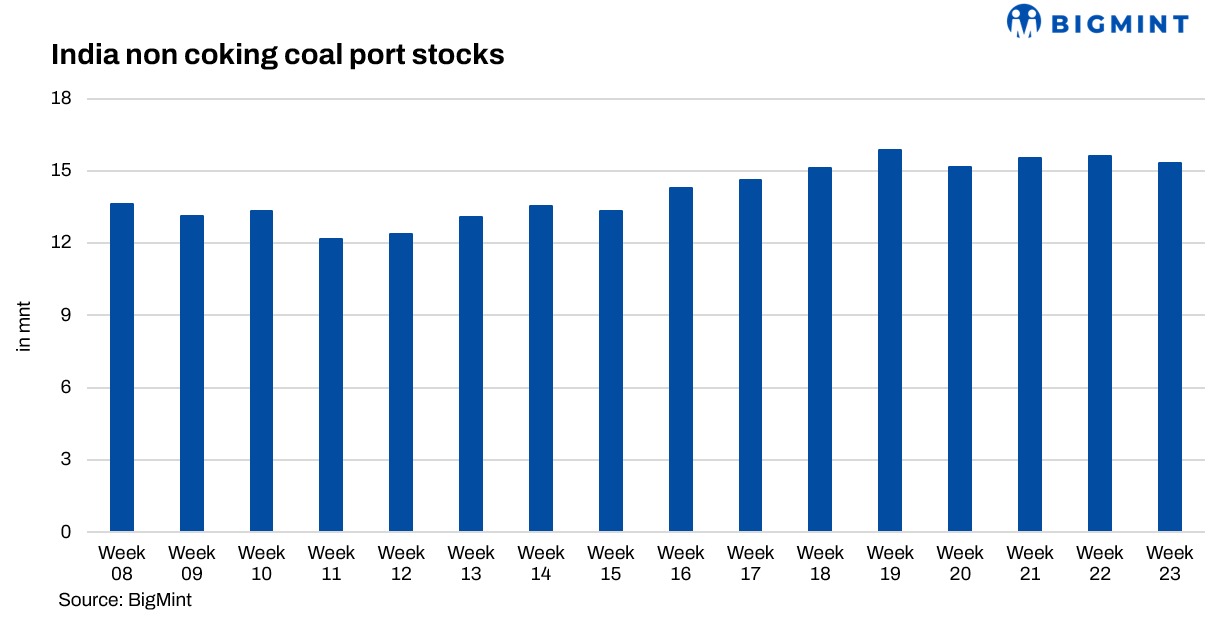

- Imported coal demand remains subdued
- Domestic supply keeps market comfortable
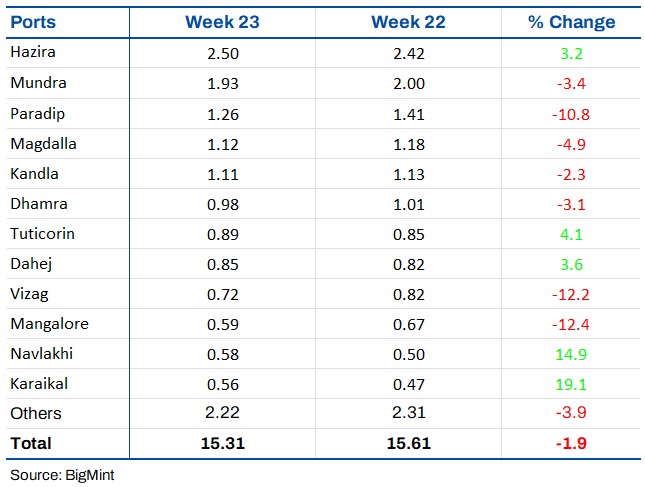
India's coal inventories at major ports declined by 1.9% week-on-week (w-o-w) to 15.31 million tonnes (mnt) in Week 23, compared to 15.61 mnt in Week 22, reflecting a slight drawdown amid mixed port-level trends.
Port-wise inventory movement
Inventory trends remained divergent across ports. Hazira, the largest stockholder, registered a 3.2% increase to 2.50 mnt, while Mundra declined 3.4% to 1.93 mnt. Paradip saw a sharp drop of 10.8% to 1.26 mnt, with Magdalla and Kandla also falling 4.9% and 2.3%, respectively.
Among other ports, Dhamra decreased 3.1% to 0.98 mnt, while Vizag and Mangalore recorded notable declines of 12.2% and 12.4%. Gangavaram inventories dropped significantly by 20.5%, while Haldia and Pipavav fell 13.8% and 14.3%, respectively.
On the upside, Tuticorin rose 4.1% to 0.89 mnt and Dahej gained 3.6% to 0.85 mnt. Navlakhi increased 14.9%, while Karaikal surged 19.1% and Kakinada recorded the highest jump of 42.2%, indicating higher arrivals or slower evacuation. Krishnapatnam also rose 7.3%, and Goa reported fresh volumes during the week.
However, Tuna declined sharply by 17.5%, while Jamnagar and Bhavnagar fell 10.2% and 4.2%, respectively.
Importer-wise trends
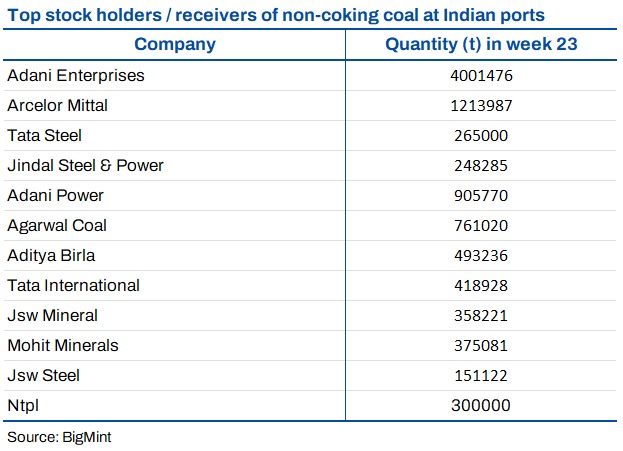
Adani Enterprises remained the largest importer with volumes of 4.00 mnt, followed by ArcelorMittal at 1.21 mnt and Adani Power at 0.91 mnt. Other key importers included Agarwal Coal (0.76 mnt), Aditya Birla Group (0.49 mnt), Tata International (0.42 mnt), and Mohit Minerals (0.38 mnt).
JSW Mineral and JSW Steel reported volumes of 0.36 mnt and 0.15 mnt, respectively, while Tata Steel and Jindal Steel & Power imported 0.27 mnt and 0.25 mnt. NTPL recorded imports of 0.30 mnt.
Market dynamics
Imported coal demand remained subdued during the week, as ample domestic coal availability continued to meet consumption needs. Steady domestic supply has kept the market comfortable, reducing reliance on seaborne procurement.