India: Chhattisgarh's power tariff hike to increase production costs in steel value chain
...

- Billet production costs may rise INR 300-360/t, re-rolling up INR 48-60/t
- Producers may raise offers but weak demand could limit cost pass-through
A 40 paise/unit (INR 0.40/kWh) increase in industrial electricity tariffs in Chhattisgarh, effective 1 July 2026, is likely to have a direct impact on the cost structure of power-intensive steel value chain participants, particularly induction furnace (IF) operators, ferro alloy producers, and re-rolling mills. The magnitude of the impact will vary depending on power consumption intensity and the ability of producers to pass on higher costs to customers.
Impact on induction furnace operators
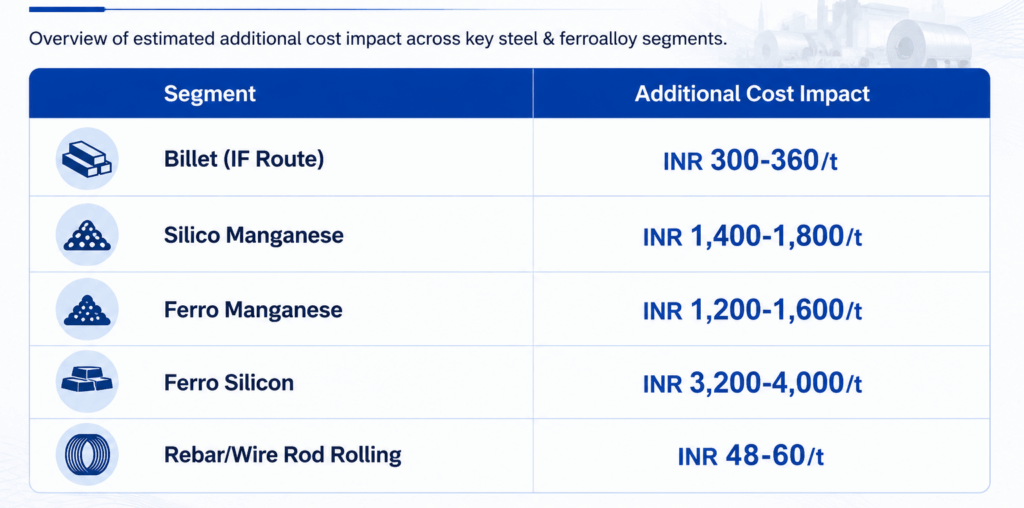
Induction furnaces are among the most electricity-intensive segments in the secondary steel value chain. The average power consumption for billet production through the IF route ranges between 750-900 kWh per tonne (depending upon the grades produced and the quality of the metallic mix). Therefore, a tariff increase of INR 0.40/unit would translate into an additional cost burden of approximately INR 300-360/t for billet production.
Consequently, producers may attempt to increase billet offers, but the success of such hikes will depend on downstream demand and market acceptance. Smaller and merchant billet producers are likely to face greater pressure compared to integrated steelmakers with captive power facilities.
Impact on re-rolling mills
Power consumption in re-rolling operations typically ranges from 120-150 kWh/t, depending on the product mix and mill efficiency. Therefore, the tariff revision could increase rolling costs by approximately INR 48-60/t of finished steel.
While the direct impact is lower than that on billet manufacturers, rolling mills operating on thin margins may still face profitability challenges. Mills producing rebar and wire rod could also find it difficult to fully pass on the increased costs during periods of weak demand.
Impact on ferro alloy producers
The ferro alloy sector is the most vulnerable because electricity accounts for a significant portion of production costs.
An additional cost of INR 0.40/unit hike will have the following impact, according to the commodity:
- Silico manganese: INR 1,400-1,800/t (power consumption: 3,500-4,500 kWh/t)
- Ferro manganese: INR 1,200-1,600/t (power consumption: 3,000-4,000 kWh/t)
- Ferro silicon: INR 3,200-4,000/t (power consumption: 8,000-10,000 kWh/t)
 Expected industry reaction
Market participants are likely to monitor the tariff increase closely during July-August 2026. If billet and finished steel demand remain healthy, producers may successfully pass on most of the additional cost. However, in a weak demand environment, as is generally the case during the monsoon months, the tariff hike could result in margin erosion of INR 250-350/t for billet producers and INR 40-60/t for rolling mills.