Guinea's bauxite export curbs could reshape global aluminium supply chain
...

- Move to tighten raw material supply for China's aluminium industry
- Guinea pushes downstream alumina refining investments
Guinea's meteoric rise in the global bauxite trade is now entering a new phase, one that could significantly alter aluminium raw material flows, reshape alumina economics, and tighten supply conditions for China's aluminium industry.
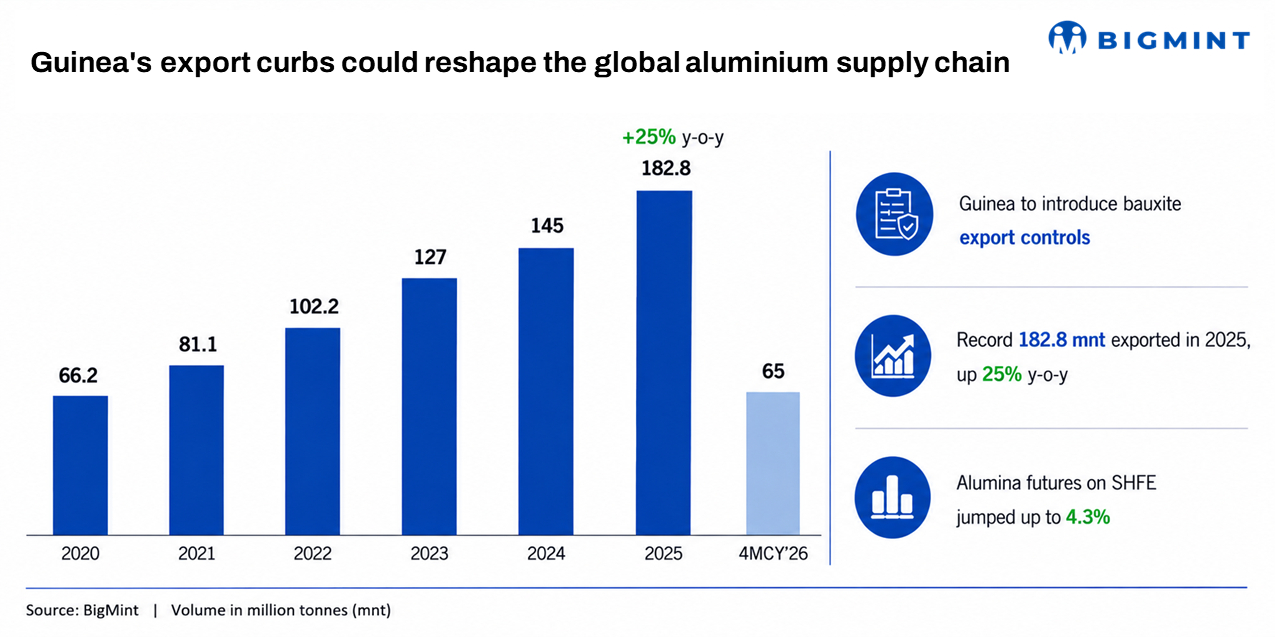
After exporting a record 182.8 million tonnes (mnt) of bauxite in 2025, up 25% y-o-y, Guinea is preparing to introduce export controls aimed at stabilising prices and accelerating domestic value addition. The move marks a strategic shift from pure volume-driven growth towards resource nationalism and downstream industrialisation.
The development has sent ripples across the aluminium value chain, especially in China, which remains overwhelmingly dependent on Guinea for bauxite feedstock.
Guinea strengthens its dominance in global bauxite trade
Guinea overtook Australia as the world's largest bauxite exporter in 2023 and has since continued to expand output aggressively. According to official data, 23 companies exported bauxite from Guinea in 2025.
The leading exporters are as follows:
- China's Chalco shipped 22.1 mnt
- Compagnie des Bauxites de Guinee (CBG) exported 17.4 mnt
- Societe Miniere de Boke (SMB) shipped 17.0 mnt
- AGB2A/SDM exported 17.0 mnt
Despite some slowdown during the second half of the year, Guinea still exported 84 mnt during 2025, representing a 16% increase y-o-y. The scale of Guinea's expansion has fundamentally reshaped the global aluminium raw material market over the past three years.
China's dependence on Guinea deepens further
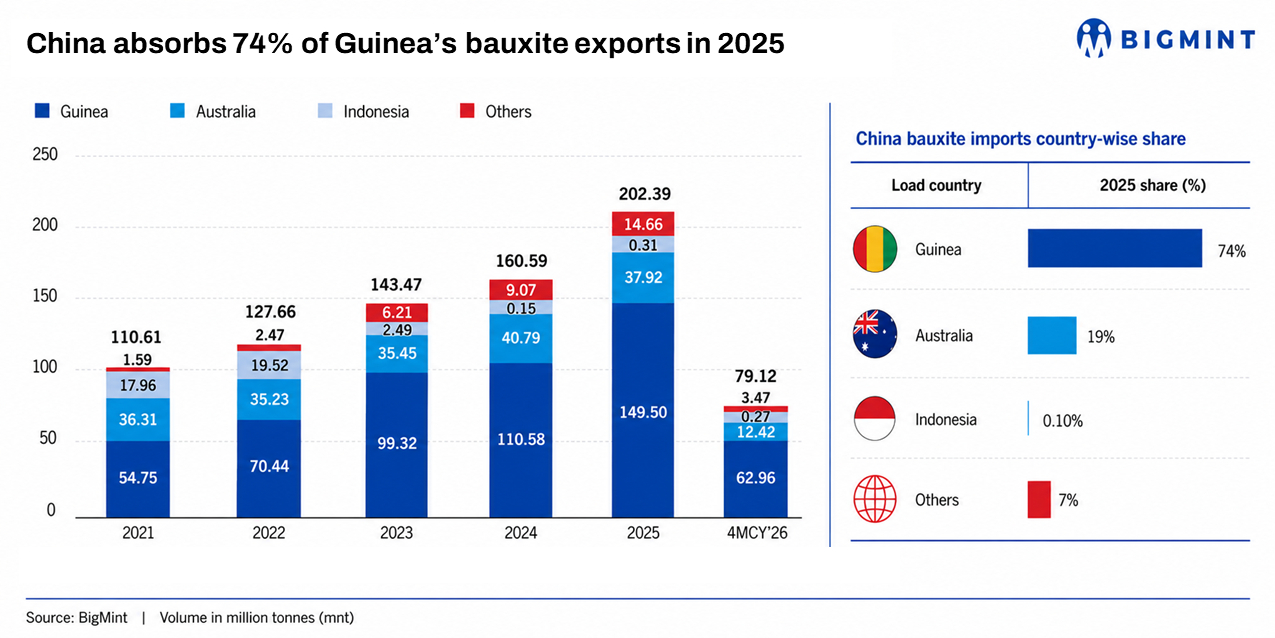
China remains the biggest beneficiary of Guinea's mining boom. Chinese customs data showed that 74% of Guinea's bauxite exports were shipped to China in 2025. Meanwhile, China's total bauxite imports surged 26.4% y-o-y to 200.5 mnt, driven primarily by Guinean supply. Notably, Guinea had already supplied China with 150 mnt of bauxite by November 2025, equivalent to more than 80% of the feedstock requirements for China's 45 mnt aluminium smelting capacity.
China's involvement in Guinea also extends far beyond bauxite. Chinese firms currently control over 60% of the massive Simandou iron ore project, while also maintaining stakes in the country's gold and lithium assets. Companies such as State Power Investment Corp., Aluminum Corp. of China Ltd., and Winning International Group are also investing heavily in Guinea's future alumina refining infrastructure.
This growing concentration of supply has now become both a strategic advantage and a vulnerability for China's aluminium sector.
Guinea moves towards export restrictions
The sharp increase in bauxite supply has led to a severe correction in prices.
Bauxite prices delivered to China fell below $60/t earlier this year, the lowest level in four years, compared to record highs of nearly $120/t in January 2025, according to Asian Metal Inc. At the same time, alumina prices on the Shanghai Futures Exchange plunged 48% during the first 10 months of 2025 due to abundant raw material availability and China's aluminium smelting capacity caps.
Guinea now wants to reverse that trend. Mines and Geology Minister Bouna Sylla confirmed that the government is finalising export control measures expected to be announced in June 2026. "Supply mustn't exceed demand," Sylla told Bloomberg. "We want to regulate the quantity to raise prices back to reasonable levels."
Market participants in China are already speculating that Guinea could impose an annual export cap of around 150 mnt. If implemented, such a move would drastically tighten global bauxite availability. According to Zhongtai Futures analyst Peng Dinggui, a cap at that level would transform the market from surplus to significantly tight conditions and accelerate the closure of inefficient Chinese alumina refining capacity.
Following the news, alumina futures on the Shanghai Futures Exchange surged as much as 4.3% on, reflecting concerns over future raw material availability.
Resource nationalism gains momentum globally
Guinea's policy direction mirrors a broader global trend where resource-rich nations are attempting to secure greater economic value from their mineral wealth. The Democratic Republic of Congo restricted cobalt exports, Zimbabwe curbed lithium shipments, and Indonesia continues to strengthen state oversight across nickel and other mineral exports.
Guinea is now positioning itself within that same strategic framework. Rather than remaining solely a raw material exporter, the country is aggressively pushing for domestic refining capacity. Currently, Guinea has only one operational alumina refinery. However, three additional refinery projects are already planned or under construction.
The government aims to establish five alumina refineries with a combined annual capacity of 7.2 mnt. Even then, those facilities would consume less than 15% of the country's current bauxite production, highlighting the enormous scale of Guinea's mining sector.
The country is also seeking investment for future aluminium smelting operations. "For us, the transition from alumina to aluminium is inevitable," Sylla told Bloomberg.
Implications for the global aluminium market
Guinea's proposed export curbs could become one of the most important developments for the aluminium market in 2026.
For China, tighter bauxite supply could increase raw material costs, raise alumina prices, pressure refining margins, accelerate the closure of inefficient capacity, and increase overseas asset acquisitions.
For the broader market, the move could support global alumina prices, tighten seaborne bauxite availability, shift trade flows toward alternative suppliers, increase investment in refining outside China, and intensify competition for long-term supply contracts.
The development is also likely to revive discussions around supply diversification, strategic raw material security, and the growing influence of resource nationalism across critical mineral markets.
As Guinea transitions from volume expansion to supply management, the global aluminium industry may soon enter a new era where access to bauxite becomes not just a logistical issue, but a geopolitical one.
