European main port coal stocks stay low amid logistics bottlenecks, renewable surge
...

- Low water levels in Rhine affect procurement by power plants
- Coal demand softens on milder weather, surging renewables output
Coal stockpiles at Europe's main import hub in Amsterdam-Rotterdam-Antwerp, or ARA, remain at unusually low levels despite a recent modest recovery. While imports have picked up, two major factors are preventing a full rebuild of inventories: low water levels on the Rhine River, which limit the transport of coal to inland power plants, and a surge in renewable energy generation, which is directly reducing demand for coal-fired power.
The inventory situation
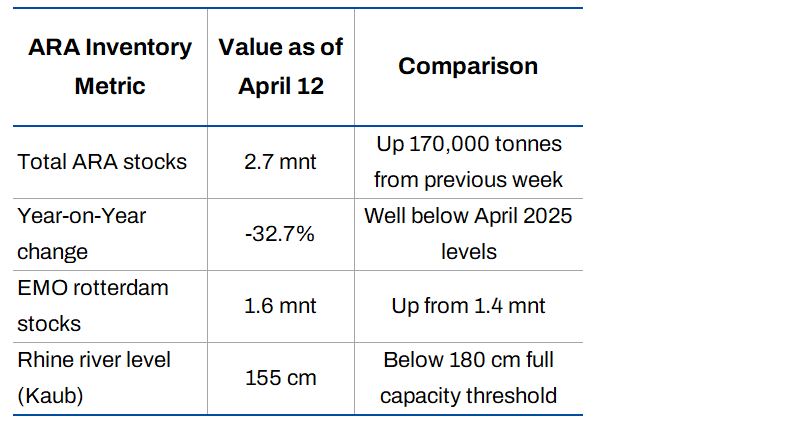
As of 12 April, total coal stocks at ARA terminals stood at 2.7 million tonnes (mnt). This represented an increase of 170,000 tonnes (t) from the previous week, offering some relief after stocks had fallen to a decade-long low of 2.33 mnt at the end of March. However, the current inventory level remains 32.7% lower than it was at the same time last year.
The largest terminal, EMO in Rotterdam, saw stocks increase by 200,000 t to 1.6 mnt. This was partially offset by lower inventories at terminals in Amsterdam and Vlissingen. While the weekly increase is positive, the overall picture is one of continued tightness.
The logistics bottleneck: Low Rhine levels
The key constraint is not the availability of coal at the port but the ability to move it up the Rhine River to power plants in Germany and Switzerland. Water levels at the critical measuring point in Kaub remain suppressed. At 155 centimeters, the river is well short of the 180-centimeter threshold required for barges to sail at full capacity.
This bottleneck means that even as coal arrives at the port, it cannot be efficiently delivered to end-users. As a result, the stockdraw from the ARA hub is limited, and power plants downstream are unable to replenish their own inventories at a normal pace. The situation is expected to persist in the near term, with water levels forecast to hover around 160 centimeters.
The demand factor: Renewables and mild weather
At the same time, demand for coal-fired power in Germany has fallen sharply. Over the first two weeks of April, hard coal-fired generation dropped to 1.1 terawatt-hours, an 18.6% decline from the previous month and an 11.4% decline from the same period last year. The average load factor for coal plants was only around 50%.
This decline is largely due to two factors. First, overall power demand has fallen as milder spring weather reduces the need for heating. Second, renewable energy output has surged. Wind power recovered to 5 terawatt-hours over the period, an 11% increase from the previous month. Solar generation reached 3.7 terawatt-hours, a 9.2% monthly increase. This renewable output is directly displacing fossil fuel generation.
Outlook
Despite the low stock levels, current ARA inventories can still cover approximately 85 days of consumption at Germany's hard coal-fired power plants, based on recent generation data. While imports are expected to remain firm in the coming week, with additional Colombian and US coal scheduled to arrive, the combination of logistical bottlenecks and strong renewable generation is likely to keep a lid on any sharp price increases. The European coal market remains adequately supplied for now, but the situation remains vulnerable to any changes in weather, river levels, or gas supply.