Daily round-up: Base metals supported by tighter inventories; oil slips below $80/bbl
...

- LME tightens curbs on Russian metals
- UK detains Russia oil tanker bound for India
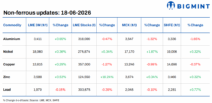
Base metals on the London Metal Exchange (LME) traded mostly higher on 18 June 2026, with aluminium leading gains among major non-ferrous metals. Aluminium rose 0.65% d-o-d to $3,411/t, followed by zinc and nickel, which increased 0.53% and 0.36% to $3,588/t and $18,060/t, respectively. Copper also edged higher by 0.29% to $13,815/t, supported by continued inventory declines. In contrast, lead was the only decliner, slipping 0.15% to $1,979/t.
On the inventory side, trends were mixed across major metals. Copper stocks registered the sharpest decline, falling 1.27% d-o-d to 357,000 t, followed by aluminium inventories, which dropped 0.47% to 318,000 t. Lead stocks also eased 0.39% to 303,675 t, while nickel inventories rose 0.34% to 275,874 t. Zinc stocks surged 16.24% to 124,550 t, marking the largest inventory increase among major base metals. Despite the rise in zinc inventories, continued drawdowns in copper and aluminium stocks indicate underlying tightness in key industrial metals.
Domestic market overview
India's non-ferrous scrap market weakened on 18 June amid softer global sentiment and lower benchmark metal prices. Aluminium tense scrap (loose), ex-Delhi, declined by INR 7,000/t, or 2.33% d-o-d, to INR 293,000/t, while ex-Chennai prices fell by INR 8,000/t, or 2.62%, to INR 297,000/t.
Meanwhile, copper armature scrap (Cu 99%), ex-Delhi, decreased by INR 4,000/t, or 0.32% d-o-d, to INR 1,250,000/t. The decline reflected cautious buying activity in the domestic market despite continued strength in LME copper prices.
Oil prices extend losses on hopes of supply normalization
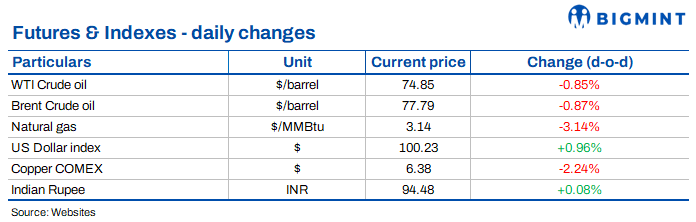
Global crude oil prices continued to decline on 18 June 2026 as growing optimism surrounding the US-Iran peace agreement eased concerns over prolonged supply disruptions in the Middle East. Brent crude fell 0.87% d-o-d to $77.79/bbl, while WTI crude declined 0.85% to $74.85/bbl, extending losses after sharp corrections earlier in the week. Natural gas prices also dropped 3.14% to $3.14/MMBtu, reflecting improving sentiment across energy markets.
Market sentiment remained largely optimistic ahead of the formal signing of the US-Iran framework agreement. Brent crude, which had surged to nearly $120/bbl following the outbreak of the conflict in late February, fell below $80/bbl for the first time since March, settling near $78/bbl as traders increasingly priced in the reopening of the Strait of Hormuz and the resumption of disrupted oil flows.
The International Energy Agency (IEA) noted that global oil supply is expected to decline by 3.9 million bpd in 2026 to 102.4 million bpd, with Gulf supply losses only partly offset by growth from non-OPEC+ producers. Industry experts estimate it could take 8-9 months for oil-producing nations to rebuild inventories to pre-war levels, while precautionary stockpiling by importing countries may continue to support crude prices and tanker rates above pre-conflict levels despite the recent correction in oil markets.
Other updates
UK seizes Russia-linked tanker, raising shipping risks
The UKs seizure of the Smyrtos, a Russia-linked oil tanker carrying approximately $40 million worth of crude oil to India, has raised concerns over potential retaliation from Moscow and heightened risks for global shipping. The detention marks the first time British authorities have seized a Russia-linked tanker and forms part of efforts to target Russias shadow fleet of nearly 600 vessels, which transports around 50% of the countrys crude oil exports.
Industry groups have urged greater vigilance amid fears of retaliatory actions, drawing comparisons with previous tanker seizures in the Strait of Hormuz. Market participants are closely monitoring the situation as escalating tensions between the UK and Russia could disrupt maritime trade flows and increase freight and insurance costs.
LME restricts Russian copper deliveries under new EU sanctions
The London Metal Exchange announced new measures to comply with the European Unions latest sanctions package against Russia, stating that Russian-origin copper and cobalt can only be registered in EU-listed LME warehouses if imported before 25 July 2026. The restrictions are part of the EUs 20th sanctions package, which includes a ban on imports of Russian copper, cobalt, nickel products, iron ore, and various scrap metals.
The LME noted that no Russian-origin copper or cobalt has been warranted in its EU warehouses for more than a year and therefore expects limited immediate market impact. However, the move further tightens restrictions on Russian metal flows into Europe and reinforces efforts to reduce the regions reliance on Russian raw materials.