China: Steel exports top 10 mnt in May as supply disruptions offset structural headwinds
...
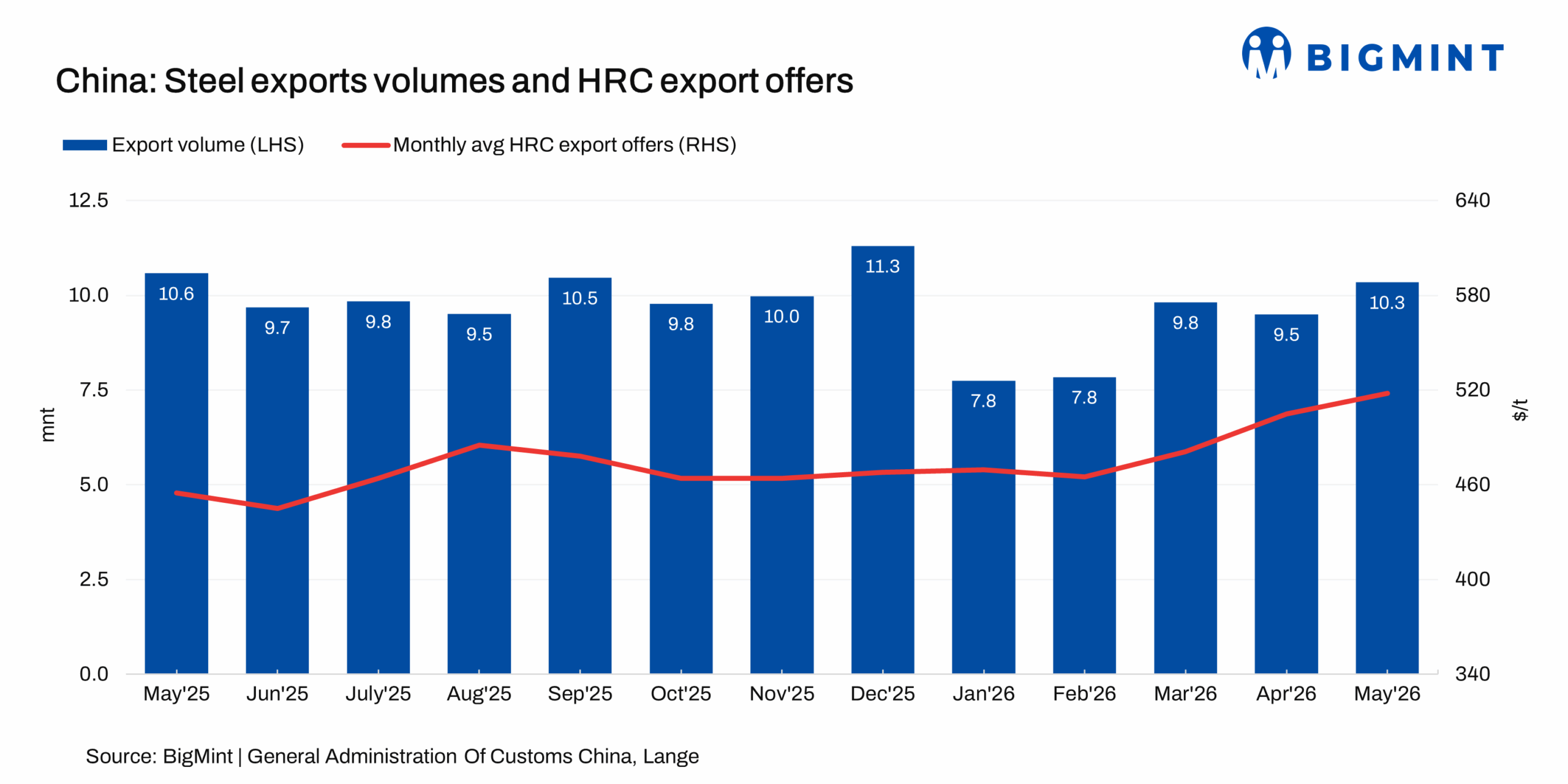

- China's steel exports exceeded 10 mnt for the first time in five months, reaching 10.34 mnt in May
- Disruptions to Iranian steel exports created fresh opportunities for Chinese mills in Southeast Asia and the Middle East
- Export licensing rules, rising trade barriers and weak global demand continue to weigh on the broader outlook
China's finished steel exports reached 10.341 million tonnes (mnt) in May'26, rising by around 840,000 tonnes (t) from April and surpassing the 10 mnt mark for the first time in five months, according to customs data. Although shipments remained 2% lower than a year earlier, the monthly recovery marked a notable improvement against the backdrop of weaker global demand and tightening trade restrictions.
For the January-May period, China's finished steel exports totalled 44.5 mnt, down 8.1% y-o-y. The broader decline reflects persistent weakness across several of China's key export markets, where softer downstream steel consumption and rising protectionist measures have constrained demand for imported material.
Export curbs and weak domestic demand continue to weigh
China's steel exports have remained under pressure since the introduction of stricter export licensing and compliance measures at the start of 2026. The new framework increased administrative requirements and transaction costs for exporters, reducing shipment flexibility and adding to costs at a time when overseas market conditions were already becoming more challenging.
At the same time, domestic steel demand has remained structurally weak, particularly across the property and construction sectors. Indicators such as housing starts, construction activity and property completions have continued to soften, while infrastructure investment growth has moderated. Although manufacturing-related demand from sectors including automotive, shipbuilding, machinery and energy equipment has remained comparatively resilient, it has not been sufficient to fully offset the contraction in construction-led steel consumption. As a result, Chinese mills have continued to rely heavily on export markets to absorb surplus production.
Iranian supply disruptions reshape regional trade flows
The improvement in May exports appears to have been supported by temporary changes in regional supply dynamics rather than a broad-based recovery in global steel demand. According to market participants and media reports, disruptions to Iranian steel production and exports created a supply gap across parts of Southeast Asia and the Middle East, allowing Chinese producers to capture additional demand.
Iran suspended exports of certain steel products, including billets, slabs and some flat steel products, following disruptions to domestic production, while damage to major steel facilities reduced the country's export capacity. Media reports indicated that the loss of Iranian supply could create a sizeable gap in semis and finished steel availability across key importing regions, particularly Southeast Asia and the Middle East.
Industry sources indicated that many of the replacement orders were booked during March and April and were subsequently shipped in May, contributing to the month-on-month increase in Chinese export volumes. The timing also coincided with a gradual return of overseas buying interest as customers replenished inventories and secured material for ongoing infrastructure and construction projects.
While geopolitical tensions and conflict in the Middle East increased freight costs, insurance expenses and logistical uncertainty, they also altered regional trade flows by reducing the availability of Iranian-origin material. Rather than signalling a broad recovery in global demand, the increase in May shipments appears to reflect China's ability to fill temporary supply gaps created elsewhere in the market.
Rising trade barriers continue to limit export growth
Despite the improvement in May, China's export environment remains increasingly constrained by trade protectionism. Several countries, including Brazil, Vietnam, Indonesia, South Korea, Pakistan, Mexico and Canada, have either imposed or expanded anti-dumping duties, safeguard measures or other import restrictions targeting Chinese steel products.
Traditional export destinations have also become more challenging. Weaker import demand across Southeast Asia and softer industrial activity in parts of East Asia have reduced opportunities for Chinese mills, while tighter safeguard quotas and elevated off-quota tariffs continue to restrict access to European markets. In addition, appreciation pressure on the Chinese yuan is expected to gradually reduce China's export pricing advantage in overseas markets.
Although Europe and the CIS have recorded comparatively stronger import demand, the increase in shipments to these regions has not been sufficient to offset the slowdown across China's larger export destinations.
Outlook
China's steel exports are likely to remain elevated in the near term as weak domestic demand and the onset of the rainy season in parts of southern China encourage mills to continue targeting overseas markets. Ongoing infrastructure activity and inventory replenishment across several importing regions may also provide intermittent support for export bookings.
However, the sustainability of May's rebound remains uncertain. Temporary factors such as disruptions to Iranian steel exports and the execution of earlier export orders helped lift shipments during the month, but structural headwinds, including weak global steel demand, stricter export compliance requirements and rising trade barriers, are expected to continue limiting China's overall export growth. The pace of recovery in Iranian supply and the evolution of protectionist measures across key importing markets will remain important factors shaping China's steel trade flows in the months ahead.
