Bangladesh: Imported scrap prices soften as mills delay bookings amid weak steel demand
...
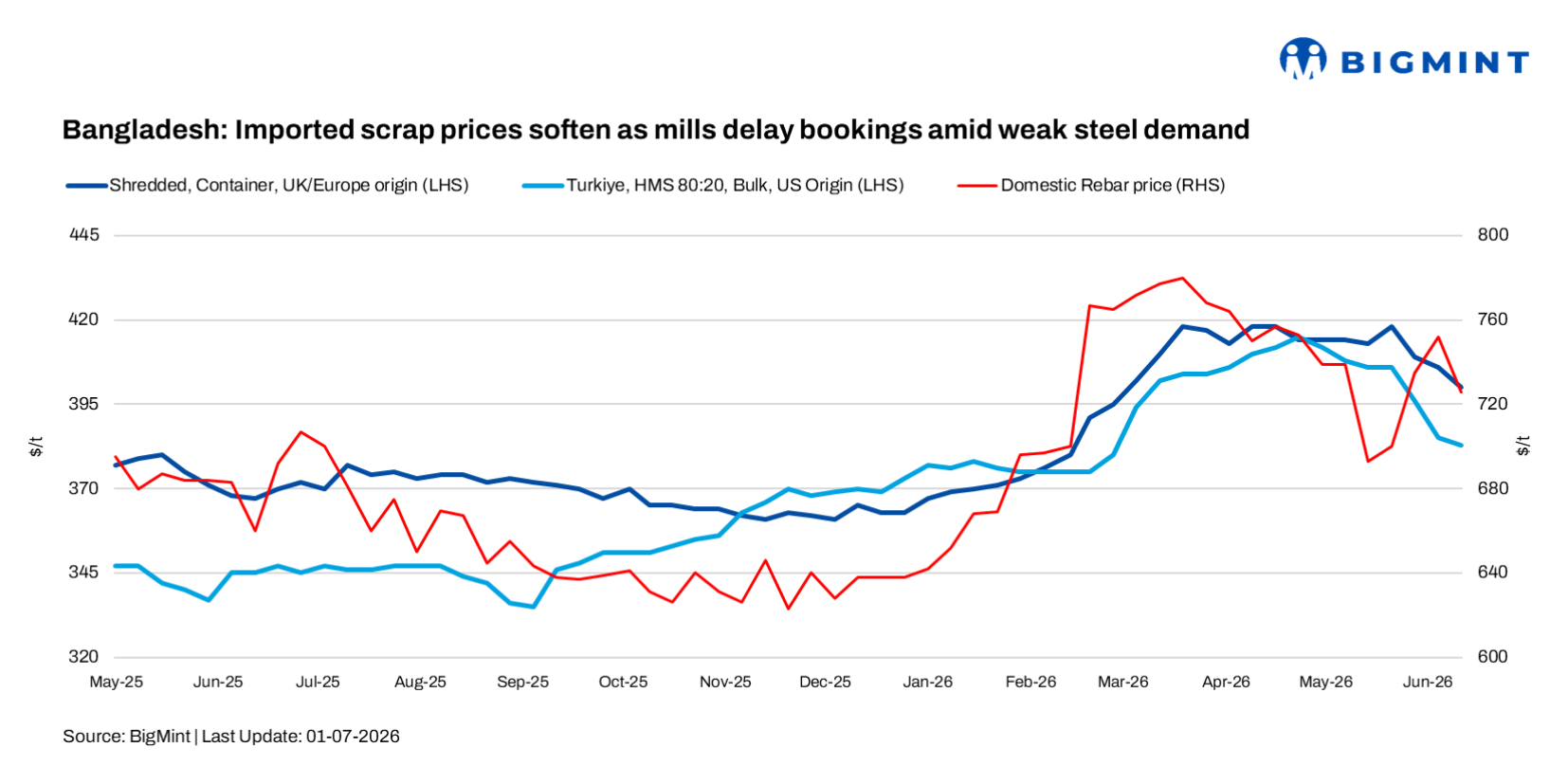

- Mills stay cautious, expecting further price drops
- Bid-offer disparities limit fresh trading activity
Bangladesh's imported ferrous scrap prices fell w-o-w on 1 July, as mills continued to postpone fresh bookings amid weak finished steel demand and expectations of further price declines. Trading activity remained limited following the Muharram holidays, as buyers continued to adopt a cautious approach.
In the containerised market, Australia-origin HMS (80:20) was indicated at $370-375/t CFR, and Brazil-origin HMS at $365-370/t CFR, while containerised shredded scrap was heard around $395-405/t CFR. Market participants noted that workable levels for both HMS and shredded scrap had declined to around $370-390/t CFR, reflecting continued downward pressure on import prices.
BigMint's weekly assessments, CFR Chattogram
- European-origin containerised HMS (80:20): $366/t, down $9/t w-o-w
- European-origin containerised shredded: $400/t, down by $6/t w-o-w
- Japanese-origin bulk H2: $389/t, down by $5/t w-o-w
- US-origin bulk HMS (80:20): $395/t, down by $4/t w-o-w
Market updates
Trading activity remained largely quiet during the week, with the only notable deal being a 1,000-t UK-origin shredded scrap cargo booked at $400/t CFR Chattogram. Buyers largely stayed on the sidelines, keeping bids for US-origin HMS at $350-355/t CFR, while offers for US West Coast-origin HMS (80:20) remained at $400-405/t CFR against buyers' workable levels of $390-395/t CFR. The continued mismatch between buyer expectations and seller offers kept fresh trading activity limited.
A Dhaka-based trader said, "We are hearing demand from Bangladesh, but buyers remain on the fence as they expect import scrap prices to decline further." Another market participant added that most buyers remain in a wait-and-watch mode, as weak finished steel demand continues to make scrap procurement less attractive.
The domestic steel market remained broadly stable despite softer imported scrap prices. Rebar was heard at BDT 84,000-86,000/t ($698-714/t) exw Dhaka and BDT 88,000-90,000/t ($747-763/t) exw Chattogram. Billet traded at BDT 71,500-72,000/t ($580-584/t), while ship scrap was assessed at around BDT 53,500-54,500/t ($434-443/t) exy.
Bangladesh's ship recycling market remained quiet during the week, with no fresh market sales reported as the Ashura holiday and monsoon conditions continued to limit beaching activity. However, the first post-conflict vessel, the 9,369-LDT bulker Andhika Paramesti, was sold at $460/LDT (as-is Sambu), indicating that deferred recycling candidates are gradually returning to the market.
Domestic steel plate prices rose to BDT 67,000/t ($543/t) from BDT 65,000/t ($527/t) a week earlier, supported by firm local demand. Recyclers remained optimistic about improved vessel arrivals in the third quarter, backed by healthy letter of credit (LC) availability, stable financing conditions, and supportive macroeconomic fundamentals. Indicative recycling prices were heard at $458-463/LDT for tankers, $478-483/LDT for bulkers, and $488-493/LDT for container vessels.
Outlook
BigMint expects Bangladesh's imported scrap market to remain subdued in the coming week as mills continue need-based procurement and wait for lower import prices. Unless finished steel demand improves, buyers are likely to maintain cautious purchasing, keeping pressure on deep-sea and containerised scrap prices.
