Angola mandates 20% local sourcing for rice and key food imports from June 2026
...

Angola mandates 20% local sourcing for selected food imports from June 26, 2026.
New import licensing rule covers poultry, pork, rice, refined sugar and tilapia.
Angola has announced a significant expansion of its import substitution strategy by requiring importers of selected food products to procure at least 20% of their intended import volumes from domestic producers as a condition for obtaining or renewing import licenses. The measure, introduced through Executive Decree No. 130/26, will come into effect on 26 June 2026.
Local procurement becomes mandatory
Under the new decree, importers of poultry meat, pork, rice, refined sugar and tilapia must source a minimum of 20% of their planned purchase volumes from domestic producers. Import license applications and renewals will require documentary proof of local procurement, including electronic invoices, supply contracts or delivery notes. The decree also requires retailers to prominently display domestically produced goods and authorizes Angola's Ministry of Industry and Commerce to expand the list of covered products based on national production capacity.
Extension of import substitution policy
Executive Decree No. 130/26 builds on Presidential Decree No. 213/23, issued on 30 October 2023, which established the Legal Regime to Promote National Production and replaced the previous import substitution framework under Decree No. 23/19. The earlier regulation required importers to prioritize purchases from domestic producers and demonstrate that local supply options had been exhausted before importing products. It also encouraged wholesalers, retailers, aggregators and importers to support national production as part of Angola's Production Support, Export Diversification and Import Substitution (PRODESI) strategy. The new decree strengthens these provisions by introducing a mandatory local procurement requirement tied directly to import licensing.
Potential trade impact
According to the report, the new measure is expected to affect trade flows and increase compliance costs for importers while creating new market opportunities for domestic producers. For exporters, particularly poultry suppliers, import approvals will now depend on demonstrating that 20% of intended purchase volumes have been sourced locally before licenses are granted for the remaining 80%. Previously, importers could satisfy requirements by showing that domestic production was insufficient to meet demand.
Local production capacity remains limited
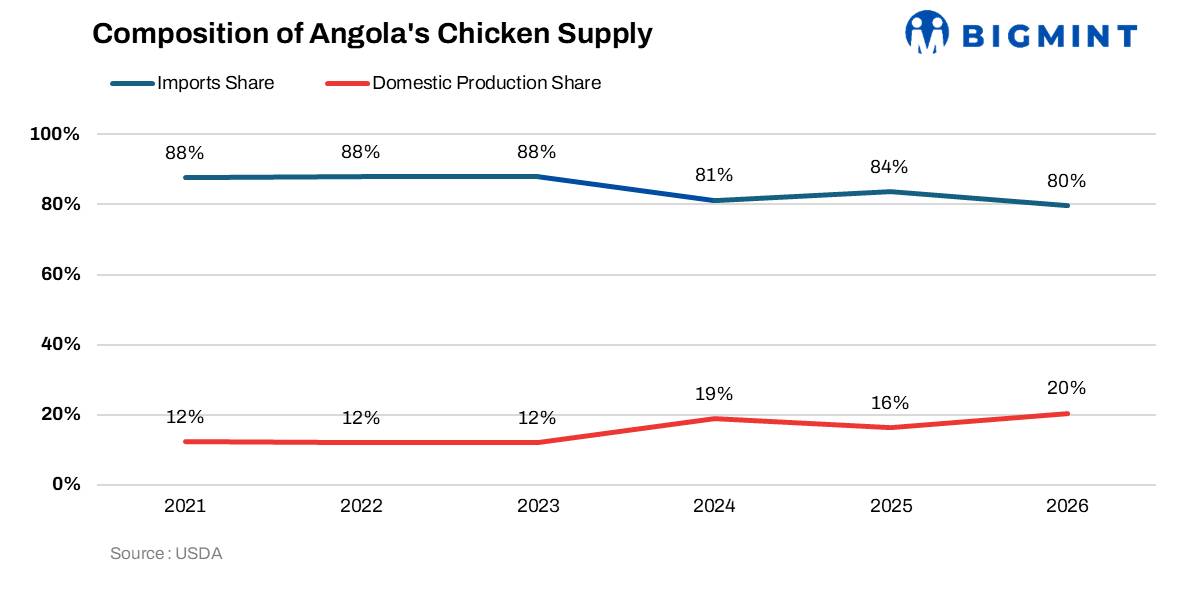
The report notes that Angola's local production capacity is forecast to reach 20.4% in 2026 and has never previously attained that level. As a result, the mandatory sourcing requirement could increase transaction costs and create additional uncertainty for importers and foreign suppliers regardless of its impact on domestic production.
Outlook
Executive Decree No. 130/26 formalizes a key component of Angola's import substitution strategy by making local procurement a prerequisite for import licensing of poultry, pork, rice, refined sugar and tilapia. While the policy aims to encourage domestic production and investment partnerships, it could also create additional compliance requirements and market access challenges for importers. According to FAS contacts cited in the report, the decree may not be fully enforced in the near term because local suppliers currently lack sufficient production capacity to meet the mandated 20% sourcing requirement.
