A new risk to India's aluminium scrap supply chain? Assessing the impact of potential UAE scrap export restrictions
...

- Recycling expansion drives UAE policy shift
- Import dependence increases India's supply risk
Industry participants in the UAE have reported the introduction of a temporary four-month export ban covering aluminium scrap, ferrous scrap, and copper scrap under a new ministerial decision. While further clarity from UAE authorities is still awaited, the development has already sparked concerns across importing markets, particularly India, which remains heavily dependent on imported aluminium scrap.
The timing of the reported restriction is noteworthy. India's aluminium scrap market entered 2026 with imports already under pressure due to elevated LME aluminium prices, adverse currency movements, and geopolitical disruptions in West Asia. Any further tightening of supply from a key supplier such as the UAE could have meaningful implications for scrap availability, secondary alloy production, and pricing trends in India.
Why is the UAE important to India?
The UAE has emerged as one of India's most important aluminium scrap suppliers due to its geographical proximity, lower freight costs, strong trade connectivity, and consistent availability of mixed scrap grades.
India imported nearly 2 mnt of aluminium scrap in 2025, the highest level on record, highlighting the country's growing dependence on overseas raw materials. However, import trends have weakened considerably in 2026.
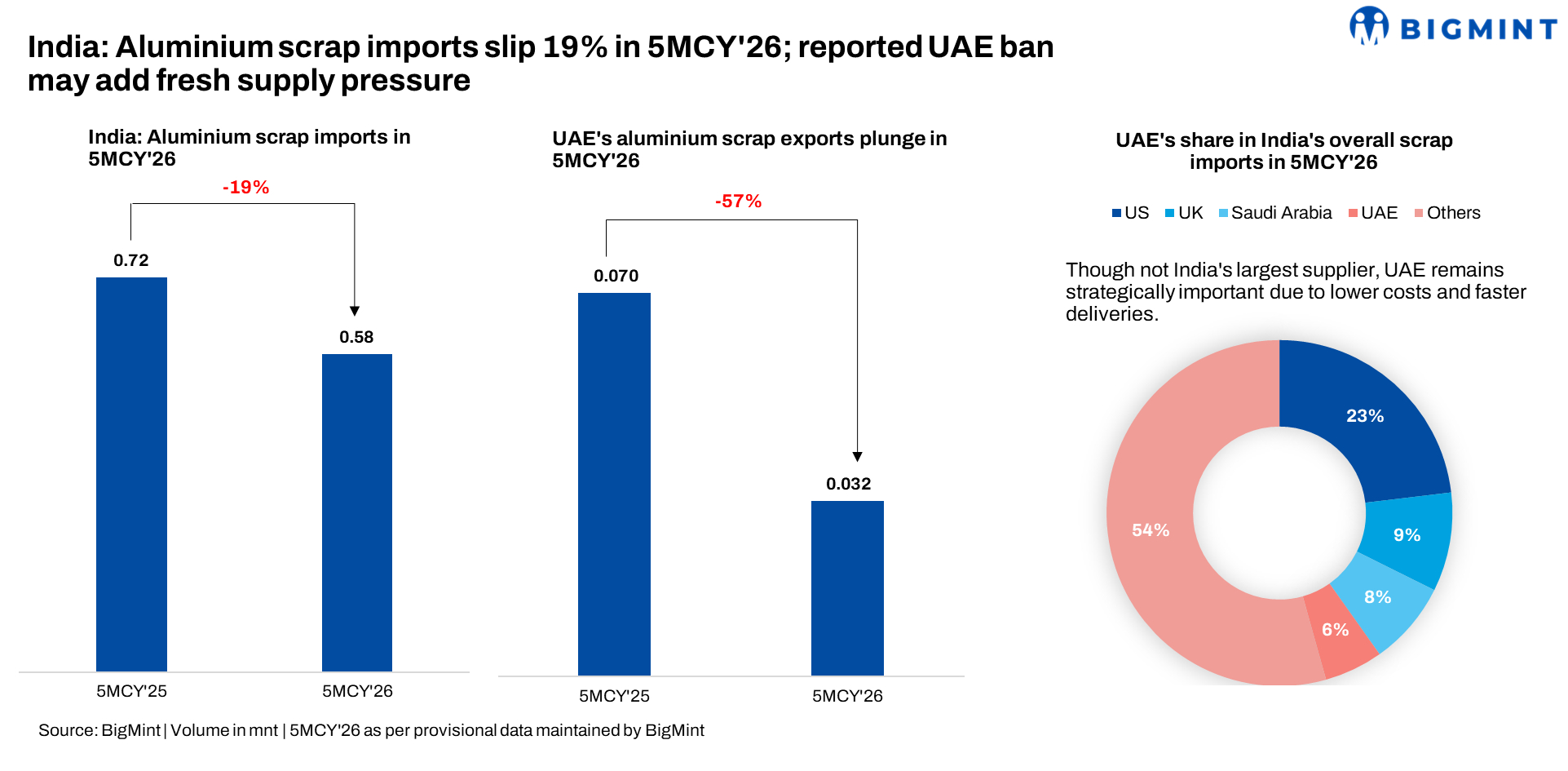
As per BigMint's provisional estimates, during January-May 2026 (5MCY'26), India's aluminium scrap imports declined by 19% y-o-y to 0.58 mnt from 0.72 mnt in the corresponding period last year.
The United States remained India's largest supplier, with shipments increasing 3% y-o-y to 135,475 t. Imports from the UK fell 16% to 54,238 t, while volumes from Saudi Arabia declined 28% to 45,942 t.
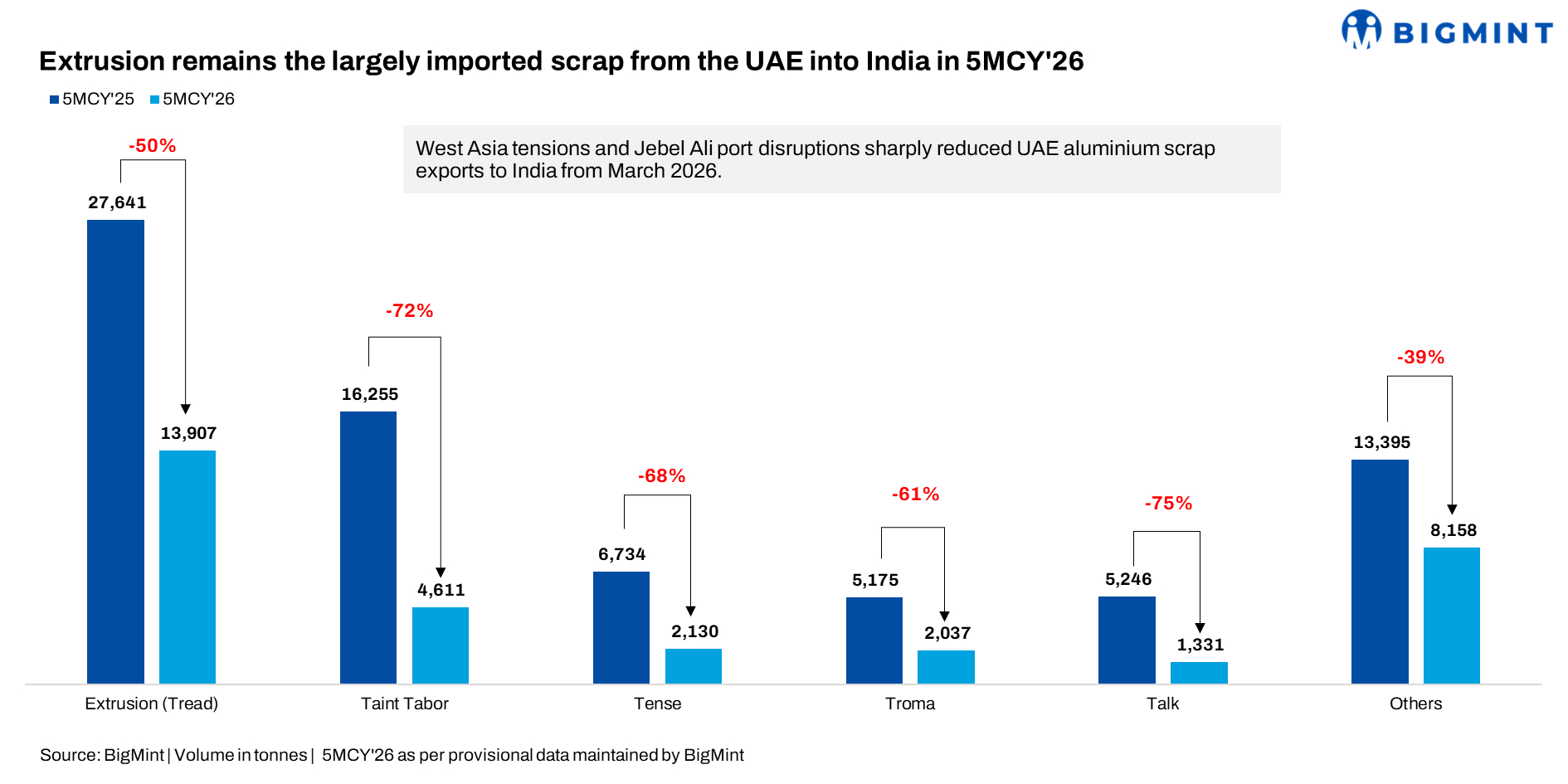
The sharpest drop came from the UAE, where imports fell 57% y-o-y to 32,176 t from 74,445 t during 5MCY'25.
The broader Middle East region supplied around 381,154 t of aluminium scrap to India in 2025, accounting for nearly 20% of the country's total aluminium scrap imports. Within this, the UAE contributed around 119,768 t, representing approximately 8% of India's overall aluminium scrap imports.
Although the UAE is not India's largest supplier by volume, its strategic importance is significantly higher because of shorter transit times and lower procurement costs compared with Western origins.
Why could the UAE be restricting scrap exports?
The reported restriction appears to align with a broader shift in UAE policy toward retaining more recyclable material within the country.
Over the past few years, the UAE has increasingly viewed scrap as a strategic industrial resource rather than simply a waste stream. The government has already implemented measures aimed at formalising the scrap sector, including the introduction of a Reverse Charge Mechanism (RCM) for scrap transactions from January 2026.
In the past, the country has also moved away from outright export restrictions, replacing earlier bans with export duty mechanisms to balance domestic requirements with international trade.
Industry estimates suggest the UAE generates approximately 2-3 mnt of ferrous scrap annually (nearly 50% is being exported to the South Asian countries with Pakistan being a major buyer) and around 1-2 mnt of aluminium scrap, although official figures are not publicly available. Retaining a larger portion of this material domestically would support the country's ambitions to expand recycling and downstream manufacturing.
UAE's recycling industry is expanding rapidly
One of the strongest drivers behind any potential export restriction is the rapid expansion of domestic recycling capacity.
Emirates Global Aluminium (EGA), the UAE's largest aluminium producer, has invested heavily in recycling infrastructure and is commissioning a major aluminium recycling facility. The company has repeatedly highlighted the importance of increasing domestic scrap utilisation as part of its long-term sustainability and growth strategy.
As more recycling capacity comes online, scrap becomes increasingly valuable as a feedstock for domestic production. Instead of exporting raw material, the UAE can capture greater economic value by producing recycled aluminium products within the country.
This reflects a broader global trend, where governments are seeking to retain critical secondary raw materials to support decarbonisation goals and strengthen domestic manufacturing industries.
India is already facing a tight scrap market
The reported ban comes at a particularly sensitive time for India. The country relies on imports for approximately 85-87% of its aluminium scrap requirements, making it one of the most import-dependent aluminium scrap consumers globally.
Since late 2025, aluminium scrap imports have steadily declined due to elevated LME aluminium prices and unfavourable exchange rate movements. The situation worsened further following the escalation of geopolitical tensions in West Asia during late February 2026.
Shipping disruptions, higher freight costs, longer transit times, and uncertainty surrounding regional trade routes reduced the flow of scrap into India. As imported material became harder to secure, secondary producers increasingly turned to domestic scrap, tightening local availability and pushing prices higher across most grades.
Consequently, imported and domestic scrap prices remained firm throughout much of the first half of 2026 despite softer demand conditions in some downstream sectors.
Aluminium prices corrected, but scrap may remain supported
The market dynamic began to shift during June. LME aluminium prices, which had surged to a 2026 high of $3,854/t amid concerns over Middle East supply disruptions and the Strait of Hormuz, corrected sharply following profit-booking and easing geopolitical tensions after the tentative US-Iran peace understanding.
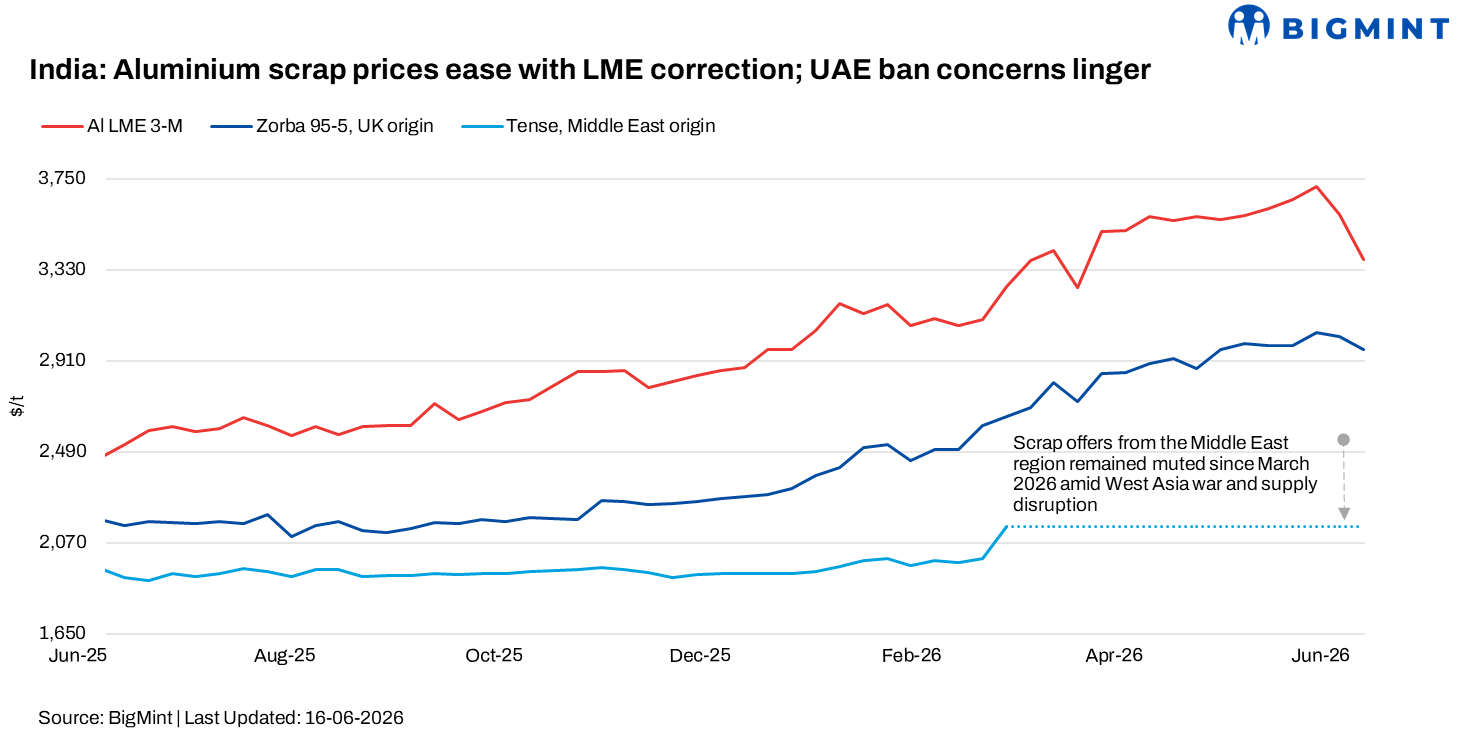 The correction triggered expectations of lower scrap prices as well, with buyers anticipating improved availability and reduced raw material costs.
However, the emergence of the UAE export ban reports could alter that outlook.
If exports from the UAE are restricted, the availability of imported scrap could tighten further, limiting the extent of any correction in scrap prices. The development could also encourage consumers to secure material proactively, providing additional support to both imported and domestic scrap values.
Not just the UAE: Scrap nationalism is growing globally
The UAE is not the only region moving towards tighter control of scrap flows. The European Union has already explored measures aimed at retaining more aluminium scrap within the bloc as part of its circular economy and industrial strategy. Similar discussions are taking place across several regions as governments increasingly recognise scrap as a strategic resource.
For countries such as India, which rely heavily on imported scrap, these developments could gradually reduce the pool of internationally traded material and intensify competition for available supplies.
Outlook
While the final details and implementation of the reported UAE restriction remain uncertain, the broader implications are clear.
India entered 2026 with aluminium scrap imports already down 19% y-o-y, Middle Eastern shipments down 40%, and imports from the UAE down 57%. Any additional disruption from one of its key suppliers would therefore impact an already tight market rather than a well-supplied one.
Even if LME aluminium prices continue to soften in the near term, concerns surrounding scrap availability are likely to keep the aluminium scrap market supported. For secondary alloy producers and ADC12 manufacturers, this could mean continued raw material cost pressures despite the recent correction in primary aluminium prices.
The immediate impact may be psychological, but if the reported restrictions remain in place, India's aluminium scrap market could face a fresh round of supply-side tightening at a time when alternative sources are becoming increasingly difficult to secure.
