Worldsteel data shows Asian primary steel production far higher in CO2 emissions than Europe
...
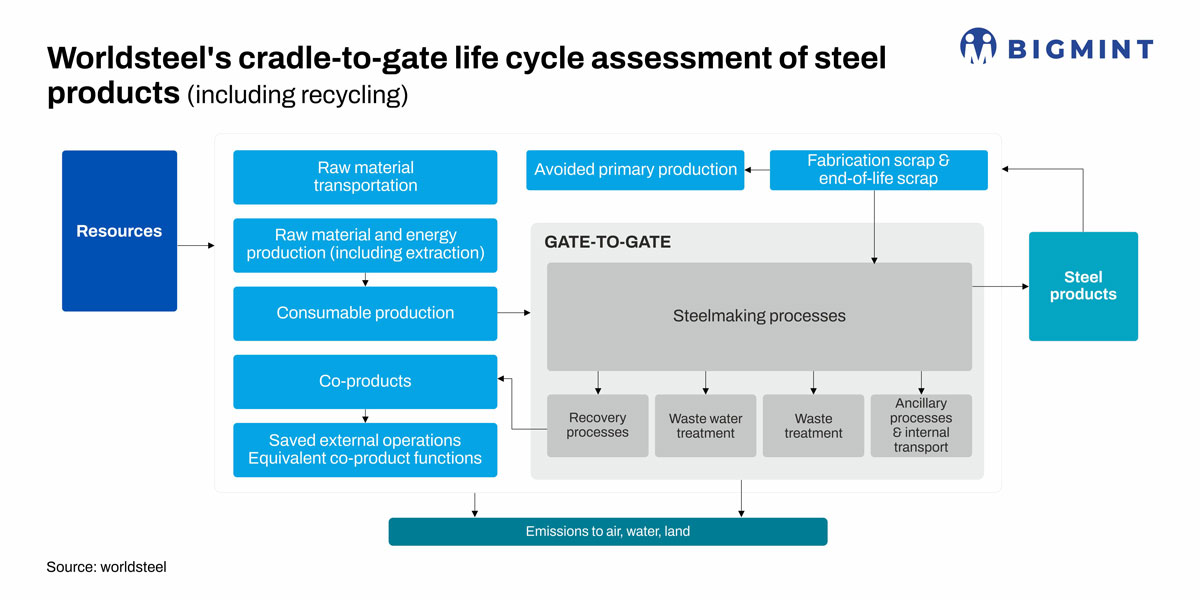

- Life cycle inventory (LCI) data based on 'cradle-to-grave' methodology
- Worldsteel data covers 34 companies from over 160 sites worldwide
- Unequal access to scrap accounts for higher emissions in Asia than EU
Morning Brief: Our choice of materials and metals for infrastructure and industry are not only shaped by considerations of functionality, durability and cost but also, increasingly, environmental sustainability. The environmental performance of materials or products, most directly in terms of manufacturing and lifecycle emissions, has emerged as a foremost consideration for businesses.
With the objective of producing a globally acceptable lifecycle database of the energy, resource use and emissions of steel products, the World Steel Organisation (worldsteel) has recently refreshed its global life cycle inventory (LCI) database which captures the full "cradle-to-gate" picture of steel production - from the moment iron ore is mined to the point where a steel product leaves the factory gate.
The LCI database measures the global warming potential, energy intensity, resource consumption, and impact on water quality and air quality of steel production. The unit is 1 tonne of a standard steel product produced through the BF-BOF route. This LCI methodology has been produced by worldsteel to outline a steel specific standard based on ISO 14040: 20062 and ISO 14044: 2006.
The updated data set covers products from hot-rolled coil to plate, rebar, galvanised steels and tinplate, across all major market sectors. It has been developed with data from 34 companies in more than 160 sites worldwide, representing over 356 million tonnes (mnt) of steel production.
System boundary & role of scrap
As per worldsteel's LCI methodology published in 2017, a gate-to-gate level model consists of all the steelmaking processes (process chain) as well as any additional on-site ancillary services that are required. This includes all necessary inputs and outputs per process, including materials, energy carriers, emissions, wastes and co-products and ancillary services such as boilers, compressors, waste water treatment etc.
As worldsteel defines it, a cradle-to-gate-with-recycling LCI study considers the cradle-to-gate level as well as the impacts of using steel scrap in the steelmaking process and the credits for the end-of-life recycling of the steel from the final product when it reaches the end of its life (end-of-life scrap), at a specified recycling rate (95%). These impacts and credits can be calculated separately on the input and output side, or as net credits.
The recovery and use of steel industry co-products outside of the steelworks are taken into account, using the method of system expansion based on ISO 14044: 2006. For cradle-to-gate with recycling data, the upstream burdens from using ferrous scrap (scrap LCI) in making new steel are included as well as the credits for recycling steel scrap at the end of the final product's life.
Latest results - key takeaways
The latest datasets provide insights on many aspects of steel's climate footprint; however, let's focus on just the CO2-equivalent emissions (climate change impact) of steel products across geographies. The datasets also provide product-wise usage of steel scrap in production.
The LCI product profiles show that for hot-rolled coil (HRC) produced via the BF-BOF route, the CO2-equivalent emissions for Asia are partially higher than Europe but for cold rolled coils (CRC) Asian product-level CO2-equivalent emissions are around 0.55 tCO2/t higher than Europe.
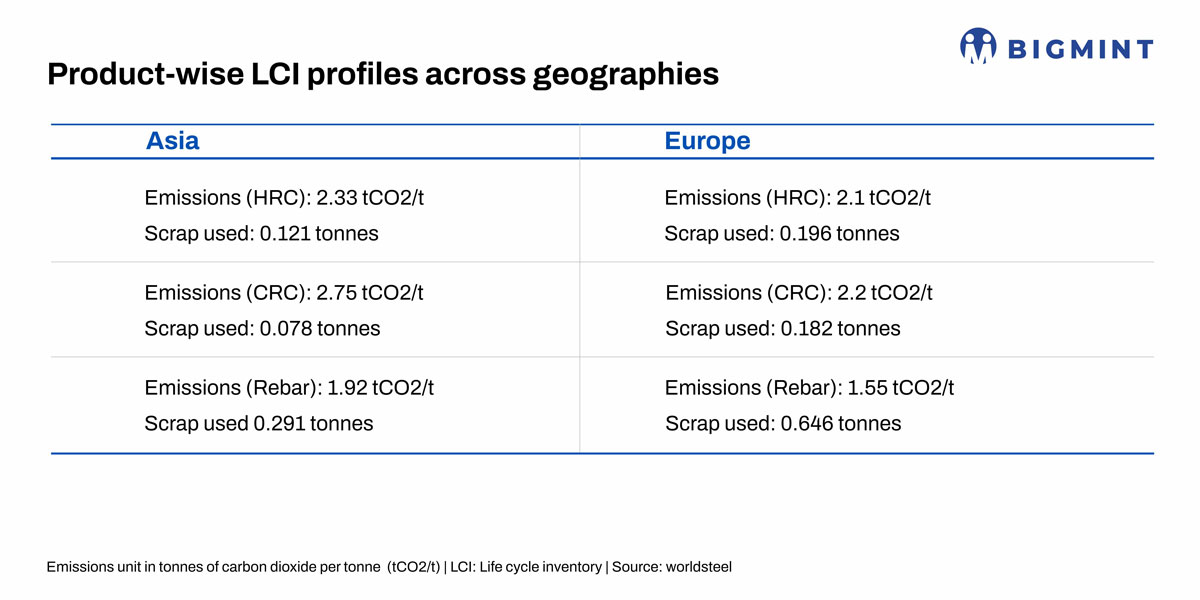
For construction steel products such as rebar, typical emissions in Europe are around 0.4 tCO2/t lower than in Asia. Significantly, the volume of scrap used to produce long products in Europe is much higher compared to Asia which accounts for the difference in emissions.
While the underperformance of Asian mills compared with those in Europe in terms of emissions is not altogether unexpected, the datasets point to the prospect of increasing loss of competitiveness of BF-reliant Asian producers in the age of CBAM and other emerging climate-induced trade regulations. For example, the CBAM threshold for HRC imported into the EU will obviously be far lower than the Asian average of 2.33 tCO2/t.
Another critical factor is the use and availability of ferrous scrap, which is far lower for the Asian mills. While usage is expected to increase going forward, supply will inevitably lag demand and, therefore, direct decarbonisation efforts will be somewhat restricted.
In fact, this reinforces the disadvantage of the Asian mills. Also, importantly, the high emissions profile of BF-based producers across geographies point to the urgent need for mitigating BF-based steel emissions at a time when billions of dollars are being pumped into new BF facilities in Asia.
