Weekly round-up: Holiday lull, weak steel demand weigh on global scrap trade
...

- Turkish prices remain stable, bid-offer gaps stall trade
- Poor import viability, weak rupee limits Indian demand
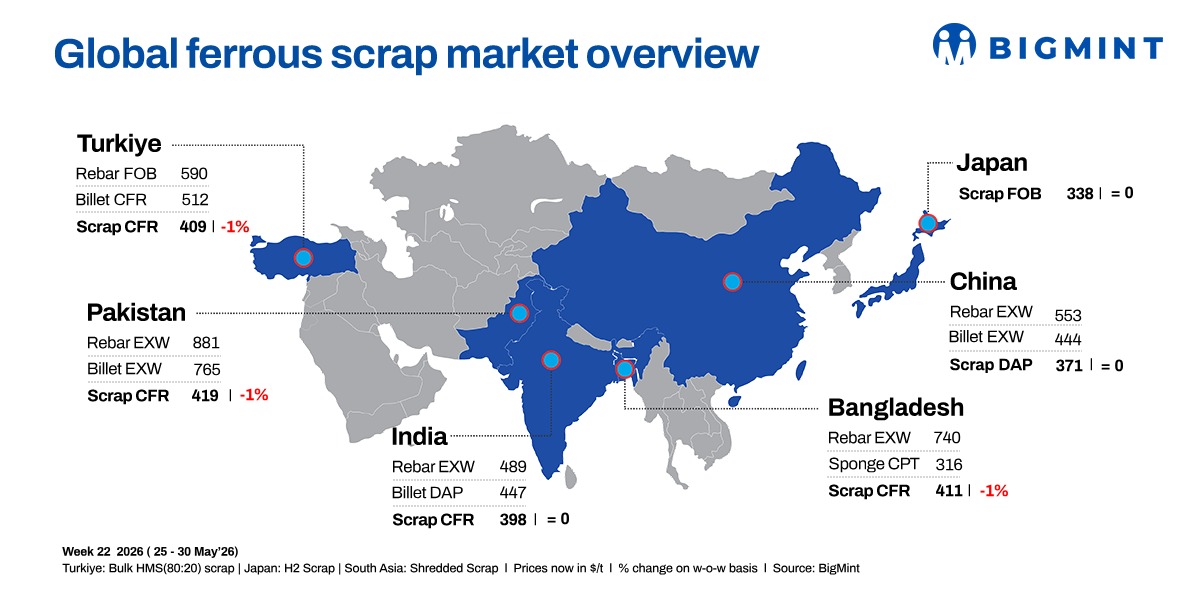
Global ferrous scrap markets remained largely subdued during the week ended 30 May 2026, as weak steel demand, Eid holiday-related slowdowns, and cautious mill buying limited trading activity across key importing regions. While Turkiye's prices remained stable, Japan's domestic and export scrap prices fell, and South Asian markets remained quiet.
Turkiye: Deep-sea imported scrap prices remained largely stable throughout the week, with HMS 80:20 prices fluctuating within a narrow range of $408-410/t CFR amid weak buying interest and limited trading activity. Market sentiment remained subdued as weak domestic and export rebar demand, coupled with the Eid al-Adha holidays, kept most mills away from the market.
Turkish mills were bidding at $400-405/t CFR for US-origin HMS 80:20, below supplier offers near $415/t CFR, with the wide bid-offer gap continuing to limit fresh bookings ahead of post-holiday buying activity.
Additionally, Turkiye's ferrous scrap imports remained broadly stable at 4.73 mnt in Q1CY'26, as elevated freight costs, weak steel margins, and tight liquidity conditions kept mills cautious in their scrap procurement.
India: The imported ferrous scrap market remained weak as poor import viability, rupee depreciation, weak steel demand, and slow downstream sales continued weighing on buying sentiment. Market participants noted that southern mills increasingly preferred domestic scrap, further reducing interest in imported cargoes.
Imported scrap offers softened during the week, with UK-origin HMS 80:20 heard around $360-370/t CFR India and UK-origin shredded scrap at $395-400/t CFR by week-end but bids remained $15-20/t lower. A wide bid-offer gap persisted, with buyers targeting significantly lower levels amid continued pressure on mill margins.
Trading activity remained limited, with only 1,500-2,000 t of imported scrap heard booked during the week, including Yemen-origin LMS and Mozambique- and Africa-origin HMS cargoes at Mundra. Chennai remained largely inactive despite ample offer availability.
Pakistan: The imported scrap market remained largely inactive during the week as Eid holidays curtailed trading activity and kept most market participants away from the market. Workable shredded scrap indications were heard around $414-415/t CFR before assessments were suspended on 28-29 May due to insufficient market activity.
Booking activity remained limited, although a UK-origin shredded scrap cargo of around 1,300 t was heard sold at approximately $414/t CFR, while Malaysia-origin LMS bundle offers were indicated near $355/t CFR. Assessments were suspended on 28-29 May due to insufficient market activity.
Bangladesh: The imported scrap market remained subdued during the week as buyers preferred domestic feedstock amid taka depreciation. Demand was also affected by active shipbreaking operations, steady sponge iron availability from India, and the Eid holiday slowdown.
Imported shredded scrap offers were heard at $405-410/t CFR and HMS at $380-385/t CFR before assessments were suspended on 28-29 May, while booking activity remained limited, with only a 1,000-t Australia-origin HMS 80:20 cargo heard concluded at around $393/t CFR.
Additionally, Bangladesh's scrap imports increased 14% y-o-y to 1.66 mnt in January-April 2026, supported by stronger bookings from Japan, Singapore, and Australia, improved letter of credit (LC) availability, and lower domestic ship-breaking scrap supply.
Japan: Tokyo Steel cut scrap purchase prices by JPY 500/t ($3/t) at its Kansai plant to JPY 53,000/t on 27 May, while Japanese H2 export prices eased by JPY 100/t to JPY 53,800/t amid weaker steel demand, mill maintenance, and limited export activity.
Barzil: Ferrous scrap exports rose 35% y-o-y to 0.23 mnt in Q1CY'26, driven by stronger shipments to India, which increased its imports to 0.17 mnt. Competitive pricing and favourable freights supported exports, while shipments to Bangladesh declined 33% y-o-y to 0.02 mnt.