Vietnam: Bulk coal and coke imports decline 42% m-o-m in Jun'26; Australia remains top supplier
...
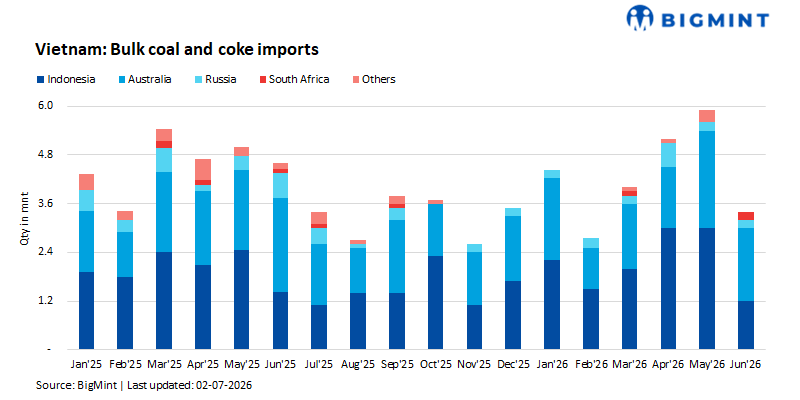

- Vietnam's coal imports fall sharply as buying momentum weakens
- Strong Q2 imports indicate resilient underlying coal demand
Vietnam's coal imports declined significantly in June 2026, falling to 3.4 million tonnes (mnt) from 5.9 mnt in May, marking a 42.4% m-o-m contraction. On a y-o-y basis, imports were also down 26.1% from 4.6 mnt in June 2025. The decline was primarily attributed to softer procurement by end-users following elevated purchases in previous months, adequate inventory levels, and cautious buying amid changing regional coal market dynamics.
Despite the sharp correction in June, Vietnam's coal imports during Q2 2026 (April-June) reached 14.5 mnt, rising 30% q-o-q from 11.15 mnt in Q1 2026 (January-March). The quarterly growth reflected stronger procurement during April and May, supported by higher power generation requirements and industrial demand, which more than offset the slowdown witnessed in June.
On a cumulative basis, Vietnam imported 25.65 mnt of coal during H1 (January-June) 2026, down 6.4% from 27.4 mnt in the corresponding period of 2025. The overall decline indicates relatively moderated import demand compared with last year.
Australia retains leadership despite lower shipments
Australia continued to be Vietnam's largest coal supplier in June, exporting 1.8 mnt, accounting for more than half of the country's total coal imports. However, shipments declined 25% m-o-m from 2.4 mnt in May and were 22.4% lower y-o-y than 2.32 mnt in June 2025. The decline largely reflected weaker spot buying and reduced import requirements following stronger procurement earlier in the quarter.
During H1 2026, Australian coal exports to Vietnam totalled 10.31 mnt, marginally lower by 3.3% compared with 10.66 mnt during the same period last year, indicating that Australia continues to remain Vietnam's preferred supplier despite softer overall demand.
Indonesian exports witness steepest monthly correction
Coal imports from Indonesia fell sharply to 1.2 mnt in June from 3 mnt in May, registering a steep 60% m-o-m decline. Shipments were also 15.3% lower y-o-y compared with 1.42 mnt in June 2025. The sharp monthly decline was primarily driven by reduced spot buying after heavy imports in previous months and sufficient inventories at consuming industries.
Nevertheless, Indonesia remained Vietnam's second-largest coal supplier during the first half of the year. Cumulative shipments reached 12.93 mnt during H1 2026, up 6.8% from 12.11 mnt a year earlier, supported by its competitive pricing and strong supply availability.
Russian exports remain subdued
Russia exported 0.2 mnt of coal to Vietnam in June, remaining unchanged from May but registering a significant 68% y-o-y decline compared with 0.62 mnt in June 2025. The subdued performance reflects continued challenges in maintaining export volumes amid changing trade flows and increased competition from other supplying countries.
For H1 2026, Russian coal exports to Vietnam declined to 1.63 mnt, down 36.1% from 2.55 mnt during the corresponding period last year, highlighting a sustained weakening of Russia's market share in Vietnam.
South African shipments rebound from May
South African coal exports to Vietnam recovered to 0.2 mnt in June after no shipments were recorded in May. On a y-o-y basis, imports surged 149.7% from 0.08 mnt in June 2025, reflecting the resumption of cargo arrivals following the temporary absence of shipments in the previous month.
Despite the strong monthly recovery, cumulative imports from South Africa during January-June 2026 remained broadly stable at 0.37 mnt, nearly unchanged from the corresponding period last year, indicating that South Africa continues to play a relatively limited but consistent role in Vietnam's coal import basket.
Market outlook
Vietnam's coal imports weakened sharply in June following strong buying in May, mainly due to lower arrivals from Indonesia and Australia.
However, second-quarter imports remained significantly higher than the first quarter, indicating healthy underlying demand. Going forward, import trends are likely to remain supported by thermal power generation and industrial consumption, although monthly volumes may continue to fluctuate depending on international prices and procurement strategies.