US rice emergence reaches 98%; crop condition remains stable as heading advances
...
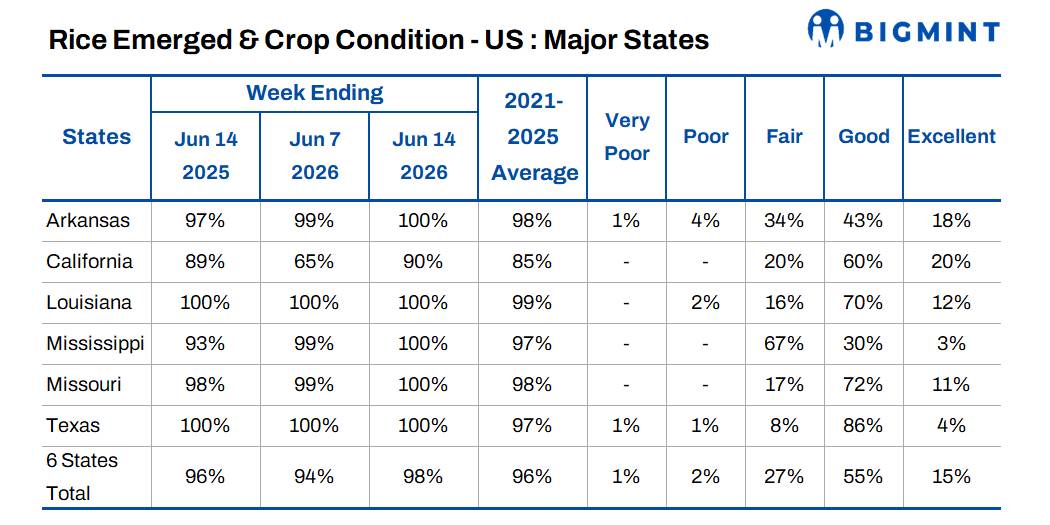

- Rice emergence remains ahead of 5-year average of 96%
- Around 70% of the crop rated good-to-excellent
US rice crop continued to make steady progress during the week ended 14 June 2026, with emergence nearing completion and crop development advancing across major producing states. According to the latest USDA Crop Progress report, rice emergence reached 98%, improving from 94% in the previous week and exceeding the five-year average of 96%. Crop heading also accelerated, while overall field conditions remained stable, reinforcing expectations of a favourable 2026/27 production outlook.
Emergence advances ahead of normal
Rice emergence, that is, the stage when rice seedlings break through the soil surface and become visible,reached 98% as of 14 June across six major producing states -- Arkansas, California, Louisiana, Mississippi, Missouri and Texas -- compared with 94% a week earlier and 96% during the corresponding period last year, as well as the 2021-2025 average.
Arkansas, Louisiana, Mississippi, Missouri and Texas reported complete emergence at 100%, while California improved significantly to 90% from 65% recorded a week earlier. The sharp weekly improvement in California reflects continued planting progress despite the state's relatively later production calendar compared with the southern rice belt.
Heading activity gathers momentum
Crop development continued to advance during the reporting week, with 8% of the six-state rice crop reaching the headed stage (when the rice panicle, the flowering head that eventually contains grains, emerges from the stem). This compares with 4% in the previous week, 5% during the same period last year and a five-year average of 4%, indicating that crop development is progressing ahead of the normal pace. Louisiana remained the most advanced producing state, with 32% of the crop headed, followed by Texas at 17%, Mississippi at 6%, and Arkansas and Missouri at 3% each. California has not yet entered the heading stage, consistent with its typical seasonal development pattern.
Crop condition remains broadly favourable
The overall condition of the US rice crop remained largely unchanged from the previous week. Across the six major producing states, 55% of the crop was rated good and 15% excellent, resulting in a combined good-to-excellent rating of 70%. Around 27% of the crop was classified as fair, while only 2% was rated poor and 1% very poor. Although the good-to-excellent rating remains four percentage points below the 74% recorded during the same period last year, the current assessment continues to indicate healthy crop conditions across most producing regions with limited signs of widespread stress.
Weather to determine yield potential
With emergence virtually complete and heading progressing ahead of historical norms, the US rice crop is entering one of its most critical growth stages. Weather conditions during heading, flowering, and grain filling will play a decisive role in determining final yields. Current crop ratings suggest that production prospects remain favourable, although excessive heat, prolonged dryness or adverse weather events during the coming weeks could still influence productivity across major growing regions.
Market implications
The latest USDA data reinforce expectations of stable US rice production during the 2026/27 marketing year. Faster-than-normal emergence and ahead-of-average crop development reduce immediate production concerns and support expectations of comfortable long-grain rice availability later in the season. For global rice markets, a favourable US crop could help maintain export supplies to key destinations in Latin America, the Middle East and other traditional markets. However, market participants are expected to closely monitor weather developments through the reproductive stage, as yield risks remain sensitive to summer conditions.
Outlook
The US rice crop remains on a favourable trajectory, with emergence reaching 98%, heading advancing ahead of historical averages and overall crop conditions remaining stable. Approximately 70% of the crop is rated good-to-excellent, indicating healthy field conditions despite ratings being slightly below last year's levels. Unless adverse weather emerges during the critical reproductive period, current crop progress points towards a stable production outlook and continued export availability during the 2026/27 marketing year.
