Richards Bay rail disruption has limited impact amid subdued Indian demand
...
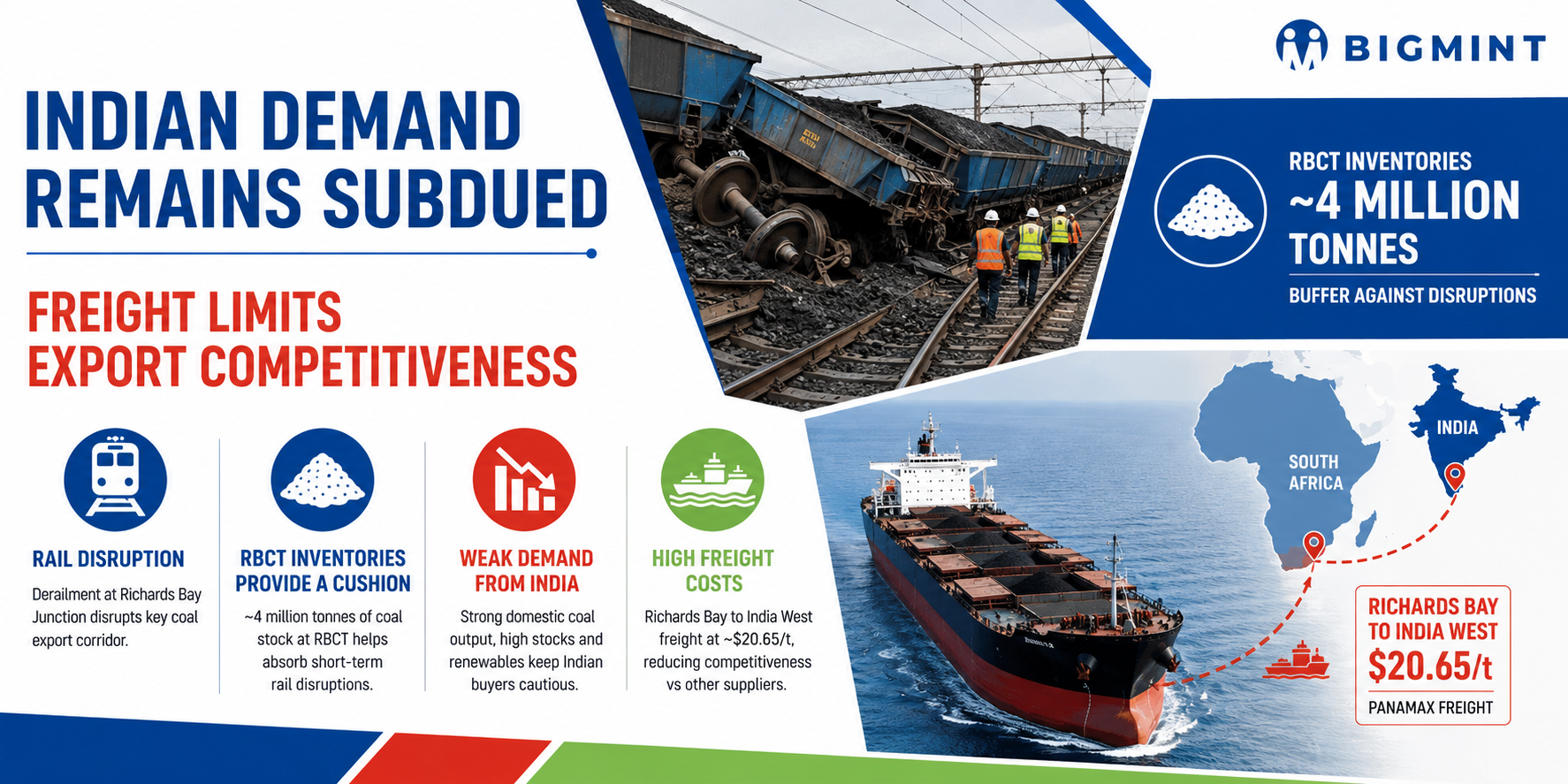

- Indian demand remains subdued
- Freight limits export competitiveness
A derailment on South Africa's key coal export corridor has highlighted a growing disconnect between supply-side disruptions and market pricing.
Transnet Rail Infrastructure Manager (TRIM) suspended coal train operations following a derailment at Richards Bay Junction on 8 June, damaging rail infrastructure and disrupting traffic on multiple lines serving the Richards Bay Coal Terminal (RBCT). Under different market conditions, such an event would likely have triggered a sharp increase in export coal prices.
Instead, the market response was muted.
FOB Richards Bay 5,500 NAR rose only $0.60/t d-o-d to $96/t on 9 June, reflecting limited concern among buyers about the immediate impact on export availability. The restrained price movement suggests that demand-side weakness, particularly from India, is currently exerting a stronger influence on market sentiment than short-term logistical disruptions.
Rail operations disrupted
According to Transnet, the derailment affected Lines 2, 3 and 4 at Richards Bay Junction, along with the Empangeni line. The company confirmed damage to both rail infrastructure and rolling stock, while specialist recovery teams were deployed to restore operations.
As of 9 June, no formal timeline had been provided for the resumption of normal rail services.
The Richards Bay export corridor remains the most important coal transportation route in South Africa, connecting major coal-producing regions with RBCT, one of the world's largest coal export terminals.
Despite the disruption, market participants expressed confidence that existing stockpiles would help mitigate any immediate impact on exports.
Terminal inventories provide a cushion
One of the key reasons for the limited market reaction is the availability of coal already positioned at RBCT.
Market sources estimate terminal inventories at around 4 million tonnes, providing a substantial buffer against short-term rail interruptions.
With vessels continuing to load and significant stocks already available within the export system, traders view the derailment as a logistical challenge rather than a material threat to near-term supply.
Several market participants indicated that unless rail disruptions extend significantly beyond current expectations, export programmes are unlikely to experience major disruptions.
Indian demand remains subdued
More importantly, the South African market continues to face weak demand from its largest traditional customer base.
Indian buyers remain cautious amid strong domestic coal production, healthy inventory levels and increasing renewable generation within the country's power sector.
The industrial segment, including sponge iron, ferroalloy and captive power producers, has historically been an important consumer of South African coal. However, elevated freight costs have reduced the competitiveness of South African material compared with alternative origins.
As a result, many Indian buyers have reduced spot market participation despite relatively stable FOB prices.
Freight remains a key challenge
Ocean freight continues to be one of the biggest obstacles for South African exports into India.
Current Panamax freight assessments place Richards Bay-to-India West freight at around $20.65/t, substantially higher than equivalent freight costs from Indonesia into Indian ports.
This freight disadvantage narrows the competitiveness of South African coal, particularly when buyers are increasingly focused on delivered fuel costs rather than calorific value alone.
Many consumers have opted to increase purchases of lower-calorific Indonesian coal, which often remains more attractive on a landed-cost basis despite offering lower energy content.
The trend has been particularly evident among cost-sensitive industrial consumers.
Market fundamentals outweigh disruption
The limited response to the derailment reflects broader changes within the seaborne thermal coal market.
Historically, disruptions on the Richards Bay export corridor often generated significant price reactions due to concerns over supply availability. Today, however, ample inventories,
diversified supply options and softer import demand have reduced the market's sensitivity to short-term logistical events.
The recent derailment demonstrates that supply-side issues alone are no longer sufficient to drive substantial price increases unless accompanied by stronger underlying demand.
Outlook
The South African thermal coal market is expected to remain largely influenced by freight economics and Indian buying activity rather than the recent rail disruption.
While the restoration timeline for affected rail infrastructure will remain closely monitored, existing inventories at RBCT appear sufficient to absorb a short-term interruption in rail deliveries.
For producers, improving export competitiveness into India may prove more important than resolving isolated logistical disruptions. Any sustained decline in freight rates could improve South African coal's attractiveness and generate stronger buying interest from industrial consumers.
Until then, FOB Richards Bay prices are likely to remain range-bound, supported by stable export demand but constrained by weak import appetite from key Asian markets.
Market participants will closely monitor Transnet's recovery efforts, freight rate movements and Indian purchasing activity for indications of a shift in market direction.