Recycling, renewables key levers in Chinese steel industry decarbonisation
...

- China targets to cut emissions by 18% per unit of GDP by 2025
- Steel demand management, higher scrap availability key to low-CO2 transition
- With EU not accepting EPD platform, tax burden on steel industry to increase
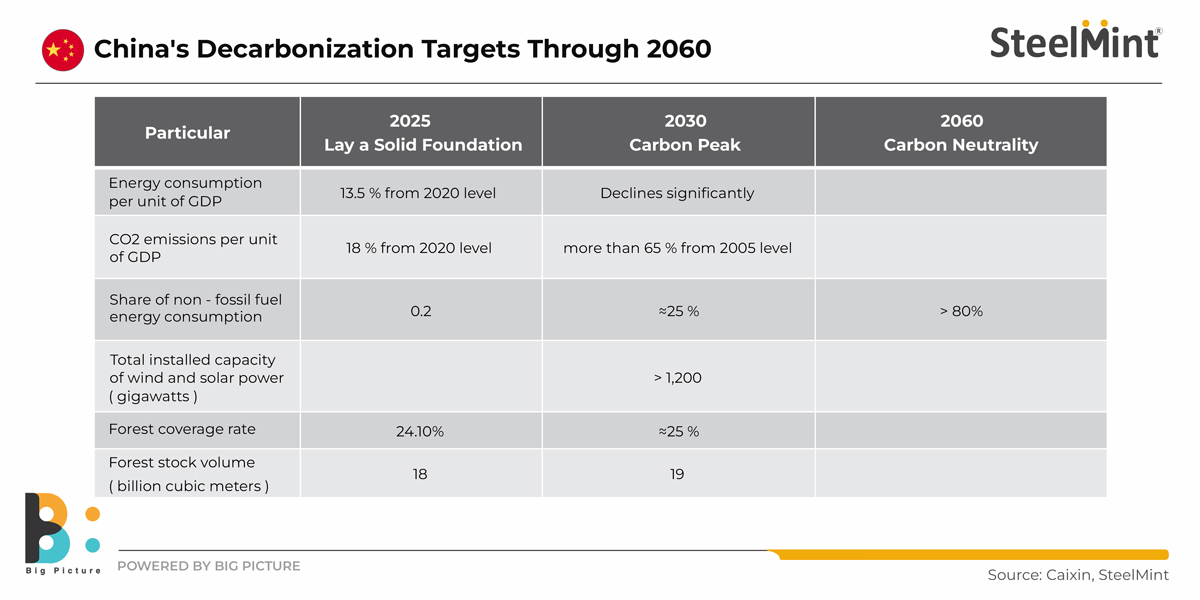
China, the highest GHG-emitting country in the world in absolute terms, has announced the "dual carbon" policy of peaking emissions in 2030 and attaining carbon neutrality by 2060. The policy is based on the following broad objectives.
- China's energy consumption per unit of GDP in 2025 will be 13.5% lower than that in 2020. CO2 emission per unit of GDP will be 18% lower than 2020.
- By 2030, the proportion of non-fossil energy consumption will reach about 25%
- By 2030, the share of new and clean energy vehicles will reach about 40% and carbon emission intensity per unit of operating vehicles will decrease by about 9.5% compared with 2020
- By 2060, the proportion of non-fossil energy consumption will reach more than 80%
Steel industry
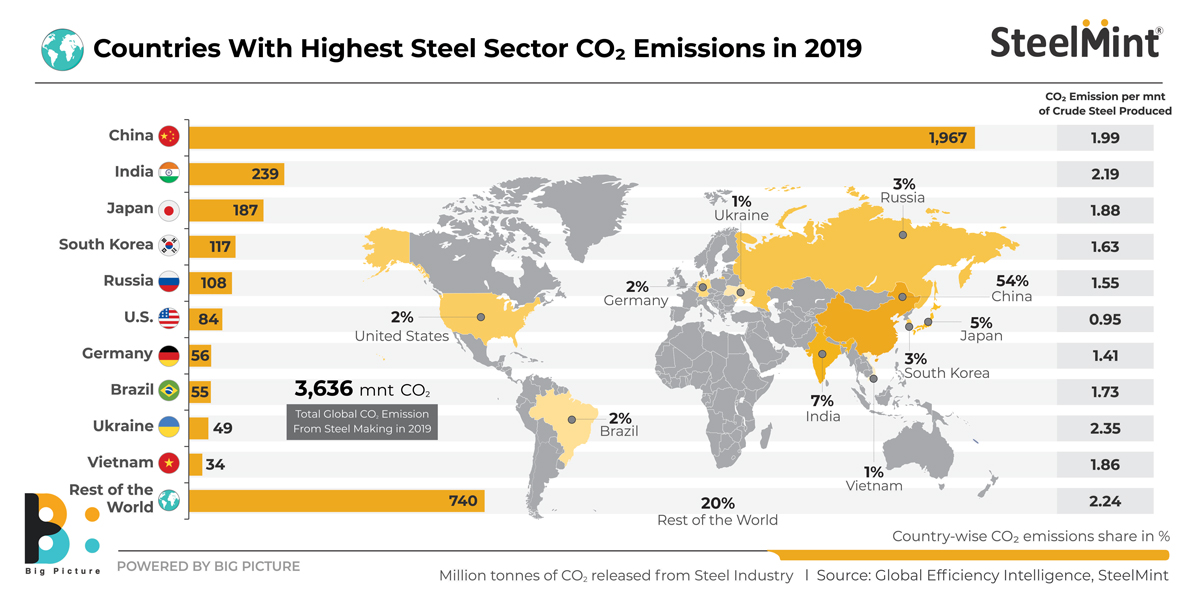
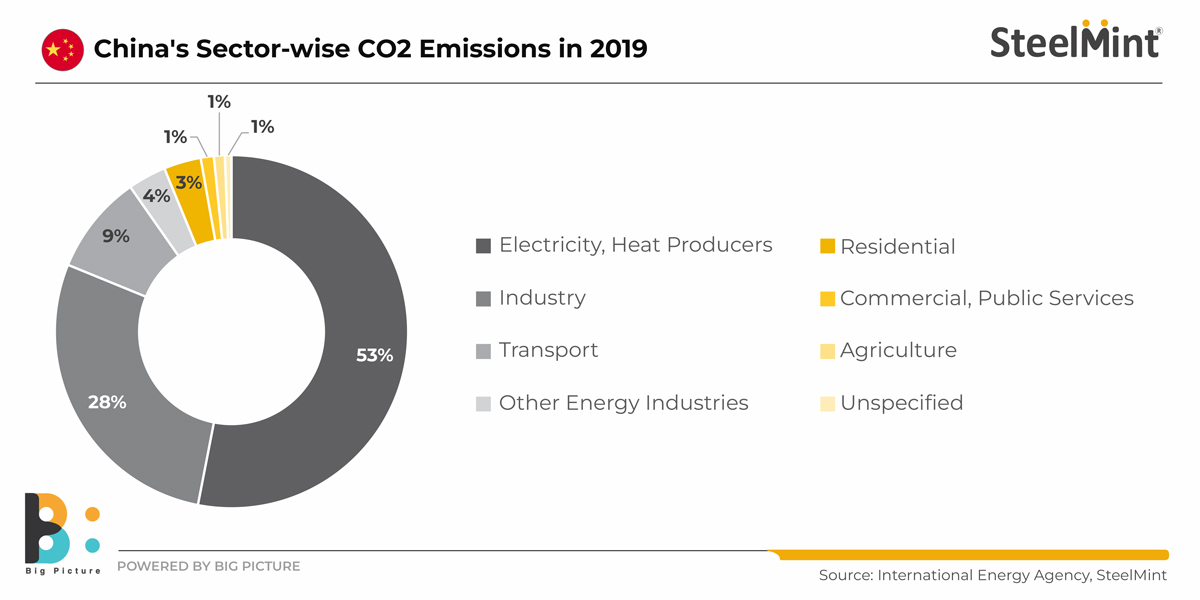
According to the China Iron and Steel Association (CISA) to which around 80% of Chinese steel mills are affiliated, the steel industry's carbon dioxide (CO2) emissions are around 15% of the country's total carbon emissions. This is markedly higher than the global average of around 7%. The emissions intensity of China's BF-BOF steel production route is around 2.2 tco2/tcs (tonnes of CO2 per tonne of crude steel). The total energy consumption as well as the CO2 emissions intensity of the Chinese steel industry is much higher than the global average. The reasons for this are:
Low share of EAF in total steel production
- Coal and coke heavy fuel mix in iron and steel industry
- Higher electricity grid CO2 emissions
- Low penetration of energy-efficient technologies
Key targets
According to CISA, the two key targets before the Chinese steel industry are:
- Reaching carbon peak in 2030, reducing emissions by 40% from the peak value by 2040, 85% lower than the peak in 2050 and about 95% lower in 2060. Through carbon sinks and CCUS, the steel industry will achieve carbon neutrality.
- The main carbon reduction technology routes include: a) system energy efficiency improvement, b) resource recycling, c)process optimisation and reconstruction, d) product performance improvement, e) smelting reduction process breakthrough, and f) capture, storage and utilisation of CO2.
Low-carbon progress
Development in low-carbon steelmaking technology is quite evident. The following instances are particularly noteworthy:
- Steel major HBIS's H2-based DRI can achieve 94% metallisation rate in DRI and reduce CO2 emissions by more than 70% compared with the traditional BF route
- Baowu has completed the construction of 400m3 H2-rich carbon recycling BF (HyCROF) achieving reduction of solid fuel (coke) consumption by 30% and carbon emissions by 21%. Commercial demonstration of 2500m3 HyCROF underway
- Beijing Jianlong Heavy Industry Group's H2-based smelting reduction technology has achieved 300,000 t of capacity since its first trial
- HBIS Group's near zero-carbon emission 1 mnt EAF project will promote hydrogen-based DRI and will have an emissions intensity of just 100 kgCO2/tcs
- Jiangsu Shagang's net shape manufacturing technology will achieve carbon emission reduction in steel rolling by 56% and total emissions of about 1.05 Tco2/tcs in the integrated process
EPD platform & challenges
The Environmental Product Declaration (EPD) platform is an effective platform for the steel industry, as per CISA. Launched in 2022, environmental product declaration is used to describe the environmental factors of the product or service which mainly includes LCA-based product carbon footprint (carbon emissions per unit).
It is an environmental statement based on quantitative environmental data of preset parameters, and other environmental information can be added if necessary. The preset parameters are based on ISO 14040 series.
China Baowu, Jiuquan Steel, Shougang, Shagang, Baotou Steel, Wantai Special Steel and Baowu Resources have issued 44 EPD reports. Among them, there are 34 steel products reports and 10 iron ore reports. Steel products are divided according to manufacturing process, 33 reports for long process and 1 report for short process, according to CISA.
Countries worldwide, apart from the EU, are yet to settle emissions benchmarks for steel products. The methodology of CBAM is based on the international ISO 14000 series standards. Calculation, reporting, and verification can be conducted according to unified methods and standards adopted voluntarily by industry parties.
China's steel EPD report is qualified for the EU's carbon verification, although the European Commission has not accepted it.
This is a major challenge as the tax burden on China's steel industry will increase under CBAM. As per industry consultancy Mysteel, CBAM would add some Euro 134/t to China's export prices of steel items to Europe, with the price being Euro 80/t CO2e (equivalent) under the EU's ETS.