Philippines lowers 2026-27 rice production forecast to 12.3 mnt; imports revised up to 5.2 mnt
...
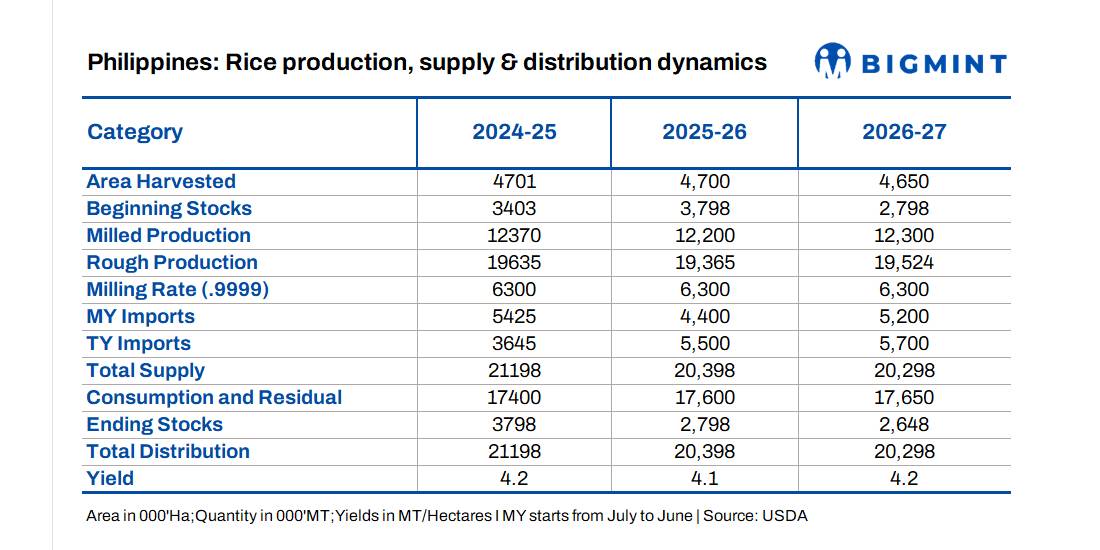

- Ending stocks tighten to 2.65 mnt amid weaker production
- Farmgate prices for rice varieties decline dampening planting intentions
The Philippines has lowered its milled rice production forecast for MY 2026-27 to 12.3 mnt, compared with the previous forecast of 12.4 MMT, while the harvested area has been revised down to 4.65 million hectares from 4.70 million hectares. The revision reflects rising input costs, decreased dam water levels and declining farmgate prices.
Production
According to FAS Manila, rising fuel and fertilizer prices continue to reduce farmer profitability and limit the incentive to expand planted area. Fertilizer prices have risen sharply since March 2026 and continued to accelerate through June 2026.
Farmgate prices for both fancy and other rice varieties declined in April 2026 after rising steadily from September 2025 through March 2026, further dampening planting intentions and contributing to the reduction in harvested area.
Despite these challenges, yield is forecast to improve marginally to 4.1987 MT/ha from the previous forecast of 4.1879 MT/ha, supported by the Department of Agriculture's promotion of drought-resistant and high-yielding rice varieties.
FAS Manila noted that reduced dam water levels continue to pose a significant risk to production in key lowland areas. PAGASA reported that all four major irrigation dams supplying key rice and corn producing regions were below their normal high-water levels as of June 15, 2026.
The agency also indicated that El Nio is expected to fully develop between June and August 2026, strengthen between October and December 2026, and persist into early 2027. FAS Manila stated that it will continue to monitor rainfall, heat and dam water levels and may revise its production forecast further downward in subsequent updates.
Consumption
FAS Manila maintained its 2026-27 milled rice consumption forecast at 17.65 mnt, unchanged from the previous forecast.
The report stated that rice remains the primary staple food in the Philippines, with demand continuing to be driven by population growth. Although retail prices across all rice variants have increased during measurement year (MY) 2025-26, consumption is expected to remain resilient, with higher prices moderating but not reversing demand growth.
Trade
Rice imports are forecast at 5.2 mnt in MY 2026-27, compared with the previous forecast of 5.1 mnt, reflecting lower domestic milled rice production and continued demand growth.
According to the report, the increase in imports is expected to be moderated by the Php 50/kg maximum suggested retail price (MSRP) on imported well-milled rice and the price-indexed tariff mechanism, which increases the landed cost of imported rice based on prevailing international prices.
During the July-April period of MY 2025-26, Vietnam accounted for 88.7% of the Philippines' rice imports, followed by Thailand (5.4%), Myanmar (3.0%) and Cambodia (1.8%).
Stocks
FAS Manila forecasts MY 2026-27 ending stocks at 2.648 MMT, down from the previous forecast of 2.798 MMT.
The report attributed the decline to lower domestic milled rice production and moderated import volumes, with the resulting supply gap expected to be absorbed through a drawdown in ending stocks. It also noted that the Php 50/kg MSRP on imported well-milled rice continues to limit incentives for the commercial sector to build excessive inventories.
Policy
The Department of Agriculture has recommended extending the Php 50/kg maximum suggested retail price (MSRP) for imported rice beyond its initial 30-day period. The proposal remains under evaluation before submission for presidential approval.
The Philippines also continues to implement the price-indexed tariff mechanism introduced in January 2026, under which import duties vary between 15% and 35% based on movements in world rice prices.
