Pakistan seeks Rs 20 bn budget support for rice exporters to improve global competitiveness
...
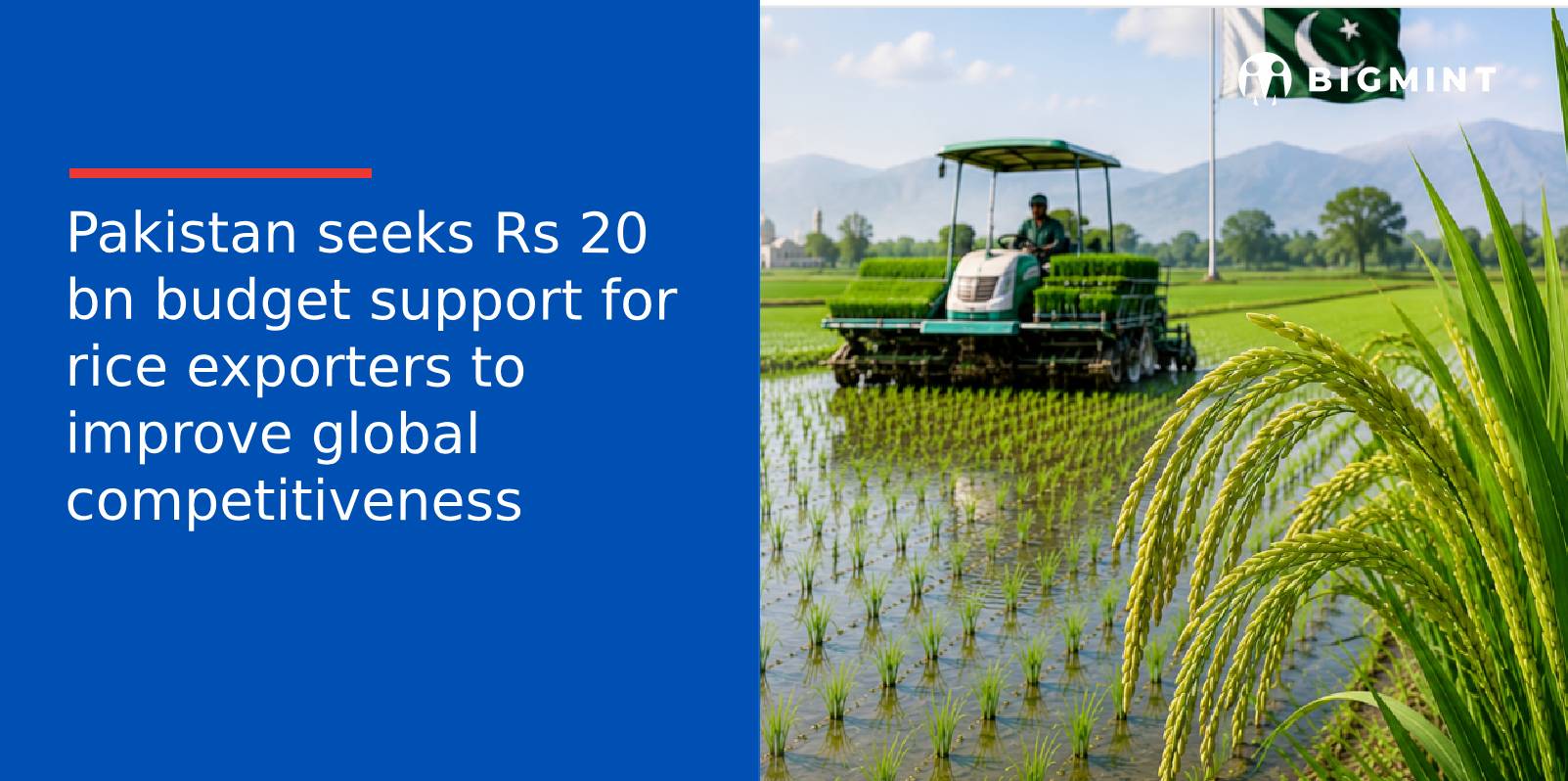

- Pakistan plans Rs 20 bn support for rice exporters to improve competitiveness.
- Rising domestic costs and India's aggressive pricing continue to pressure exports.
Pakistan is preparing to extend Rs 20 billion in budgetary support to its rice export sector as the government seeks to restore the industry's competitiveness amid declining overseas shipments and intense price competition from India. The financial assistance, initially provided through the Export Development Fund (EDF), is expected to be reimbursed through a formal federal budget allocation. The initiative comes at a time when Pakistan's rice exports are facing mounting pressure from lower-priced Indian supplies, elevated domestic paddy prices and high financing costs, which have significantly narrowed exporters' margins.
Government moves to support exporters
According to official sources, Pakistan's Ministry of Commerce has sought federal budget support for the Rs 20 bn bridge financing already extended to rice exporters through the Export Development Fund. The assistance was approved by the Export Development Board and is intended to provide short-term liquidity support to exporters facing challenging market conditions. To ensure transparency, the Ministry of Commerce, in coordination with the State Bank of Pakistan, Pakistan Single Window and Customs authorities, has introduced a monitoring mechanism aimed at preventing misuse of the financial assistance during the three-month support period.
India's pricing advantage weighs on exports
Pakistan's rice export sector has witnessed a sharp deterioration in competitiveness following India's full return to the global rice market. The restoration of Indian non-basmati exports and abundant domestic supplies have significantly increased competition across key importing destinations. Indian basmati rice is currently quoted at around USD 850-900/t, substantially below Pakistani basmati prices of USD 1,150-1,275/t, creating a price gap that has shifted buying interest toward Indian origins. Competitive pricing in India's non-basmati segment has also intensified pressure on Pakistan's volume exports.
Export earnings decline despite healthy production
Rice remains Pakistan's second-largest export commodity after textiles and a major source of foreign exchange earnings, rural employment and agri-industrial activity. Export earnings increased from USD 2.04 bn in FY2021 to USD 3.93 bn in FY2024, supported by global supply disruptions and India's export restrictions. However, exports moderated to USD 3.35 bn in FY2025 as major suppliers re-entered the market and international prices softened. The slowdown has accelerated in the current fiscal year, with rice exports during July-December declining by approximately USD 854 million year-on-year. Non-basmati rice accounted for nearly USD 716 millionof the decline, while basmati exports fell by around USD 138 million, indicating pressure across both premium and mass-market segments.
Higher costs and stock accumulation add pressure
Apart from stronger competition from India, Pakistan's exporters are also facing elevated domestic paddy prices, higher financing costs and weaker international demand due to stock accumulation in several importing countries. Regional trade frictions and tighter liquidity conditions have further constrained export activity across the value chain. Despite these challenges, industry representatives maintain that production is not the limiting factor. The Rice Exporters Association of Pakistan (REAP) estimates that the country has an exportable surplus of around 4.1 MMT, equivalent to nearly USD 2 bn in potential exports if short-term competitiveness issues are addressed.
Outlook
The proposed Rs 20 bn support package is expected to provide temporary relief to Pakistan's rice exporters by easing liquidity constraints and improving export competitiveness. However, sustained recovery will depend on narrowing the price gap with Indian supplies, stabilizing domestic procurement costs and strengthening demand from key international buyers. With India continuing to offer competitively priced rice and global supplies remaining comfortable, Pakistan's export performance is likely to remain closely tied to government support measures and evolving international market dynamics.
