Manufacturing drives India's steel demand growth in FY'26 as infrastructure loses momentum
...

- Manufacturing-linked sectors contribute 70% of demand growth
- Construction grows 9% y-o-y, remains single-largest steel consumer
- Infrastructure steel demand remains flat as project execution slows
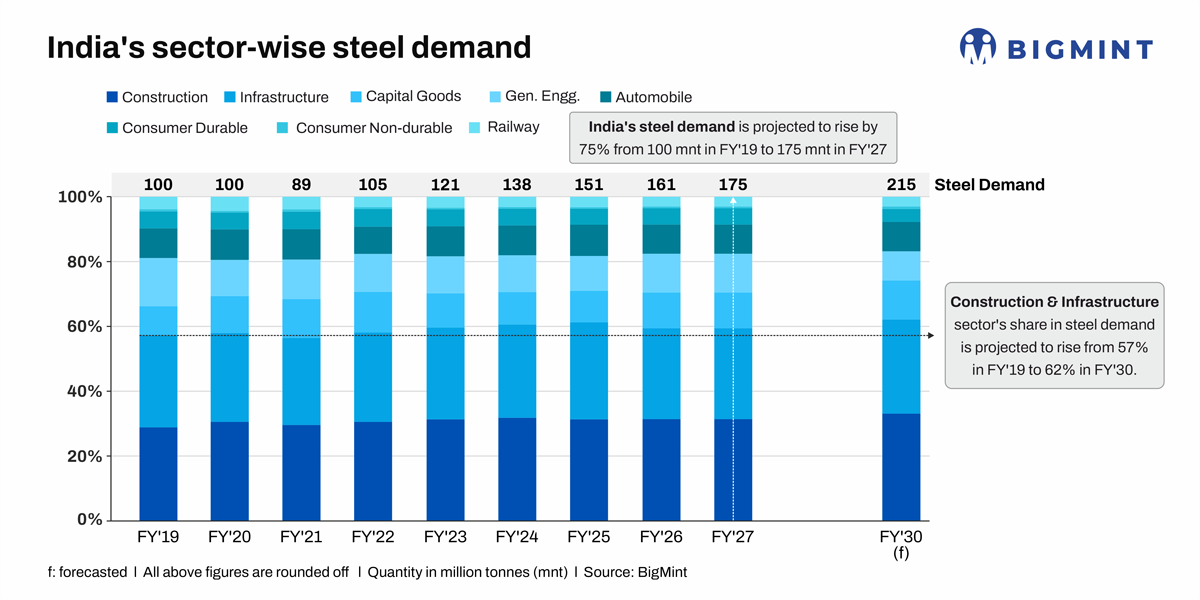
Morning Brief: India's finished steel consumption rose 7% y-o-y to 161 million tonnes (mnt) in FY'26, recording the slowest growth in the post-pandemic era and slightly lower than the 9% increase recorded in 151 mnt in FY'25.
This followed a marked shift in the composition of Indias steel demand, with infrastructure-linked consumption remaining stagnant y-o-y at 45 mnt. In comparison, manufacturing-linked sectors gained share, accounting for over 70% of the 10 mnt increase in steel demand.
Indias sector-wise steel consumption in FY26
Construction demand accelerates
Construction remained India's largest steel-consuming sector and contributed the biggest increase in demand during FY'26. Consumption rose 8.5% y-o-y to 51 mnt, adding around 4 mnt of incremental demand.
The housing market remained relatively supportive, according to data from real estate consultancy Liases Foras. New residential supply across 75 tracked cities rose 10% y-o-y despite a slight 1% decline in sales, indicating developers remained confident about medium-term demand.
Infrastructure-linked growth stalls
In contrast, infrastructure-linked steel demand remained stagnant, as slower project execution, rather than a lack of budgetary support, weighed on the sector. Key challenges included delays in land acquisition, slower project awards, moderation in highway construction and Jal Jeevan Mission implementation, delayed contractor payments, and slower fund disbursement cycles.
For example, national highway construction fell to around 9,380 km in FY26, missing the government's 10,000 km target and marking the lowest level since FY18. Highway project awards also declined, reducing the pipeline of steel-intensive construction activity.
Execution challenges were also evident at the state level. By February 2026, 22 states had utilised only around 55% of their combined capital expenditure budgets for FY26, indicating a significant lag between budget allocations and on-ground project implementation.
It should be noted that steel demand from both the construction and infrastructure sectors grew at double-digit rates between FY22 and FY24, driven by a post-pandemic recovery in construction activity, accelerated execution of government infrastructure projects, and a sharp increase in public capital expenditure. However, this momentum weakened from FY25 as project execution slowed.
Manufacturing sector takes over as growth driver
While infrastructure lost momentum, manufacturing-linked demand strengthened. Manufacturing-linked steel demand strengthened significantly in FY'26. Combined steel demand from general engineering, capital goods, consumer durables, and automobiles rose to 60 mnt in FY26 from 53 mnt in FY25.
Indias manufacturing GVA growth accelerated to around 11.5% y-o-y in FY26 from 9.3% in FY25, according to World Bank data. Private consumption grew 7.7% y-o-y in FY26, accelerating from 5.8% in FY25, aided by rising household income, lower inflation, income tax relief, and GST rationalisation.
Moreover, investment growth accelerated due to higher private spending on manufacturing plants and equipment alongside continued public capital expenditure.
The favourable demand and investment environment contributed to stronger steel consumption in the general engineering, capital goods, and consumer durable sectors.
Engineering, capital goods momentum strengthens
The engineering sector alone contributed around 3 mnt of incremental steel demand during FY26. Notably, India's engineering exports rose 5% y-o-y to an all-time high of approximately $122 billion in FY26, accounting for nearly 28% of the country's merchandise exports.
Steel demand from the capital goods sector increased 20% y-o-y to 18 mnt in FY26, coinciding with stronger manufacturing investment and expansion in machinery and equipment production. According to the governments Index of Industrial Production (IIP), capital goods output growth accelerated to 11.7% y-o-y in FY26 from 9.3% y-o-y in FY25.
Consumer durables also contributed modestly, with steel demand rising to 8 mnt as appliance manufacturers continued to expand domestic production and localisation.
Notably, manufacturing activity benefited from the governments Production-Linked Incentive (PLI) programme, which has attracted cumulative investments of INR 2.4 lakh crore by the end of FY26. Significant investments flowed into solar photovoltaic modules, automobiles and auto components, and white goods, supporting demand for machinery, engineering products, and industrial facilities.
In the power segment, India also added a record 55.3 GW of non-fossil fuel-based capacity during FY'26, with the volume nearly doubling y-o-y.
Record sales fail to lift auto sector steel consumption
Strikingly, steel demand from the automobile sector remained unchanged at 15 mnt in FY26 despite record vehicle production and sales. Total vehicle production increased 11.8% y-o-y to 347 million units, while domestic sales rose 10.4% to 28.3 million units, according to Society of Indian Automobile Manufacturers (SIAM).
The growth in sales was heavily concentrated in two-wheelers, which accounted for nearly 80% of incremental vehicle sales during the year. Two-wheeler sales rose by 2.1 million units, while passenger vehicle sales increased by only 342,000 units and commercial vehicle sales by 123,000 units. Since two-wheelers consume significantly less steel per unit than passenger vehicles and commercial vehicles, the increase in overall vehicle volumes possibly did not translate into proportionate growth in steel demand.
Moreover, automotive steel demand had already rebounded strongly between FY'22 and FY'25, limiting the scope for further gains.
Steel demand from railways remains stable
The railways sector contributed 5 mnt of steel demand in total in FY26, stable y-o-y. Demand remained supported by sustained investment in network expansion, track doubling, electrification, rolling stock procurement, station redevelopment, and Dedicated Freight Corridor (DFC) projects. Notably, Indian Railways fully utilised its record capital expenditure allocation of INR 2.78 lakh crore in FY'26, increasing from INR 2.65 lakh crore in FY25.
Outlook
BigMint expects India's finished steel consumption to rise 8% y-o-y to 175 mnt in FY'27. The main change from FY'26 is likely to be the return of infrastructure as a growth driver. Steel demand from the sector is projected to increase to 49 mnt as project execution improves and large public investment programmes gain traction.
We also expect construction demand to remain robust, rising to 55 mnt, supported by housing and urban development activity. However, although manufacturing-linked sectors should continue to grow, we believe that the pace will slow, with the sector contributing 5 mnt to incremental steel demand. This follows concerns over slower economic growth, shrinking discretionary spending, and softer rural demand due to the West Asia crisis and a weak monsoon.
The result would be a broader-based demand recovery, with construction, infrastructure, and manufacturing once again expanding in tandem.