LME base metals trade mostly higher amid tariff uncertainty and supply-side risks
...

- Asian crude buyers turn to US amid Gulf supply disruptions
- New US tariff framework adds volatility to aluminium, copper markets
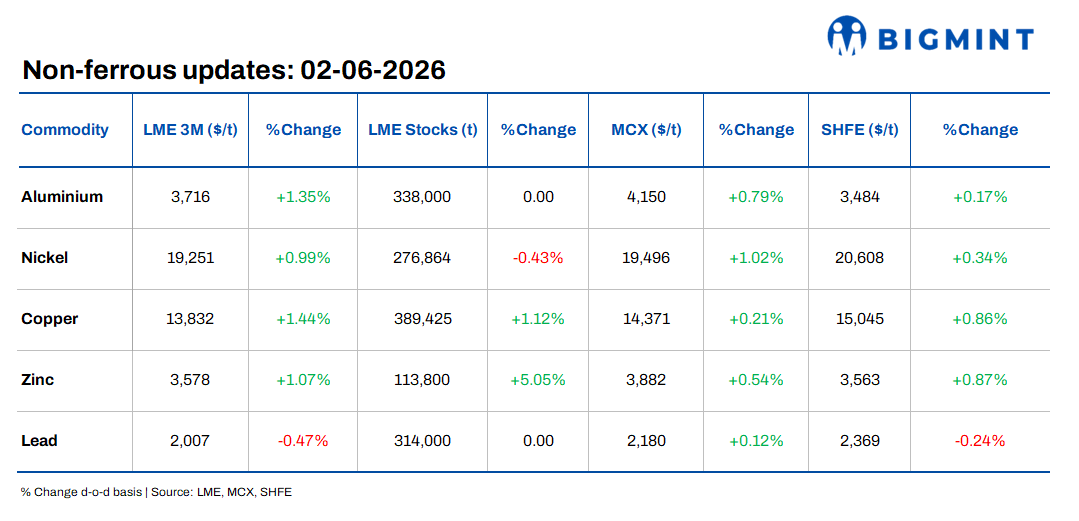
Base metals prices on the London Metal Exchange (LME) traded mostly higher on 1 June. Copper recorded the strongest gain, rising 1.44% d-o-d to $13,832/t, followed by aluminium, which increased 1.35% to $3,716/t. Zinc also moved higher by 1.07% to $3,578/t, while nickel gained 0.99% to $19,251/t. In contrast, lead was the only decliner, slipping 0.47% to $2,007/t.
On the inventory side, zinc stocks registered the sharpest increase, rising 5.05% d-o-d to 113,800 t, followed by copper inventories, which climbed 1.12% to 389,425 t. Meanwhile, nickel inventories declined by 0.43% to 276,864 t, while aluminium and lead stocks remained unchanged at 338,000 t and 314,000 t, respectively, indicating mixed trends across LME warehouses.
Domestic market overview
India's non-ferrous scrap market displayed mixed trends d-o-d. Aluminium tense scrap (loose), ex-Delhi, remained unchanged at INR 304,000/t, while ex-Chennai prices declined by INR 2,500/t or 0.8% d-o-d to INR 309,000/t from INR 311,500/t, indicating slightly softer regional market sentiment.
Meanwhile, copper armature scrap (Cu 99%), ex-Delhi, increased by INR 10,000/t or 0.8% d-o-d to INR 1,250,000/t from INR 1,240,000/t, supported by stronger copper market trends and improved spot buying activity.
Other updates
Trump revises tariffs on aluminium and copper imports
US President Donald Trump signed a proclamation on 2 June revising tariffs on imported aluminium and copper products under Section 232 measures, expanding coverage across selected downstream metal products and adjusting duty structures for certain industrial equipment.
The revised framework lowers tariffs on some metal-intensive industrial equipment from 25% to 15%, while products manufactured using at least 85% US-smelted aluminium or US-produced copper and steel may qualify for reduced 10% duties. The move is expected to influence global non-ferrous trade flows, regional premiums, and overseas pricing sentiment across aluminium and copper markets.
Oil steadies amid uncertainty over US-Iran talks
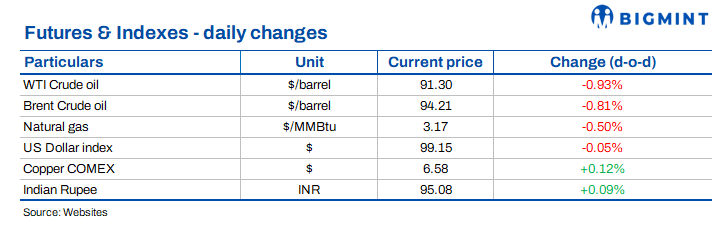
Global oil prices held firm on 2 June as uncertainty surrounding ongoing US-Iran negotiations continued to support market sentiment and keep traders cautious over potential supply disruptions linked to the Strait of Hormuz. Brent crude traded near $94/bbl, while WTI crude remained above $91/bbl after sharp gains in the previous session.
Market participants continued to monitor developments around a possible ceasefire framework and the reopening of key shipping routes in the Gulf region. However, conflicting signals regarding the progress of US-Iran talks and concerns over energy supply security kept volatility elevated across global oil markets.
Asia ramps up US crude imports
Asian imports of US crude oil surged to record levels in May as refiners sought alternative supplies following disruptions to Middle East oil flows through the Strait of Hormuz. However, the increase in US shipments remained insufficient to offset the sharp decline in Gulf crude availability, keeping regional supply conditions tight.
Despite rising inflows from the US, Asia's overall crude arrivals remained significantly below normal levels as Hormuz transit volumes continued to weaken. The ongoing supply disruption forced several Asian refiners to draw down inventories and adjust refinery operating rates, while concerns over prolonged shortages continued to support global oil prices and freight market volatility.
