Japan: Copper exports hold firm in 4MCY'26; India gains share
...
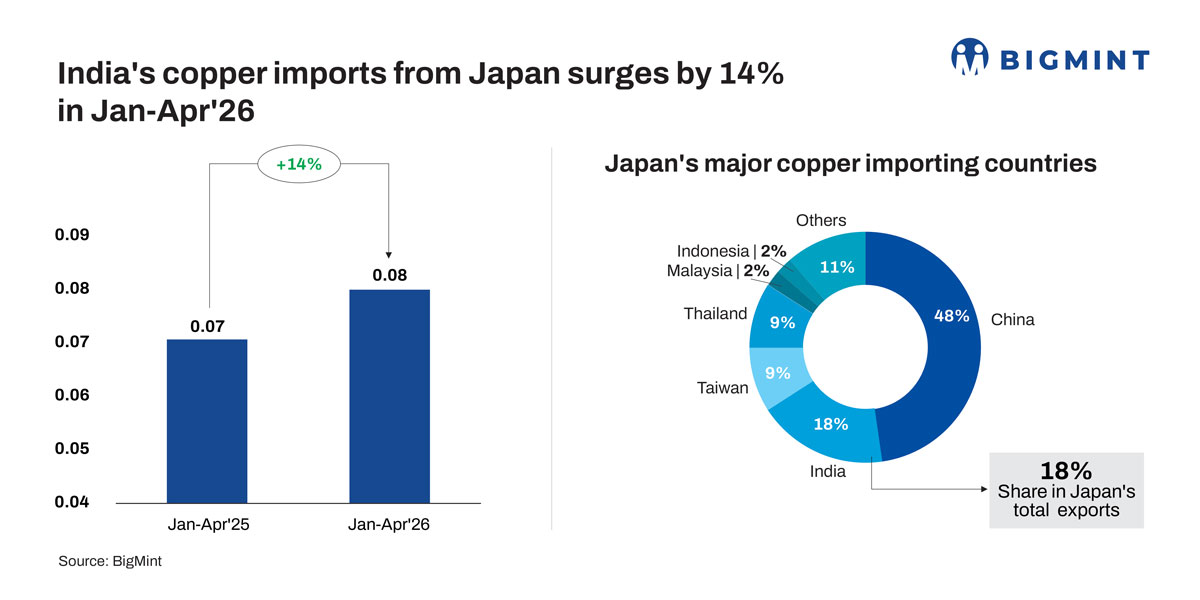

- India's share in Japan copper exports rises to nearly 18%
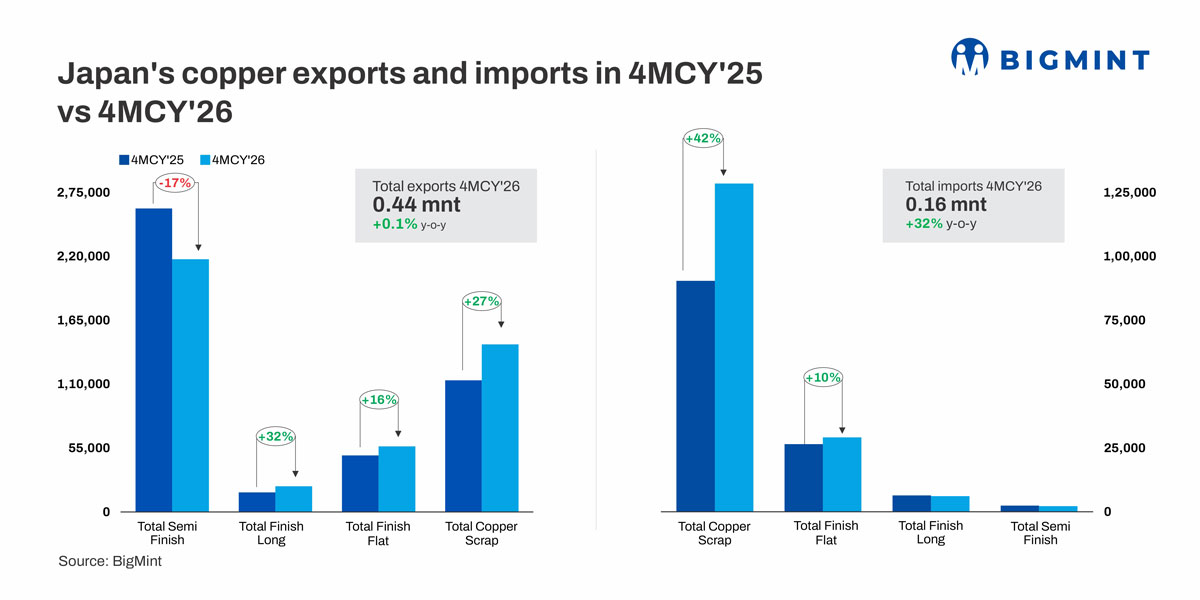
- Copper wire exports from Japan surge 63% during 4MCY26
Japan's copper exports remained broadly stable y-o-y during January-April 2026, but India continued strengthening its position as one of the key destinations for Japanese copper material amid rising domestic demand from infrastructure, renewable energy, cable, EV and precision engineering sectors.
According to BigMint data, copper shipments from Japan to India increased around 14% y-o-y during January-April 2026 to nearly 0.08 mnt compared with around 0.07 mnt in the corresponding period last year. Market participants noted that Indias increasing share in Japan's export basket reflects not only higher consumption growth, but also the country's increasing requirement for high-quality copper semis and refined copper products.
India continued strengthening its position in Japan's copper export portfolio during January-April 2026, accounting for nearly 18% of Japan's total copper exports compared with around 16.7% in the corresponding period last year. The increase highlights India's growing importance as a stable demand destination for Japanese copper material amid expanding domestic consumption.
Why is India importing more copper material from Japan?
India's rising imports from Japan are being increasingly driven by downstream manufacturing expansion and growing consumption from high-value sectors rather than only basic commodity demand.
Market participants indicated that Japanese-origin copper material is preferred by several Indian cable, transformer, switchgear and electronics manufacturers due to better conductivity consistency, lower impurity levels and stable long-term supply reliability.
India's power infrastructure expansion remains one of the biggest drivers supporting copper demand growth. Ongoing investments in renewable energy transmission, railway electrification, EV charging infrastructure and urban power distribution projects are increasing copper intensity across the country.
At the same time, India's domestic manufacturing sector is also witnessing rapid expansion in copper-consuming industries.
Companies such as KEI Industries, Polycab India and RR Kabel have continued expanding cable and conductor manufacturing capacities to cater to growing domestic and export demand. Several transformer and electrical equipment manufacturers are also increasing production capacities amid rising transmission and renewable energy investments.
Market participants noted that these sectors increasingly require higher-specification copper semis, including copper wire rods, foils and precision flat products, where Japanese suppliers continue maintaining strong market positioning.
Which Japanese copper products are seeing stronger demand?
The strongest growth in Japan's export basket during January-April 2026 came from copper wire, flat products and scrap exports.
Copper wire exports surged around 62.7% y-o-y to 14,115 t, supported by robust global demand from power infrastructure, electronics and data center-related applications.
At the same time, exports of copper pipes and tubes more than doubled by 105% y-o-y to around 2,800 t, while foil exports increased 18.3% to around 17,110 t. Rolled plate exports also rose around 11% y-o-y.
Copper foil demand, in particular, is gradually gaining importance due to India's increasing focus on lithium-ion battery manufacturing and electronics assembly investments under the government's PLI schemes. Several battery and EV component investments announced across Gujarat, Tamil Nadu, and Maharashtra are expected to increase future demand for high-quality copper foil and semis.
Is India's domestic copper capacity enough to meet growing downstream demand?
Despite ongoing domestic copper capacity additions, India continues to depend on imports for several high-grade semis and refined products. India's refined copper consumption is estimated to remain around 1.6-1.7 mnt over the medium term, supported by energy transition investments, infrastructure growth and increasing electrification.
Although major companies, including Hindalco, Vedanta, and Adani are expanding copper capacities domestically, market participants believe downstream demand growth is currently expanding faster than local value-added copper production capabilities. This is one of the reasons India continues increasing imports from countries such as Japan, particularly for specialised copper semis and premium-grade material.
How are global copper market changes supporting Japan-India trade flows?
The current global copper market structure is also indirectly supporting stronger Japan-India trade flows. Globally, copper concentrate availability remains tight due to mining disruptions and historically weak treatment and recycling charges (TC/RCs). This has increased focus on recycled copper and value-added downstream production globally.
Japan's copper scrap exports increased around 27.3% y-o-y during January-April 2026 to around 144,315 t, reflecting the growing importance of recycled copper feedstock across Asia.
At the same time, Japanese refined copper production is also increasing. Sumitomo Metal Mining expects refined copper production to rise around 8.2% y-o-y to nearly 446,000 t during H1FY'27 (April-September 2026) following normalisation at its Toyo smelter after maintenance disruptions last year. This improved domestic production has supported Japan's ability to maintain stable export flows despite weaker global manufacturing conditions.
Outlook
India is expected to remain an increasingly important market for Japanese copper exports over the coming years, supported by strong growth in infrastructure, renewable energy, EVs, transmission and electronics manufacturing sectors.
Market participants believe demand for high-quality copper wire rods, foils and flat products is likely to increase further as India gradually transitions toward higher-value manufacturing and electrification-led industrial growth.
At the same time, Japan's strong positioning in premium copper semis and stable trade relations under the India-Japan Comprehensive Economic Partnership Agreement (CEPA) framework are expected to continue supporting bilateral copper trade flows in the near to medium term.