Indonesia's aluminium ambition faces critical 43 mnt bauxite supply challenge
...

- Indonesia targets major aluminium expansion
- Country's aluminium capacity may reach 3.98 mnt by 2030
AL Circle: Indonesia is rapidly transforming itself into a major global aluminium hub. Supported by export restrictions, foreign 'investments, and large-scale industrial projects, the country is aggressively moving up the aluminium value chain -- from raw bauxite mining to alumina refining, smelting, and downstream manufacturing.
However, beneath this ambitious expansion lies a growing structural concern: Indonesia's bauxite mine production is not increasing at the same pace as its refining and smelting capacities. While downstream investments continue to accelerate, the country's long-term aluminium strategy may ultimately depend on whether sufficient raw material can be secured to support this growth.
Indonesia's aluminium vision
Indonesia's strategy is centred on reducing dependence on raw mineral exports and building a fully integrated domestic aluminium industry. The government's downstream policy, supported by the 2023 bauxite export ban, is aimed at increasing local processing, attracting foreign investment, generating higher export value, and creating employment opportunities.
The country already possesses significant natural resources, with bauxite reserves estimated at nearly 3 billion tonnes as of 2025. Yet despite this strong reserve base, actual mine production remains relatively modest compared to the scale of refinery projects under development.
Indonesia produced around 32 mnt of bauxite in 2022, but output declined sharply to 20 mnt in 2023, before falling further to nearly 17 mnt in 2024. Production recovered only marginally to around 18 mnt in 2025.
At the same time, demand from the domestic alumina sector is rising fast. According to Shanghai Metals Market, Indonesia's bauxite demand is expected to reach nearly 25 mnt in 2026, driven by rapid refinery expansion. This widening gap between mine supply and refinery demand is now emerging as one of the biggest risks to Indonesia's downstream aluminium ambitions.
Alumina refining capacity is expanding rapidly
Indonesia's alumina sector has witnessed substantial growth over the past two years. Alumina production increased from around 3.9 mnt in 2024 to nearly 5.9 mnt in 2025 following the commissioning of two major refineries -- PT Borneo Alumina Indonesia (BAI) and PT Borneo Alumindo Prima (BAP). Together, these projects added approximately 2.7 mnt of new alumina production capacity.
Further growth is expected in 2026, with Indonesia's alumina output projected to exceed 8 mnt as additional refineries begin operations.
PT BAI in Mempawah, West Kalimantan, backed by Inalum, currently produces around 1 mnt annually and plans to eventually double capacity to 2 mnt. Meanwhile, PT Borneo Alumindo Prima, part of China's Jinjiang Group, currently produces around 1.75 mnt annually, with long-term expansion plans targeting as much as 6 mnt per year.
Larger refinery pipeline emerging
Indonesia's refinery expansion is far from complete. A significant pipeline of new projects is already under development, largely supported by Chinese and Malaysian investors seeking long-term exposure to Indonesia's bauxite and alumina sector.
Among the major planned developments, PT Tianshan Alumina Indonesia is expected to add 2 mnt of refining capacity. Malaysia's Press Metal Aluminium Holdings Berhad is associated with PT Kalimantan Alumina Refinery, planned at 2 mnt, and PT Kalimantan Alumina Nusantara, expected to contribute another 1.0-1.2 mnt. PT Supreme Alumina Indonesia is projected to develop 2 mnt of capacity, while PT Progressive Indonesia Alumina, backed by China's Sichuan Tianfu Xinchuang Group, is expected to produce 1 mnt.
In addition, PT Green Indonesia Alumina has planned a combined capacity of 2.4 mnt through two production lines, while PT Westerfield Alumina Indonesia, linked to China's East Hope Group, has proposed capacity ranging between 1 mnt and 6 mnt. PT Borneo Alumina Indonesia is also preparing additional expansion of more than 1 mnt backed by Inalum and PT Antam.
Overall, Indonesia currently has nearly 13 mnt of planned alumina refining capacity in the pipeline, highlighting the scale of its downstream ambitions.
Emerging bauxite demand gap
Using the industry-standard bauxite-to-alumina conversion ratio of 2.5:1, Indonesia's projected alumina output of 88.7 mnt in 2026 would require approximately 20-21.75 mnt of bauxite.
At current levels, domestic supply may still be sufficient in the near term. However, the long-term outlook presents a much larger challenge.
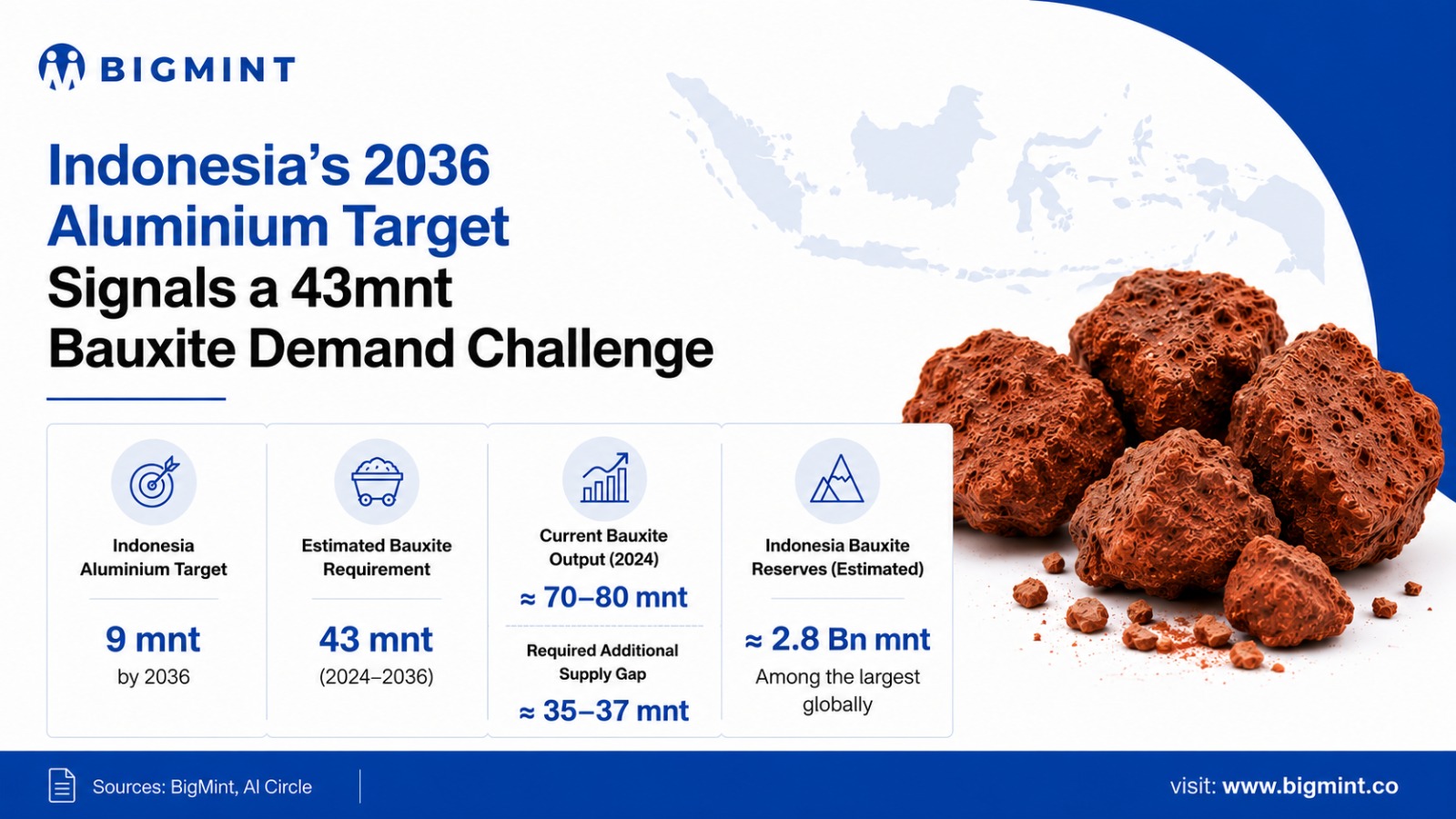
Indonesia's alumina production is projected to rise to nearly 17.2 mnt by 2036. At the same conversion ratio, the country would require roughly 43 mnt of bauxite annually.
This implies Indonesia would need to more than double its current bauxite mine production from the nearly 18 mnt recorded in 2025 in order to fully support future refining capacity.
Export ban, pricing reforms central to policy
Indonesia's bauxite export ban, implemented in June 2023, remains a cornerstone of the country's downstream mineral policy. The restriction applies to raw and washed bauxite, forcing miners to process ore domestically before export.
The policy has significantly accelerated investment into alumina refining projects, particularly from Chinese companies seeking secure raw material access.
Indonesia currently operates around 78 bauxite mines, with more than 80% concentrated in West Kalimantan. The government is also attempting to improve industry efficiency through revised bauxite pricing mechanisms.
Under the updated pricing framework, benchmark calculations have shifted from dry-tonne pricing to wet-tonne pricing while incorporating moisture and reactive silica adjustments. Although benchmark prices for some grades have declined under the revised system, official prices still remain above prevailing market transaction levels.
Currently, Indonesian bauxite ore is assessed at around $30-35/t, compared to benchmark values near $44/t for standard grades.
Aluminium smelting is becoming the next growth phase
Indonesia's industrial ambitions are no longer limited to alumina refining. Aluminium smelting is rapidly emerging as the next stage of expansion.
As of 2024, Indonesia operated only two aluminium smelters -- PT INALUM and PT Hua Chin -- with combined production capacity standing at approximately 780,000 t annually.
Capacity is expected to increase significantly from 2025 onward with the commissioning of PT Kalimantan Aluminium Industry and PT Bintan Electrolytic Aluminium. Together, these projects are projected to add nearly 750,000 t of additional smelting capacity, taking Indonesias total aluminium production capacity to approximately 1.53 mnt.
By 2030, national aluminium production capacity is projected to reach nearly 3.98 mnt annually. Beyond 2034, total aluminium smelting capacity could rise by more than 7.1 mnt.
Outlook
Indonesia has already secured strong momentum across refining, smelting, and downstream aluminium investments. The country possesses abundant bauxite reserves, strong policy support, and growing international investor participation.
However, the next stage of growth will increasingly depend on whether the mining sector can scale up quickly enough to supply the raw materials required by the rapidly expanding downstream industry.
If aluminium production capacity rises beyond 7 mnt annually, the country would require more than 14 mnt of alumina. At the standard conversion ratio, this alone would require roughly 35 mnt of bauxite.
Combined with projected alumina refining demand of 17.2 mnt by 2036, Indonesia's total bauxite requirement could approach 43 mnt annually.
The country has already laid the foundation for becoming a major integrated aluminium producer. Yet the sustainability of this transformation now depends on one critical question: can Indonesia expand its bauxite mining capacity fast enough to keep pace with its downstream ambitions?
