Indonesia: Market awaits the RKAB verdict, uncertainty hurts coal exports
...
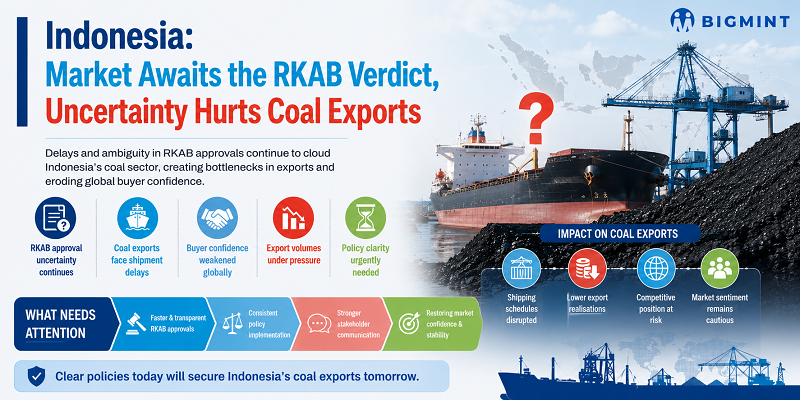

- Indonesia export uncertainty persists as RKAB approvals remain key for supply recovery
- Tighter seaborne supply from Indonesia, Australia, and Russia may support coal prices
The Indonesian thermal coal market is entering what may prove to be the most critical period of the year. While traders have largely welcomed recent clarification regarding the role of state-owned export entity PT Danantara Sumber Daya Indonesia (DSI), export volumes remain well below normal levels and uncertainty continues to grow around the approval of second-half production quotas (RKABs).
For a seaborne thermal coal market already grappling with tightening Australian supply, declining Russian production and strong Asian demand, Indonesia's next policy decisions could have a disproportionate impact on pricing during the second half of 2026.
Export flows remain below normal
Indonesia remains the world's largest thermal coal exporter and the single most important supplier of low- and medium-calorific-value coal to Asia. However, export activity has yet to fully recover from the disruptions seen earlier this year.
Recent vessel-tracking data indicates that Indonesian thermal coal exports are averaging around 970,000-990,000 tonnes per day, significantly below the approximately 1.31 million tonnes per day average recorded during 2025. Export volumes remain approximately 20-25% below 2025 operating levels.
The market has so far absorbed this slowdown because Chinese demand has been moderated by high inventories, while Indian utilities have largely remained absent from the import market. Nevertheless, the reduced export pace has materially tightened prompt cargo availability, particularly in the 3,800-4,200 GAR segment.
DSI fears begin to ease
Earlier this year, concerns over Indonesia's decision to centralise coal export oversight through DSI triggered widespread uncertainty across the market. Initial government proposals raised fears that DSI could become directly involved in coal marketing, sales negotiations and export logistics.
Many market participants warned that such a move could create bottlenecks across an industry that exports more than 350 million tonnes annually. More recently, however, DSI officials clarified that the organisation's primary role will be to monitor exports, improve transparency and ensure compliance with tax and royalty obligations, rather than replace traders and producers within the commercial chain.
The clarification has reduced concerns that DSI's involvement could disrupt export flows in the near term. Nevertheless, market participants remain cautious until the operational framework becomes clearer.
RKAB issue now dominates sentiment
While DSI has attracted most of the headlines, industry attention is increasingly shifting towards RKAB approvals. The RKAB (Work Plan and Budget) system determines how much coal individual miners are permitted to produce and sell. Historically, approvals have been relatively routine. However, recent regulatory changes and increased government scrutiny have made the process more complex.
Many producers are still awaiting clarity regarding second-half production allocations. Until approvals are finalised, miners remain reluctant to commit aggressively to forward sales programmes. As a result, trading activity for August-December loading cargoes remains unusually cautious. Several market participants report that offers for prompt and nearby cargoes remain limited, even as international benchmark prices have softened from recent highs.
Supply risks extend beyond Indonesia
The significance of the RKAB process is amplified by tightening supply conditions elsewhere. Australia's Newcastle market continues to face limited availability of 5,500 kcal/kg NAR coal for July and August loading. Russian coal production declined by approximately 5% y-o-y during January-May, reducing the market's flexibility to respond to unexpected demand growth.
Meanwhile, South Korea's thermal coal imports have increased sharply this year, while Malaysia recently recorded all-time high monthly import volumes. Although China remains well supplied, the broader Asian market is becoming increasingly dependent on stable Indonesian exports.
Why prices have not rallied harder
Under normal circumstances, Indonesian exports running 20-25% below historical averages would likely trigger a much stronger price response. Chinese power plant inventories remain near record seasonal highs, Indian utilities continue to rely primarily on domestic coal despite falling power sector stocks, while easing tensions in the Middle East have removed part of the geopolitical risk premium that had been built into energy markets during May and early June. These demand-side offsets have largely balanced Indonesia's supply-side constraints.
Outlook
For now, the market appears comfortable assuming that export flows will gradually normalise. However, if RKAB approvals are delayed, or if production allocations are lower than expected, Indonesia could enter the second half of the year with export availability well below market expectations.
Combined with ongoing supply constraints in Australia and Russia, such a scenario would materially tighten the seaborne thermal coal balance and support prices across the low- and medium-CV segments.
The market's focus has therefore shifted from DSI itself to a more fundamental question: how much coal Indonesia will actually permit its producers to export during the remainder of 2026.