Indonesia lifts thermal coal HBA benchmarks for 2nd half of Jun'26 amid supply constraints, policy uncertainty
...

- Uncertainty over export reforms, cautious selling continue to support prices
- Mid-, lower-grade indices hit record highs on demand from price-sensitive buyers
Indonesia's Harga Batubara Acuan (HBA) thermal coal benchmarks recorded broad-based gains across all calorific value (CV) categories during the second half of June 2026. The upward movement was supported by tightening spot availability, steady demand from Asian utilities, and growing uncertainty surrounding Indonesias evolving coal export framework.
The Indonesian government raised benchmark coal prices across all grades for the second half of June, following regulatory changes aimed at centralising strategic commodity exports. Although the new export mechanism is intended to improve pricing transparency, strengthen compliance, and optimise state revenue collection, market participants remain cautious as the transition phase has created uncertainty around future trade flows and supply availability.
High-CV coal gains on limited availability
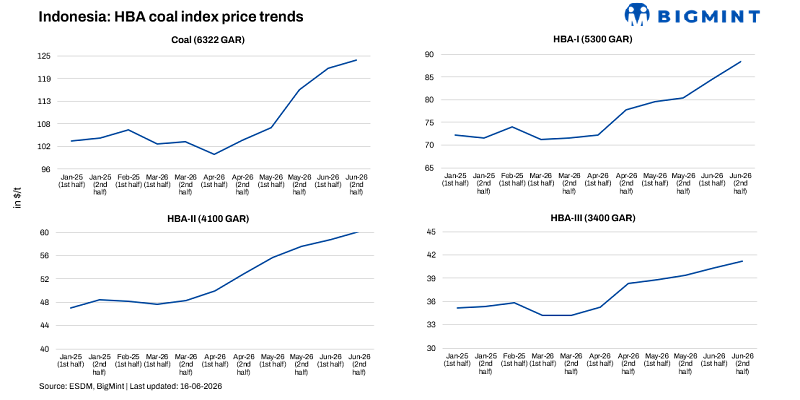
The benchmark HBA price for 6,322 kcal/kg GAR coal increased by nearly 2% to $123.91/t in the second half of June compared with the first half of the month, reaching its highest level in almost a year. The rise was primarily driven by restricted availability of high-quality coal, cautious producer selling, and higher replacement costs amid firm international coal indices and freight rates.
Mid-CV coal reaches record high on utility buying interest
The HBA-I benchmark (5,300 kcal/kg GAR) recorded the strongest increase among all grades, rising by around 5% to $88.40/t during the second half of June. The price reached its highest since the index's introduction, supported by stronger demand from cost-sensitive power utilities. Buyers continued shifting towards mid-CV coal as a more economical fuel option amid elevated prices for higher-grade material.
Lower-CV coal continues strong performance amid cost optimisation trend
Lower-calorific coal benchmarks maintained their upward momentum, with HBA-II (4,100 kcal/kg GAR) rising by around 2% to $60.19/t, while HBA-III (3,400 kcal/kg GAR) increased by nearly 2% to $41.19/t. Both indices reached record highs, reflecting strong demand from price-sensitive markets where utilities are focusing on fuel cost optimisation and blending strategies.
Export policy transition creates supply-side caution
Indonesia's revised coal export governance mechanism, implemented from 1 June 2026, has become a key factor influencing market sentiment. While the framework aims to improve export discipline, enhance transparency, and safeguard national revenue, the transition has resulted in operational uncertainty among miners, traders, and end-users.
Additionally, while the Energy Ministry has approved 664 mining companies work plans, expectations of production constraints and lower export availability throughout the year have contributed to a cautious supply outlook. Market participants are closely monitoring how the new export structure impacts mining operations, shipment schedules, and contract execution.
Key market drivers
- Tight spot availability: Limited prompt cargo availability from key Indonesian mining regions has supported prices, particularly for higher-quality coal grades.
- Strong Asian utility demand: Continued procurement from power utilities and industrial consumers across Asia has provided fundamental support to Indonesian coal prices.
- Higher replacement costs: Firm international coal benchmarks and elevated freight rates have increased the cost of alternative supplies, supporting Indonesian coal valuations.
- Preference for lower-CV coal: High-priced higher-grade coal has encouraged buyers to shift towards lower-CV Indonesian coal due to affordability and improved blending economics.
- Export policy uncertainty: The transition towards a centralised export mechanism has encouraged producers to adopt a cautious approach, limiting aggressive spot selling.
Outlook
Indonesia's thermal coal market is expected to remain supported in the near term as supply-side constraints, strong regional demand, and policy-driven uncertainty continue to influence pricing. High-CV coal is likely to remain firm due to limited availability, while mid- and lower-CV segments may continue receiving demand support from utilities seeking cost-efficient fuel alternatives.
However, market direction will largely depend on the pace of implementation of Indonesia's export reforms, production availability, and demand trends from major buyers such as China, India, and Southeast Asian markets. Any improvement in supply flows could moderate price gains, but continued export uncertainty may keep volatility elevated in the coming weeks.