Indonesia: DSI transition keeps thermal coal market cautious despite smooth initial rollout
...
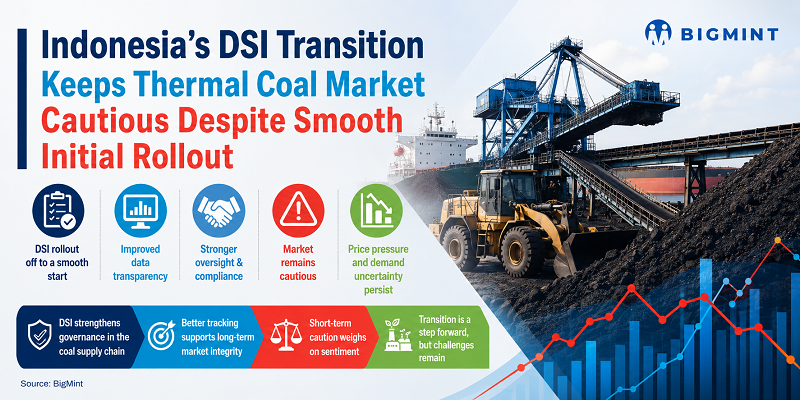

- Regulatory uncertainty begins influencing trade flows and contract negotiations
- DSI-related uncertainty is tightening coal supply and supporting prices
Indonesia's thermal coal market remains supported by tight spot availability and firm prices, but an undercurrent of regulatory uncertainty is increasingly shaping trading decisions.
The government's move to strengthen oversight of coal exports through state-owned PT Danantara Sumber Daya Indonesia (DSI) has so far proceeded without major disruption. However, traders, producers and buyers are closely monitoring the next phase of implementation amid questions surrounding future trading procedures, contract structures and export administration.
While the transition has not yet materially disrupted exports, market participants report that uncertainty surrounding the new framework is beginning to influence both spot market liquidity and longer-term contracting activity.
Initial implementation remains orderly
Indonesia began implementing the DSI framework from 1 June as part of a broader effort to improve oversight and monitoring of coal trade activities.
Under the current phase, producers are required to register contracts and transactions within the DSI system while existing trading arrangements continue to operate largely as before.
Market participants report that the transition has so far been relatively smooth, with no major interruptions to export flows.
However, producers and buyers alike remain focused on how the framework will evolve during the coming months.
Several traders note that the market expects a gradual expansion of DSI's role later this year, although implementation details remain under discussion.
Uncertainty affects longer-term contracting
The most significant impact is currently being felt in contract negotiations rather than physical exports.
Market participants report that some buyers have become increasingly cautious when discussing long-term coal supply agreements extending into 2027.
Questions remain regarding how future transactions will be administered, whether existing commercial arrangements will remain unchanged and how pricing mechanisms will be handled under any expanded DSI framework.
As a result, some market participants are delaying longer-term commitments until greater clarity emerges.
The uncertainty is particularly relevant for utilities, industrial consumers and trading companies that rely heavily on Indonesian coal as part of their long-term procurement strategies.
Spot market liquidity tightens
The regulatory transition is also contributing to tighter spot market conditions.
Several traders report that some Indonesian producers have reduced spot market offers while they assess how future trading procedures may evolve. Although production quotas remain unchanged, sellers have shown greater caution in marketing forward cargoes.
As a result, availability for several grades remains relatively tight despite mixed demand conditions across Asia.
FOB Kalimantan 4,200 GAR was assessed at $67.15/t on 9 June, while 5,000 GAR was assessed at $86.40/t. Prices continue to find support from limited availability and cautious seller behaviour.
Market participants stress that the current tightness does not reflect a formal supply restriction but rather a more conservative approach by producers during a period of regulatory transition.
Demand remains mixed across Asia
At the same time, regional demand conditions remain uneven.
Chinese buyers continue to participate in the market but remain sensitive to import economics. Market participants report that arbitrage opportunities remain limited, reducing aggressive buying activity despite expectations of summer restocking demand later this month.
India remains largely on the sidelines, particularly for lower-calorific coal grades. Strong domestic coal production, healthy inventories and growing renewable generation continue to reduce the urgency of spot imports.
Vietnam and several Southeast Asian buyers continue to provide support for selected Indonesian grades, particularly where availability remains limited.
Indonesia remains central to global coal trade
The importance of the DSI transition extends beyond Indonesia itself.
Indonesia remains the world's largest seaborne thermal coal exporter and a critical supplier to major importers including China, India, Vietnam, the Philippines and other Southeast Asian markets.
Any changes affecting contract administration, export procedures or market liquidity therefore have implications for coal buyers across the region.
While the market has largely absorbed the initial implementation phase, participants remain focused on future announcements that could provide greater clarity regarding trading procedures and long-term contract administration.
Outlook
Indonesia's coal market remains fundamentally supported by tight spot availability and stable export demand, but regulatory developments are becoming an increasingly important market driver.
The transition to the DSI framework has so far proceeded without significant disruption, yet uncertainty surrounding future implementation is influencing contracting behaviour and contributing to cautious seller activity.
For buyers, the key issue is not current supply availability but visibility over future trading arrangements.
Over the coming months, market participants will closely monitor official guidance regarding DSI operations, future contract administration procedures and any policy reviews that could influence export market dynamics.
Until greater clarity emerges, regulatory uncertainty is likely to remain a supporting factor for Indonesian thermal coal prices and spot market sentiment.