Indian HRC export activity remains subdued w-o-w amid persistent buyer caution
...
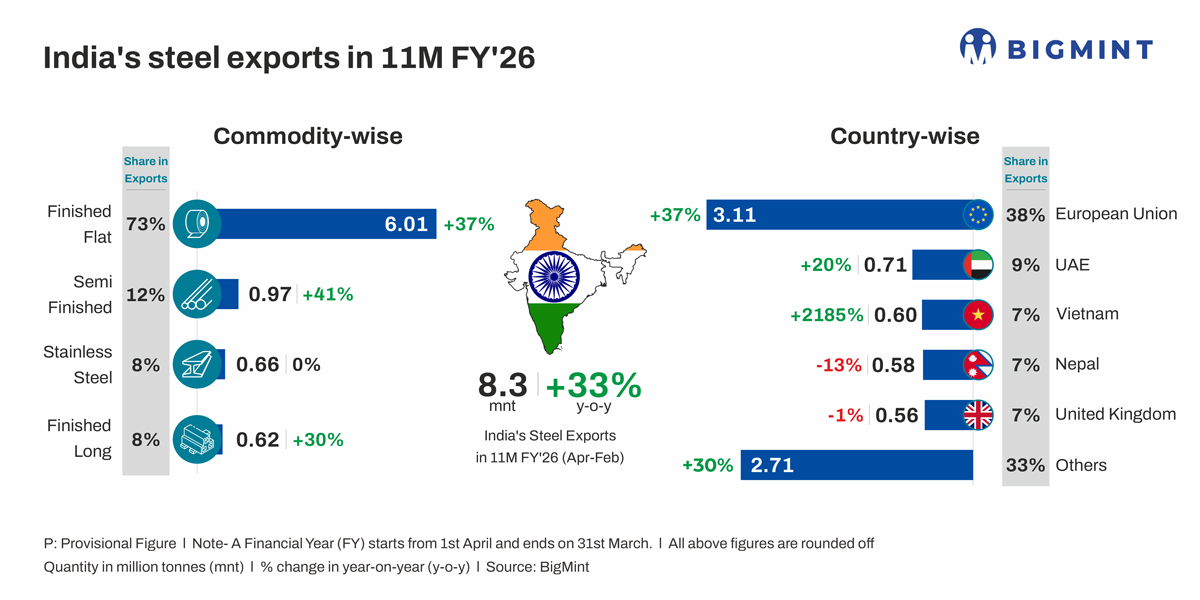

- Country-wise quota uncertainty keeps EU import demand muted
- Eid holidays, logistical disruptions weigh on Middle East trade flows
Indian HRC export activity remained subdued during the week ended 02 June 2026, as regulatory uncertainty in Europe and persistent logistical disruptions in the Middle East continued to dampen buying interest. Offers remained unchanged w-o-w; however, European buyers remained cautious ahead of revised safeguard measures, while Eid holiday-related slowdowns and shipping-related challenges constrained demand in the Middle East. As a result, no fresh bookings were reported during the assessment period.
Indian HRC export offers to the EU: Indian HRC export index to the EU remained stable w-o-w at around $625/t FOB. However, no fresh bookings were reported during the assessment period, as buyers remained cautious ahead of the implementation of the EU's revised safeguard regime from 1 July 2026.
Overall import activity across the region remained subdued amid uncertainty surrounding the allocation of country-specific quotas under the new framework. Elevated distributor inventories and weak downstream demand from key end-use sectors, particularly automotive and manufacturing, further weighed on purchasing activity.
The new trade defence measures, approved by the European Parliament on 19 May and currently awaiting final approval from the European Council, are aimed at protecting the EU steel industry from global overcapacity and unfair trade practices. The reforms are expected to reduce overall steel import quotas by around 47% to around 18.3 million tonnes (mnt) compared with 2024 levels, while simultaneously increasing out-of-quota duties from 25% to 50%
A regional exporter said, "Buyers have shown limited interest in booking imports due to concerns surrounding both the new quota system and the additional costs associated with the EU's Carbon Border Adjustment Mechanism (CBAM). Concerns regarding country-specific quota allocations and the risk of incurring higher out-of-quota duties have led many buyers to postpone bookings until greater clarity emerges, resulting in muted import activity."
HRC export offers to the Middle East: Indian HRC export index to the Middle East and Southeast Asia remained stable w-o-w at around $555/t FOB, with freight to Fujairah estimated at approximately $45-50/t. Similarly, Chinese HRC export offers to the region remained stable w-o-w at around $590/t CFR Jeddah.
A Middle East-based source said, "Shipping remains a major challenge across the region, as constrained access to regular ports, particularly the Strait of Hormuz, continues to disrupt cargo movements. Both inbound and outbound seaborne shipments have been severely affected by ongoing logistical constraints, while sharply elevated freight costs are adding additional pressure on market activity."
Another regional source noted, "Domestic market conditions remained subdued during the week amid the Eid al-Adha holiday period, weighing on trading activity. However, market sentiment remains cautiously optimistic, with demand expected to improve over the next one to two weeks as market participants return and business activity gradually normalises."
The source further added that, "inventory levels remain adequate for the time being, supported by sufficient domestic production in the UAE. However, ongoing shipping disruptions continue to limit the availability of imported material, preventing the market from receiving its full supply requirements. While current stock levels are helping to offset these constraints, prolonged logistical challenges could gradually tighten supply availability if logistics conditions do not improve soon. The arrival of imported HRC cargoes scheduled for July delivery is expected to replenish inventories and support a gradual normalisation of material flows across the market, although a sustained recovery in shipping operations will be crucial to restore normal supply flows across the region."
Outlook
Indian HRC export activity is expected to remain under pressure in the coming week, with buying interest from the EU likely to stay subdued until greater clarity emerges regarding the country-specific quota allocations. In the Middle East, demand may improve as post-holiday activity gradually resumes; however, ongoing logistical disruptions and elevated freight costs could continue to limit a sharp rebound in market activity. Overall, export activity may gradually recover if regulatory uncertainty eases and regional supply conditions normalise.
