India: SAIL's iron ore auction sales decline m-o-m in May'26, buyers shift focus towards fresh fines
...
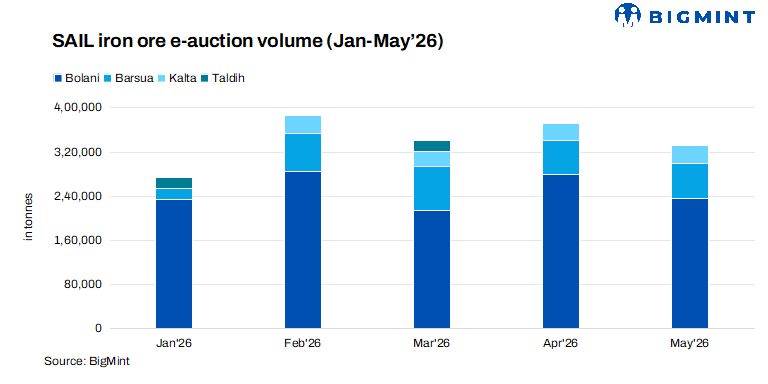

- Lower dump files, CLO sales from Bolani lead to decline
- Demand slows on weak sponge iron margins, falling steel prices
Steel Authority of India Ltd. (SAIL) sold 331,380 t of iron ore through e-auctions in May 2026 out of 587,340 t offered, down by around 11% from 371,710 t sold in April out of 547,690 t offered, according to data maintained by BigMint. The decline was primarily driven by lower sales volumes from Bolani mines, particularly in the dump fines and calibrated lump ore (CLO) segments.
The overall reduction in sales reflects cautious procurement activity across the steel value chain. Weak margins in the sponge iron sector, subdued steel prices, and uncertainty regarding near-term demand prompted buyers to limit purchases and focus on immediate requirements rather than aggressive inventory building.
Bolani mine sales decline amid lower demand for dump fines, CLO
Bolani remained the largest contributor to SAIL's auction sales, accounting for nearly 71% of total volumes sold in May. Sales from the mine stood at 236,000 t against 416,000 t offered, compared with 280,000 t sold out of 436,000 t offered in April.
The decline of 44,000 t was mainly attributable to lower sales of dump fines and CLO. Although fresh fines recorded strong growth during the month, the increase was insufficient to offset the reduction in the other two categories. Consequently, Bolani's sales mix became increasingly skewed toward fresh fines, highlighting a notable shift in buyer preference.
Dump fines sales from Bolani witness sharp correction
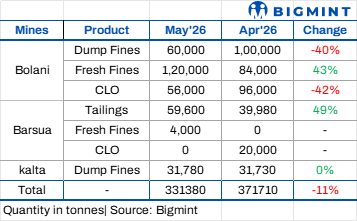
Bolani sold 60,000 t of dump fines in May, significantly lower than the 100,000 t sold in April. The 40% decline highlights weakening demand for lower-grade iron ore material.
The reduction can be attributed to buyers shifting their focus toward higher-quality feedstock to improve productivity and lower processing costs. In addition, uncertain market conditions and fluctuating iron ore prices discouraged large-scale purchases of dump fines, resulting in more conservative procurement behaviour.
Fresh fines sales from Bolani surge on stronger buyer preference
In contrast to dump fines, fresh fines sales from Bolani increased sharply to 120,000 t in May from 84,000 t in April, registering a rise of nearly 43%.
The strong growth indicates healthy demand from steelmakers, pellet producers, and beneficiation units. Higher-grade fresh fines offer better yields and operational efficiency, making them more attractive during periods of margin pressure. The increase also suggests that consumers were willing to prioritise quality material despite broader weakness in the iron ore market.
Barsua's sales increase marginally despite changing product composition
Barsua sold 63,600 t in May against 139,560 t offered, compared with 59,980 t sold out of 79,960 t offered in April.
While sales increased marginally by around 6% m-o-m, offer volumes rose substantially, resulting in a lower conversion ratio. Nevertheless, the mine managed to register higher sales primarily due to strong demand for iron ore tailings, which more than compensated for the absence of CLO sales.
Outlook
SAIL's auction performance in June is expected to remain influenced by monsoon-related disruptions, steel market sentiment, and procurement trends among end-users.
Demand for fresh fines is likely to remain relatively strong as pellet manufacturers and integrated steel producers continue to prioritise higher-grade feedstock. However, dump fines and CLO may continue to witness subdued participation unless sponge iron margins improve significantly.
Overall auction volumes are expected to remain stable to slightly lower in the near term, with buyers likely to continue adopting a need-based procurement approach. Nevertheless, any recovery in steel prices, improvement in DRI profitability, or post-monsoon restocking activity could support stronger auction participation in the coming months.