India's INR 9 trillion power push: A story of steel, electricity and storage
...

- Infrastructure is lagging demand growth
- Transmission expansion alone is insufficient to ensure grid stability
India is planning a massive INR 9 trillion investment in power transmission infrastructure. On paper, this is about building towers, wires, and substations. In reality, it is about preparing for a future where electricity demand rises sharply, where the evening peak becomes the most expensive time to buy power, and where renewable energy cannot do the job alone.
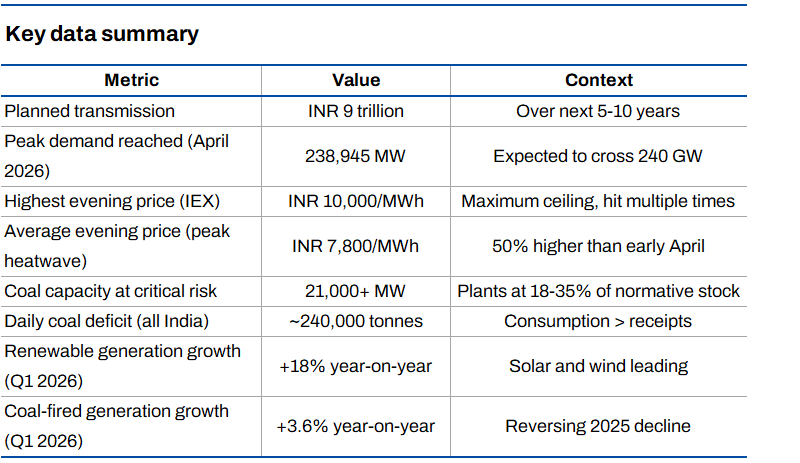
The transmission expansion is not happening in a vacuum. Over the past two weeks, we have watched Indias power market struggle through a brutal heatwave. Peak demand touched 239 GW. Evening prices hit the INR 10,000 per MWh ceiling.
Coal plants ran critically low on stocks. And every evening, as the sun set and solar generation faded, the grid held its breath.
This is the reality that the INR 9 trillion investment must address. And its impact will be felt far beyond the power sector.
The grid is being built for tomorrow, not today
India's electricity demand is growing rapidly. Air conditioners are spreading to millions of new homes. Electric vehicles are entering the market. Data centres are multiplying. Manufacturing is expanding. And every summer, heatwaves push demand to new records.
At the same time, renewable energy capacity - especially solar - is growing fast. Solar power is abundant during the day. But when the sun sets, it disappears almost entirely.
The transmission grid is the bridge between these two forces. It moves power from where it is generated to where it is needed. Without enough transmission capacity, solar-rich states cannot send power to cities that need it most during evening peaks. The INR 9 trillion pipeline is not an upgrade - it is a necessity.
But here is the challenge: the grid is being built for demand levels that will exist five or ten years from now. Yet the stress is already here. The heatwave of April 2026 showed that the current system is already struggling.
Steel demand: The first big winner
The most immediate impact of this investment will be on steel. Transmission projects are highly steel-intensive. Every tower, every substation structure, every supporting framework requires large quantities of fabricated steel.
Demand for structural steel, galvanised steel, and heavy fabricated components is expected to rise steadily over several years. Unlike cyclical demand from real estate or exports, this is infrastructure-led demand. It is stable, predictable, and long-term.
For steel producers, this creates a strong base load of demand. But the real story lies deeper.
Electricity demand: A much bigger story
While steel demand is the immediate effect, the deeper structural shift lies in electricity consumption. India's grid is being expanded because electricity demand is expected to rise sharply - and not evenly.
The IEX data from April 2026 tells this story in real time. In early April, before the worst of the heatwave, afternoon prices collapsed to near zero. Solar power flooded the grid, and sellers were practically giving power away. But by mid-April, the pattern had reversed. Evening prices jumped 50-60%. On several evenings, prices hit the INR 10,000 ceiling.
The gap between day and evening prices is not small. It is enormous. And it is growing.
More transmission capacity will help by allowing power to flow more freely across regions. A solar plant in Rajasthan can send power to Maharashtra in the afternoon. A coal plant in Chhattisgarh can supply Tamil Nadu in the evening. But transmission alone cannot solve the fundamental problem: the sun sets at the same time everywhere.
The evening peak problem - And why storage matters
This is where energy storage becomes critical. Right now, India has very little large-scale battery storage. When solar fades, the grid must rely entirely on coal, gas, and hydro. But coal plants are running at high PLF and many are running out of fuel. Gas is expensive. Hydro is limited.
The result is the IEX data we have seen: purchase bids exceeding sell bids by 2:1 or 3:1 during evening hours, and prices hitting the ceiling.
Energy storage changes this equation. Batteries can charge during the day when solar power is cheap and abundant, then discharge during the evening peak when prices are high and supply is tight. This does not just save money it prevents blackouts.
The strategic importance of storage is now clear. It is no longer just a technology choice. It is a matter of energy security.
What the heatwave taught us
The April 2026 heatwave was a stress test for India's power system. The results were mixed.
On the positive side, solar generation performed well, keeping afternoon prices low. Generation from renewables rose 18% year-on-year. The grid did not collapse.
But the stress points were clear. Over 21,000 MW of coal capacity is at critical risk, with plants running at 18-35% of normative coal stocks. Nationwide, coal consumption exceeded receipts by nearly 240,000 tonnes per day. Evening prices spiked to the maximum allowed.
These are not problems that transmission alone can fix. Transmission moves power from one place to another. It does not create new power or shift it from day to night. That is the job of storage.
A three-part structural shift
India's power sector is undergoing a coordinated transformation across three fronts:
First, transmission expansion to move electricity efficiently across regions. The INR 9 trillion investment is the backbone of this effort.
Second, rising electricity demand driven by economic growth, electrification, and climate change. This is not a forecast - it is already happening. Peak demand reached 239 GW in April 2026 and is expected to cross 240 GW soon.
Third, energy storage development to balance renewable supply and meet evening peaks. Without storage, the grid will continue to see extreme price volatility and supply stress.
Each of these reinforces the other. Transmission enables higher offtake. Rising demand justifies new investment. Storage ensures reliability in a renewable-heavy system.
What this means for power markets
The combined effect of transmission expansion and storage development will fundamentally change how electricity flows through the system.
In the near term, grid offtake is expected to rise steadily as industrial consumption increases, urban demand grows, and electrification deepens. Power markets are likely to become more dynamic. As transmission improves, regional imbalances will reduce, price signals will travel more efficiently, and spot market participation will increase.
But volatility may also rise. As we saw in April, evening demand spikes can push prices sharply higher when supply is tight. Storage is expected to play a key role in smoothing these fluctuations.
A long-term growth cycle
The INR 9 trillion transmission pipeline is not a short-term stimulus. It is the foundation for the next phase of Indias economic growth.
For steel, it means sustained infrastructure demand over multiple years. For the power sector, it means higher electricity consumption and deeper grid integration. For the broader economy, it signals a shift toward electrification, industrial expansion, and energy security.
The direction is clear. As India builds out its power network, it is not just adding capacity - it is reshaping how energy is produced, stored, and consumed. And in that process, both steel demand and electricity offtake are set to rise significantly, supported by a new and critical pillar: energy storage.
But the heatwave of April 2026 has shown that the future is arriving faster than expected. The evening peak is already here. The price spikes are already happening. The coal stocks are already critical. The question is not whether India needs to build transmission and storage - it is whether it can build them fast enough.