South Korea rice tender highlights India's export strategy gap
...
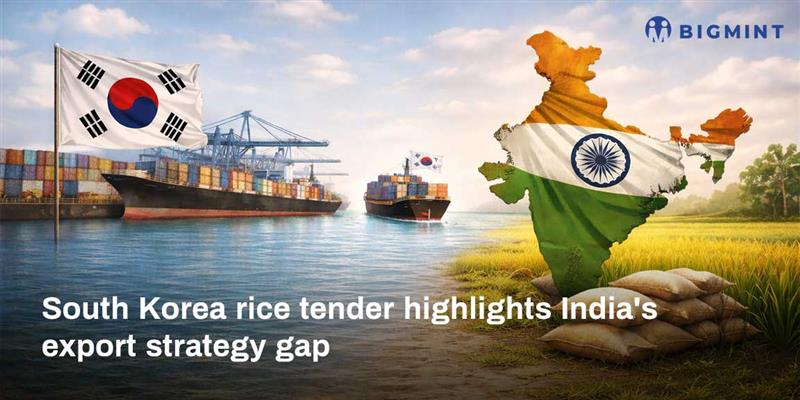

- Premium tenders expose gaps in India's value-added rice positioning
- Quality compliance and market access remain key barriers to diversification
As of April 2026, South Korea's latest rice tender for around 65,000 tonnes (t) of non-glutinous brown and medium/long grain rice underscores a shifting demand pattern toward high-quality, traceable supply chains. Issued by the state-backed Agro-Fisheries and Food Trade Corporation, the tender mandates strict quality inspection and phased shipments between June and December, reinforcing the premium nature of the market.
For India, the world's largest rice exporter, the tender represents more than a spot opportunity it reflects the evolving requirements of high-value importers. While Indian exporters dominate bulk non-basmati and parboiled segments, participation in such tenders requires consistent milling standards, certification protocols, and supply chain reliability.
Structural gap in India's export approach
Despite its scale advantage across basmati, IR varieties, and parboiled rice, India remains underrepresented in premium OECD markets like South Korea. High tariff barriers and quota-based procurement systems have historically limited access, with imports concentrated among select origins such as the US, Thailand, and Vietnam.
In CY25, the US retained its position as the leading exporter to South Korea with shipments of 158,644 t. Vietnam followed with 74,561 t, while Thailand exported 37,713 t. In contrast, India's exports stood at a marginal 834 tonnes during the same period, according to data maintained by BigMint.
More critically, India's export mix continues to lean toward volume-driven shipments rather than value-added segments such as brown rice, specialty grades, or branded retail packs. The South Korea tender highlights this gap, where compliance with stringent phytosanitary norms, uniform grain quality, and packaging standards determines competitiveness as much as price.
Competition intensifies amid shifting trade flows
Global suppliers including Thailand, Vietnam, and Pakistan are actively targeting such tenders, leveraging established trade relationships and consistent quality benchmarks.
As premium buyers diversify sourcing, India faces a strategic inflection point. Moving up the value chain through improved processing, certification, and branding will be essential to capture higher-margin markets and reduce dependence on price-sensitive destinations in Africa and Asia.
