India: Power generation hits record high in Q2CY'26, renewables drive supply growth
...

- Peak electricity demand reaches record peak of 270.8 GW
- Generation remains elevated in June despite monsoon onset
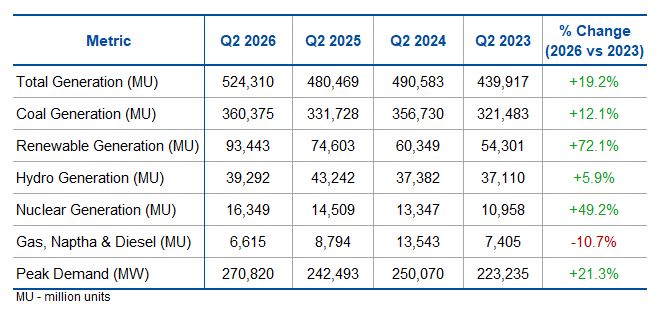
India's power sector delivered one of its strongest quarterly performances during April-June 2026 (Q2CY'26), underpinned by robust electricity demand, record generation, and a rapidly evolving generation mix. Total electricity generation reached an all-time quarterly high of 524,310 million units (MU), up 9.1% y-o-y and nearly 19.2% higher than Q2CY'23, reflecting sustained economic growth, rising industrial activity, and strong cooling demand during the summer months.
The increase in electricity demand was met by higher output across both thermal and renewable generation. While coal continued to anchor the country's power system, renewable energy emerged as the principal source of incremental generation growth, highlighting India's accelerating transition towards a more diversified electricity mix without compromising supply reliability.
The Q2 performance demonstrates that India's power sector is successfully balancing two parallel objectives: maintaining dependable baseload generation through coal while rapidly integrating renewable capacity to meet the country's expanding electricity requirements.
Electricity demand continues to scale new heights
India's electricity demand continued to strengthen during Q2CY'26, reflecting sustained momentum across the economy despite the gradual onset of the southwest monsoon during June.
Total electricity generation reached 524,310 MU, representing the highest quarterly generation ever recorded during the April-June period. Compared with Q2CY'25, generation increased by 43,841 MU, while the increase over Q2CY'23 exceeded 84,000 MU.
The data suggest that electricity consumption is no longer being driven solely by industrial production. Higher residential cooling demand, commercial activity, rapid urbanisation, digital infrastructure, expanding manufacturing and increasing electrification across multiple sectors are collectively contributing to a broader and more resilient demand base.
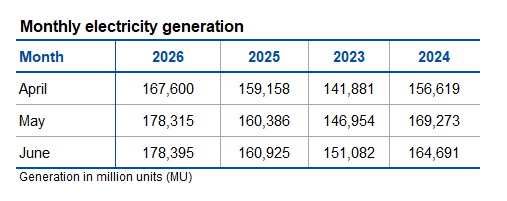
Demand remained consistently elevated throughout the quarter.
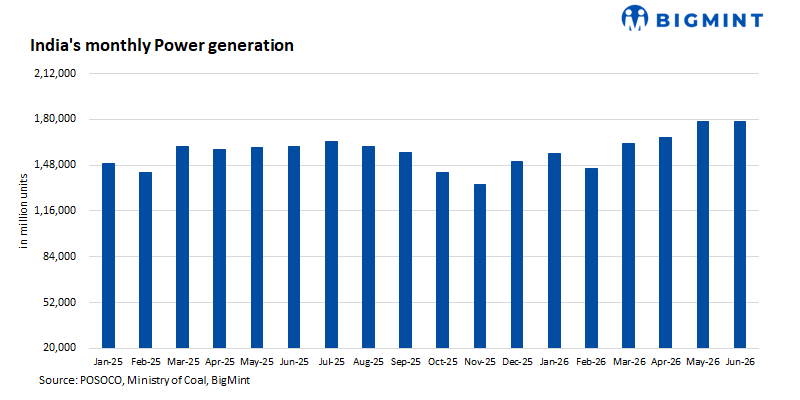
Generation increased steadily from April before reaching record monthly levels in May and June. Notably, generation remained exceptionally strong during June despite advancing monsoon conditions across many parts of the country, indicating that structural demand growth is increasingly outweighing seasonal moderation.
Peak electricity demand also reached a new milestone during Q2CY'26, touching approximately 270.8 GW, well above the highs recorded during previous years. The increase in peak demand has outpaced growth in overall electricity generation, highlighting the increasing operational challenge of meeting short-duration periods of exceptionally high system load.
This widening gap between average demand growth and peak demand growth has important implications for system planning. Future investment requirements will increasingly be determined not only by annual energy consumption but also by the ability of the grid to reliably meet rapidly rising peak loads.
Generation response demonstrates growing system resilience
The power sector responded effectively to rising demand throughout Q2CY'26, with generation increasing across almost every major source of supply.
Unlike previous years when demand growth occasionally translated into concerns over supply adequacy, the Q2CY'26 data indicate that India's generation fleet was able to respond quickly to changing load requirements.
The increase in quarterly generation of almost 44,000 MU over Q2CY'25 reflects improvements across generation planning, fuel availability, transmission readiness, and operational coordination between generators and system operators.
Importantly, the increase in generation was broad-based rather than being concentrated in a single technology.
Coal-fired stations continued operating at high utilisation levels to provide dependable baseload supply, while renewable energy made a substantially larger contribution during periods of favourable resource availability. Nuclear generation continued to increase steadily, hydro generation remained supportive, and gas-fired plants continued to play a relatively limited balancing role.
The ability of the generation fleet to accommodate record demand without widespread supply disruptions demonstrates the increasing resilience of India's electricity system.
Several structural factors have contributed to this improved performance:
- Continued expansion of installed renewable capacity.
- Improved domestic coal availability and logistics.
- Better coordination between central and state load dispatch centres.
- Enhanced transmission connectivity between regions.
- Greater operational flexibility across generating stations.
Collectively, these developments have strengthened the sector's ability to respond to periods of elevated demand while maintaining system reliability.
Generation mix continues to undergo structural transformation
Although coal remains the dominant pillar of India's electricity system, the overall composition of power generation continues to evolve rapidly..
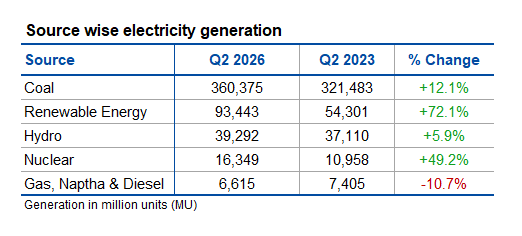
Coal generation increased by nearly 39,000 MU over the four-year period, reaffirming its indispensable role in supporting India's rapidly growing electricity demand.
Despite rapid renewable deployment, coal continued to account for approximately 69% of total electricity generation during Q2CY'26. This underlines an important reality of India's energy transition: renewable capacity is expanding rapidly, but thermal generation continues to provide the firm, dispatchable electricity required to ensure grid stability and reliability.
The most significant structural change has been the extraordinary growth in renewable energy.
Generation from wind, solar, biomass, and other renewable sources increased from 54,301 MU during Q2CY'23 to 93,443 MU during Q2CY'26 -- an increase of more than 72%. No other source recorded comparable growth.
Renewables therefore accounted for the largest share of incremental electricity generation over the period, demonstrating their increasingly important contribution to meeting India's expanding electricity demand.
Hydroelectric generation remained broadly stable over the four-year period. While hydro output continues to fluctuate according to rainfall patterns and reservoir levels, it remains a valuable source of operational flexibility during periods of high demand.
Nuclear generation continued its steady expansion, increasing by nearly 50%, reflecting improving utilisation of existing reactors and the gradual addition of new capacity.
By contrast, generation from gas, naptha and diesel continued to decline. The reduction reflects the relatively high cost of gas-based generation compared with coal and renewables, limiting its utilisation primarily to balancing requirements and specific regional supply needs.
Outlook
India's Q2CY'26 performance reinforces the view that the country's electricity sector is entering a new phase of structural expansion.
Demand growth is expected to remain robust as industrialisation, urbanisation, digital infrastructure, electric mobility, and rising household incomes continue to increase electricity consumption. Meeting this demand will require continued investment across the entire power value chain -- from generation and fuel supply to transmission and grid management.
Coal is expected to remain the backbone of India's electricity system for the foreseeable future, providing the dependable capacity needed to support rising demand. At the same time, renewable energy will continue to account for an increasing share of incremental generation, supported by ongoing capacity additions and improving grid integration.
Rather than representing a transition away from thermal generation, the Q2CY'26 data suggest that India is moving towards a more balanced electricity system -- one in which coal provides reliability, renewables drive incremental growth, hydro and nuclear strengthen system diversity, and each technology plays a complementary role in supporting one of the world's fastest-growing electricity markets.