India: Power demand hits record highs in Jun'26, but coal stocks tighten as critical plants increase
...
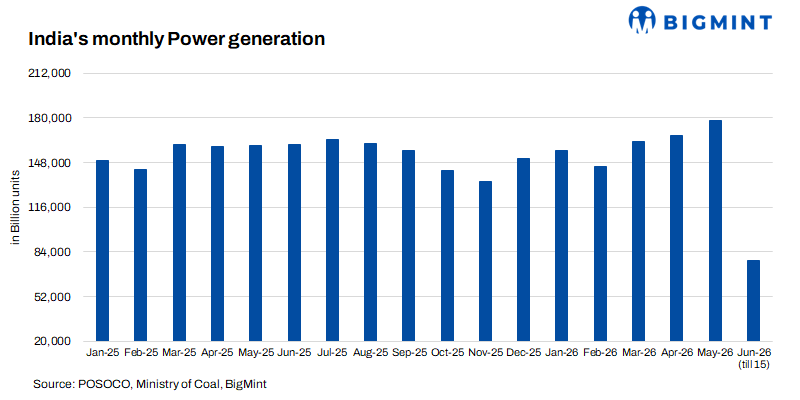

- Stock deterioration takes place almost entirely in domestic coal-based plants
- Power prices remain stable due to strong renewable support, higher sell bids
India's electricity demand has continued to surge despite the onset of the southwest monsoon, pushing peak demand to new records during the first half of June. Yet, unlike previous years, power exchange prices have remained relatively contained, supported by rising renewable generation and robust sell-side liquidity.
Beneath this seemingly stable market, however, coal inventories at thermal power stations are deteriorating. National coal stocks have declined steadily since the end of May, while the number of power plants operating under critical stock conditions has increased sharply, highlighting growing stress in coal supply logistics despite comfortable production levels at the national level.
Record demand extends beyond the May heatwave
The demand momentum witnessed during May has continued into June. India's maximum demand met touched a record 259.4 GW on 9 June 2026, significantly higher than the June 2025 peak of around 242.5 GW.
India's power demand witnessed a significant increase during the first half of June 2026 compared with the corresponding period in 2025. The average peak demand during1-14 June 2026 stood at around 245,000 MW, compared with approximately 228,000 MW during the same period last year, reflecting a growth of nearly 7-8% y-o-y.
The data indicates that monsoon rainfall has yet to deliver meaningful relief to electricity consumption patterns, with cooling demand and economic activity continuing to support elevated power usage across the country.
Renewables shoulder larger share of growth
Total electricity generation during the first 14 days of June rose to approximately 81.5 BU, up nearly 5% from the corresponding period of 2025.
Coal-fired generation remained the backbone of the power system, contributing nearly 54.9 BU, but growth from coal was relatively modest at around 2.5% year-on-year.
Renewables emerged as the strongest growth segment. Wind, solar, and other renewable sources generated approximately 15.8 BU, up nearly 15% y-o-y, helping meet incremental demand and reducing pressure on thermal generation.
Hydropower generation declined sharply, reflecting weaker reservoir conditions and delayed monsoon benefits in several regions.
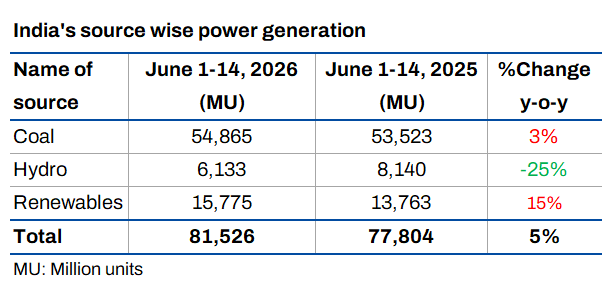
The figures reinforce a structural trend that is becoming increasingly visible in India's power sector: coal remains indispensable for reliability, but renewable energy is now providing a growing share of incremental generation growth.
IEX prices remain surprisingly stable
Perhaps the most striking feature of the first half of June has been the disconnect between record demand and relatively subdued power prices.
The Day-Ahead Market (DAM) on the Indian Energy Exchange (IEX) averaged INR 3,706/MWh during 1-14 June 2026, down 16% from INR 4,412/MWh during the corresponding period last year.
The highest daily average market clearing price reached INR 5,739/MWh on 3 June, significantly below the INR 6,600/MWh peak recorded in June 2025.
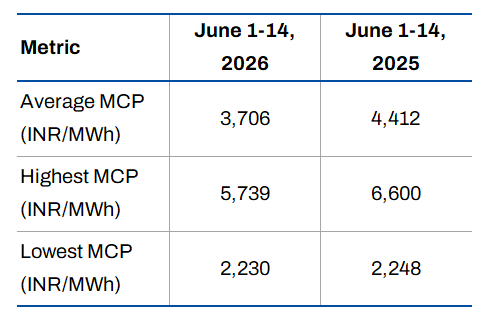
The explanation lies in a substantial increase in market liquidity.
Average daily sell bids during the first half of June exceeded 410 GWh, compared with roughly 286 GWh during the same period in 2025, an increase of more than 40%. Combined with stronger renewable generation, this additional liquidity has prevented the sharp price spikes typically associated with periods of record demand.
Coal stocks deteriorate despite comfortable national production
The coal stock picture tells a very different story. CEA data shows that total coal inventories at thermal power stations declined from 49.16 million tonnes (mnt) on 31 May to 47.6 mnt on 14 June. At the same time, stock coverage relative to normative requirements fell from 65% to 62%.
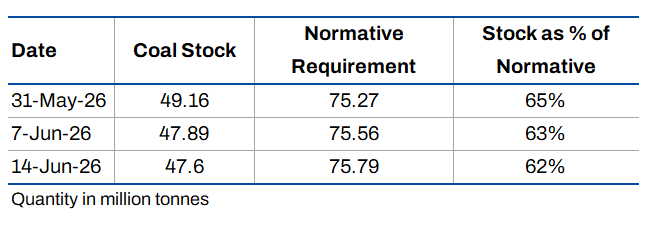
The decline coincides with elevated thermal generation requirements and record electricity demand. More importantly, the number of plants operating under critical stock conditions has increased significantly.
The number of power plants operating under critical stock conditions has increased significantly, indicating tighter fuel availability. Critical plants rose from 22 as of 31 May 2026 to 27 by 7 June 2026, and remained elevated at 27 plants as of 14 June 2026, reflecting continued pressure on coal stock levels amid strong power demand.
This suggests that coal consumption has outpaced replenishment at a growing number of stations during the first half of June.
Domestic coal-based stations under greatest pressure
The deterioration has been concentrated almost entirely in domestic coal-based plants. Stocks at domestic coal-linked stations fell from 46.76 mt at the end of May to 45.13 mt by 14 June.
More significantly, the number of critical domestic coal-based stations increased from 11 to 19 over the same period. In contrast, imported-coal-based stations recorded a marginal improvement in stock levels, while the number of critical imported coal stations declined.
The most stressed regions continue to be concentrated in southern India.
Andhra Pradesh
The situation remains particularly challenging in Andhra Pradesh.
- APGENCO stocks stood at only 20% of normative requirements as of 14 June.
- Dr N. Tata Rao TPS held stocks equivalent to only 23% of normative levels.
- Rayalaseema TPS remained critically low at 17% of normative stocks.
- Damodaram Sanjeevaiah TPS was operating at only 23% of normative requirements.
CEA remarks repeatedly called on coal companies and railways to improve supplies and urged generators to liquidate coal already available at ports.
Gujarat
Gujarat also witnessed deterioration.
- GSECL stocks fell to 50% of normative levels by 14 June.
- Gandhi Nagar TPS was operating with only 19% of normative stocks, triggering critical status.
Telangana and Tamil Nadu
Several stations in Telangana and Tamil Nadu continue to operate with inventories below 25% of normative requirements, remaining among the most vulnerable generators in the country.
Outlook
The first half of June has produced a paradox in India's power sector. Demand reached record levels and coal inventories declined, but power prices also weakened. The explanation lies in the growing contribution of renewable energy and stronger liquidity in the power market, which have helped absorb part of the demand surge.
However, the coal stock data suggests that thermal generators are increasingly relying on inventory drawdowns to sustain record levels of generation. While India is not facing a national coal shortage, the rise in critical stations from 22 to 27 within two weeks highlights growing pressure on coal logistics and stock replenishment.
If demand remains elevated through the remainder of June and into July, coal stock management is likely to become a key focus area for both generators and policymakers. The challenge facing the sector is no longer one of coal availability alone, but increasingly one of ensuring that coal reaches the right plants at the right time.