India: Pellet exports gain momentum amid fall in Chinese inventories
...
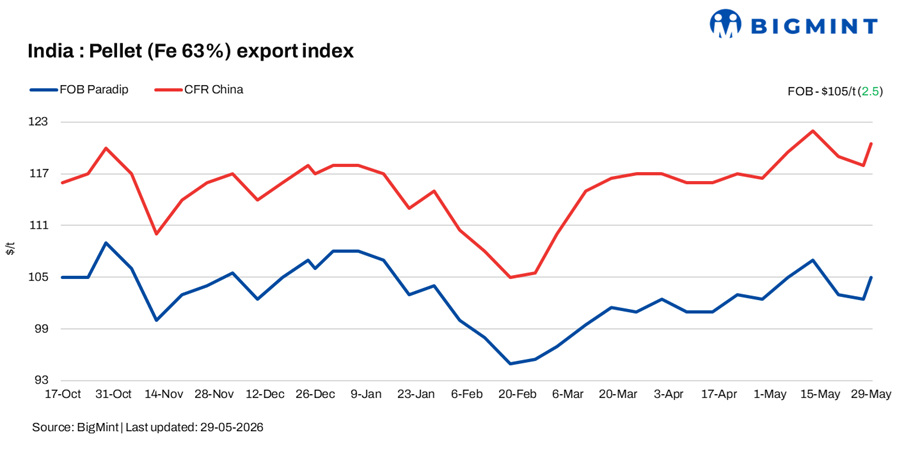

- Deals for over 350,000 t concluded in past 10 days
- Weak domestic market pushes sellers to turn to exports
BigMint's India pellet (Fe 63%, 3-3.5% Al) export index edged up by $2.5/t to $105/t FOB east coast on 29 May against its previous assessment on 27 May. The export market saw a flurry of trades, with market participants trying to take advantage of a slight reduction in Chinese raw material inventories.
Sellers offered material aggressively in the seaborne market amid the current slowdown in the domestic market due to weak sponge iron and steel fundamentals. Sellers are exploring options to keep trade active for until domestic trade rebounds.
East-India based sellers concluded deals for decent volumes. Transactions concluded by central Indian and southern Indian pellet makers supported further volumes.
Moreover, Chinese pellet inventories at 34 major ports stood at around 7.01 million tonnes (mnt) against 7.1 mnt last week.
Market updates
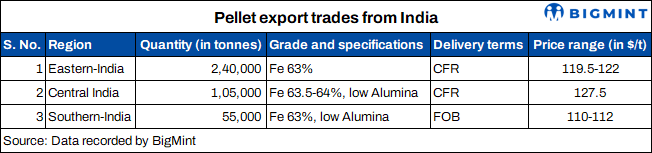
The pellet export market gained momentum during the current assessment window, with six confirmed deals for India-origin pellets (Fe 63/63.5% and 23.5% Al) concluded amid active buying interest from China, despite elevated inventories.
Around 350,000-400,000 t of iron ore pellets were heard traded at approximately $119.5-127.5/t CFR China.
Market participants noted that while there was a brief recovery in demand, the major driver remained the domestic subdued market, which compelled sellers to look out for export. BigMint heard that there was a healthy flow of inquiries from overseas buyers and decent restocking interest.
Trades recorded
Domestic vs export market
The price gap between export and domestic realisations shrinked on a m-o-m note. Export realisations (Fe 63%) were recorded at INR 7,800/t ($80.5/t) in May, reflecting a fall of INR 500/t ($5/t) m-o-m amid a wider spread between the INR and the USD. Domestic realisations (Fe 62.5%) too fell by INR 650/t ($7/t) m-o-m to INR 7,950/t ($82/t) exw. Given that the fall in domestic prices outpaced the one in exports, the gap between domestic and export realisations shrinked, resulting in sellers favouring exports.
Outlook