India: HRC export activity remains subdued amid cautious buying sentiment
...

- Quota uncertainty, elevated inventories continue to curb EU buying interest
- Shipping disruptions, subdued demand weigh on Middle East trading activity
Indian HRC export activity remained subdued during the assessment week ended 16 June 2026, as limited buying interest and cautious procurement strategiesin major destination markets resulted in a lack of significant export bookings, while market participants closely monitored developments amid an uncertain trade environment.
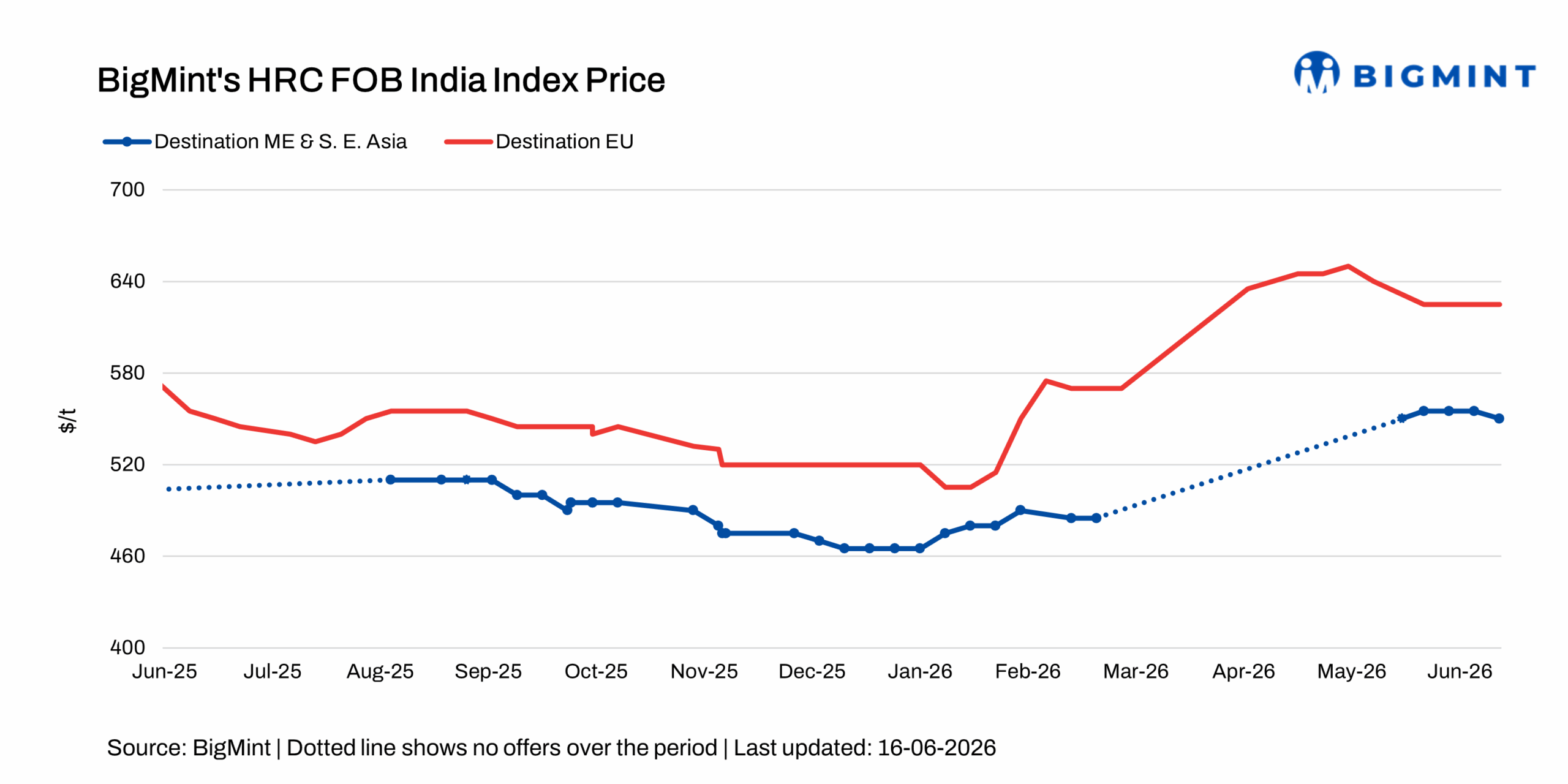
Indian HRC export offers to EU unchanged w-o-w: Indian HRC export offers to the EU remained unchanged w-o-w at around $625/t FOB. However, no fresh bookings were reported during the assessment period, as buyers remained cautious amid uncertainty surrounding country-specific quota allocations under the EU's revised steel trade defence framework, coupled with elevated inventory levels.
The revised framework, recently approved by the European Council, will replace the existing steel safeguard measures and is aimed at protecting the EU steel industry from persistent global overcapacity. Key changes include a nearly 47% reduction in overall steel import quotas to around 18.3 million tonnes compared with 2024 levels, an increase in out-of-quota duties from 25% to 50%, and the introduction of a "melt and pour" requirement to strengthen traceability and prevent circumvention.
An EU-based source indicated, "buying interest remains subdued, as there is still no clarity regarding the allocation of country-specific quotas under the new safeguard framework. Buyers have adopted a wait-and-watch approach until greater visibility emerges, and as a result, overall market sentiment remains cautious."
HRC export offers to Middle East, SE Asia fall w-o-w: Indian HRC export index to the Middle East and Southeast Asia fell by $5/t w-o-w to around $550/t FOB, from $555/t a week earlier, primarily due to lower offers to Vietnam. Indian HRC offers to Vietnam declined by $10/t w-o-w to approximately $560/t CFR Ho Chi Minh City, compared with $570/t in the previous week. Moreover, a booking of around 30,000 t was reportedly concluded at $555/t CFR for July 2026 shipment.
In contrast, Indian HRC export offers to the Middle East remained stable w-o-w at around $555/t FOB, with freight to Fujairah estimated at $45-50/t. Similarly, Chinese HRC export offers to the region also remained unchanged at around $590/t CFR Jeddah.
Market participants continued to report subdued trading conditions, citing a combination of geopolitical uncertainty and seasonal demand weakness. A regional source noted, "There has been no noticeable improvement in the situation so far. While there has been considerable discussion regarding a potential resolution to tensions surrounding the Strait of Hormuz, uncertainty remains high until a formal agreement is reached between the countries involved."
Another Middle-East based source indicated, "On the domestic front, demand conditions remain weak. With summer underway and school holidays approaching in July-August, travel activity is expected to increase, which could weigh on consumption. Additionally, construction activity has been affected by seasonal restrictions, as a mandatory midday work break for outdoor projects is in effect from 15 June-15 September due to extreme heat conditions, limiting work between 12:30 p.m. and 3:00 p.m."
Outlook
Indian HRC export activity is expected to remain under pressure in the coming week, as EU buyers are likely to stay cautious amid ongoing uncertainty over country-specific quota allocations, while elevated inventories may further restrict fresh bookings. Demand in the Middle East is also expected to remain weak due to shipping disruptions, high freight costs, and seasonal factors, including summer-related construction slowdowns and the upcoming holiday period.
Overall, export activity may gradually improve if greater clarity emerges regarding country-wise quota allocations and shipping conditions normalise, supported by the full reopening of the Strait of Hormuz and a formal agreement between the two countries that helps ease regional tensions.
