India: Domestic aluminium prices rise w-o-w as LME surges on US-Iran conflict
...

- Aluminium market firms amid tightening global supply
- Domestic aluminium premiums hold at $300-$320/t
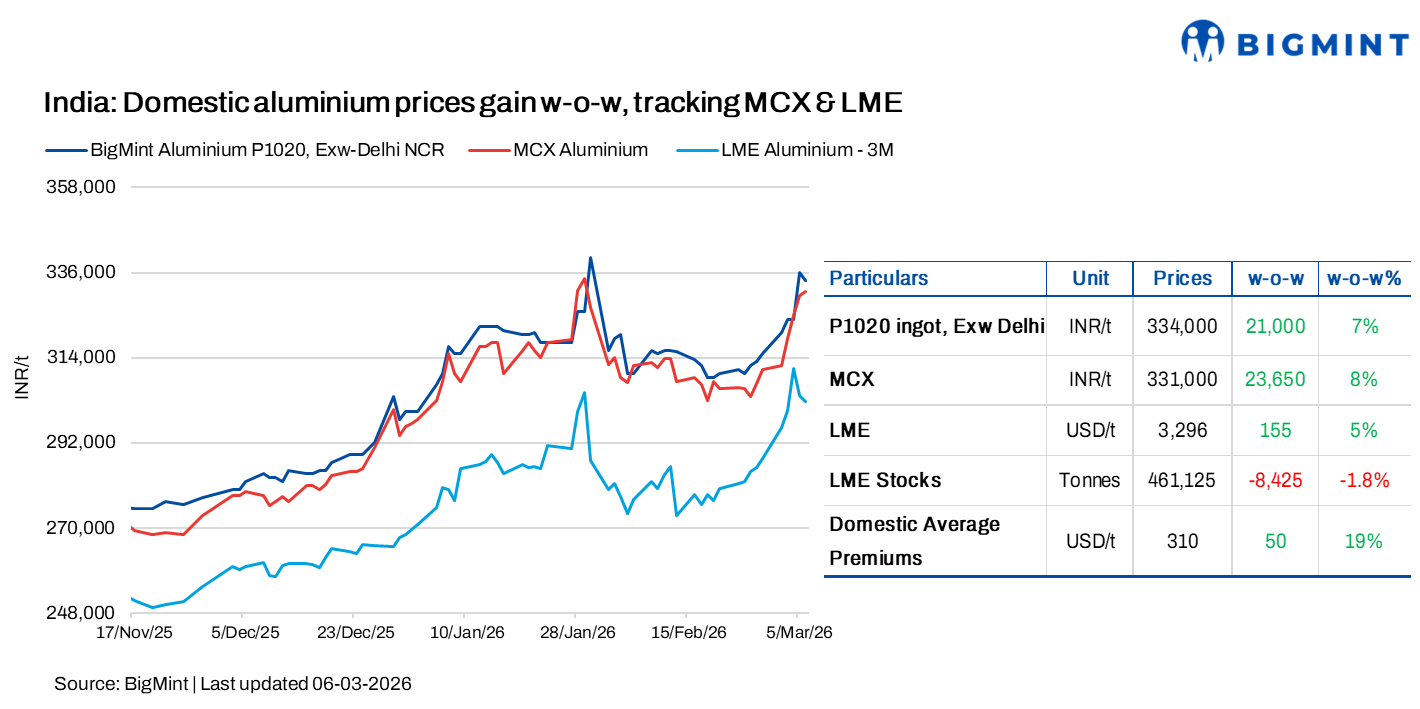
Domestic aluminium prices in India increased w-o-w on 6 March 2026, tracking gains in aluminium futures on the London Metal Exchange (LME) and Multi Commodity Exchange of India (MCX), supported by continued global supply concerns.
As per market assessment, domestic aluminium P1020 ingot prices in Delhi NCR increased by INR 21,000/t, or 7%, w-o-w to INR 334,000/t. Similarly, Mumbai prices rose by INR 13,000/t, or 4%, w-o-w to INR 338,000/t as of 6 March 2026, compared to INR 325,000/t in the previous week.
How did Indian and global exchanges perform?
Domestic aluminium futures on the Multi Commodity Exchange of India (MCX) increased w-o-w by INR 23,650/t, or 8%, to INR 331,000/t, reflecting stronger market sentiment.
In the global market, 3-month aluminium prices on the London Metal Exchange (LME) also rose by $155/t, or 5%, w-o-w to $3,296/t. Meanwhile, stocks at LME-registered warehouses declined by 8,425 t w-o-w, marking a 1.8% decrease, with total inventories standing at 461,125 t.
Aluminium prices surged to a near four-year high after Qatalum, a joint venture between QatarEnergy and Norsk Hydro, announced a shutdown following disruptions linked to the Middle East conflict. The closure came after the plant's gas supplier warned of an imminent suspension of gas supply, while a drone attack had earlier halted liquefied natural gas production, forcing Qatalum to stop production of some downstream products, including aluminium. Following the development, three-month aluminium futures on the London Metal Exchange rose sharply, with prices expected to remain supported amid tightening supply concerns.
Market insights
Primary aluminium producers in India are facing limited direct disruption from the ongoing US-Iran conflict, as most smelters rely on domestic power and key raw materials are largely sourced outside the GCC. Strong domestic demand and reduced imports from the Middle East could even benefit primary producers. the Middle East supplied nearly 30% of aluminium ingot imports
However, indirect cost pressures are emerging. Indian gas supplies to industrial users may be curtailed, coal prices have risen due to freight constraints, and pet coke availability could be affected if refineries face disruptions, potentially increasing production costs.
Domestic primary producers have already raised aluminium prices by up to INR 20,000/t. India's domestic average premiums for aluminium are currently around $300-$320/t above LME cash.
NALCO raised its primary aluminium ingot P1020 (99.7%) prices by INR 7,800/t ($85/t) on 6 March 2026, taking prices to INR 347,200/t ($3,787/t) from INR 339,400/t ($3,702/t) on 1 March 2026.
Reflecting the firm market trend, BALCO increased its P1020 ingot prices from INR 341,250/t on 28 February to INR 357,500/t on 6 March, marking a rise of INR 16,250/t during the period. Similarly, Hindalco raised prices from INR 338,250/t on 28 February to INR 357,750/t on 6 March, reflecting an increase of INR 19,500/t over the same period.
Outlook
Domestic aluminium prices in India are expected to remain firm in the near term, supported by strong futures on the London Metal Exchange and Multi Commodity Exchange of India, declining global inventories, and supply concerns following disruptions at Qatalum. Strong domestic demand and reduced imports from the Middle East--earlier accounting for nearly 30% of aluminium ingot imports--may support prices, though rising input costs such as coal, gas, and pet coke could keep prices elevated in the short term.
