India: Cumin prices rise on tighter supplies and export optimism
...
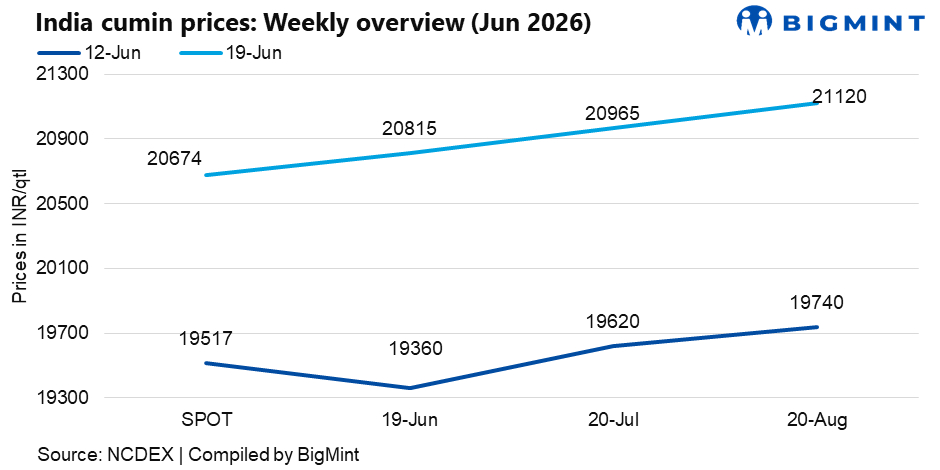

- Spot and futures prices gain on week
- Lower arrivals and shrinking stocks underpin market
Middle East developments remain key watchpoint for exports
Indian cumin prices moved higher during the week ended 19 June, supported by lower arrivals, declining exchange-monitored stocks, and improved export sentiment. Market confidence strengthened after reports of a US-Iran peace agreement raised hopes of smoother trade flows through the Strait of Hormuz, a critical shipping corridor serving key cumin-consuming markets in the Middle East. The development encouraged fresh buying interest and contributed to gains in both spot and futures markets.
NCDEX spot cumin prices rose by INR 1,157/t week-on-week to INR 20,674/t on 19 June from INR 19,517/t on 12 June. The June futures contract gained INR 1,455/t to INR 20,815/t, while July and August futures increased by INR 1,345/t and INR 1,380/t to INR 20,965/t and INR 21,120/t, respectively.
Futures activity reflects bullish sentiment
Trading activity shifted towards deferred contracts ahead of June expiry. Open interest in the July contract climbed to 9,399 lots from 6,996 lots a week earlier, while August open interest increased to 1,551 lots from 744 lots. In contrast, open interest in the June contract dropped sharply to 390 lots from 4,287 lots, indicating rollover activity and continued market participation in forward contracts.
Supply indicators remain supportive
Physical market fundamentals also lent support to prices. Arrivals declined by nearly 12% week-on-week to 11,473 mt from 13,096 mt, while exchange-monitored stocks eased to 6,979 mt from 7,222 mt, reflecting steady offtake and tighter availability. Traders reported active buying from stockists and exporters amid expectations of stronger overseas demand.
Outlook
While lower arrivals and reduced stocks continue to support prices, market direction will increasingly depend on developments in the Middle East. The optimism generated by the US-Iran peace agreement contributed to the recent rally; however, renewed uncertainty surrounding the Strait of Hormuz has once again raised concerns over regional trade flows. Market participants are closely monitoring the situation, as any prolonged disruption could affect export demand and freight movement. Consequently, both domestic supply fundamentals and geopolitical developments are expected to remain the key determinants of cumin prices in the near term.
