India: Crude steel expansion approvals reach nearly 6 mnt in May'26 BigMint data
...

- Crude steel expansion approvals total 5.8 mnt in May
- BOF-based projects remain concentrated in Odisha, Chhattisgarh
- Eastern India retains its position as country's principal steel hub
Morning Brief: India's crude steel expansion pipeline continued to advance in May'26, with 5.8 million tonnes per annum (mnt/year) of new capacity receiving regulatory approvals across the environmental clearance (EC) and consent-to-establish (CTE) stages. The latest approvals indicate that capacity creation remains distributed across both integrated and secondary steelmaking routes while continuing to concentrate in eastern India.
BigMint data show that 3.7 mnt received EC approvals, while a further 2.1 mnt progressed through the CTE stage, reflecting a steady flow of projects moving through the regulatory pipeline.
Environmental clearance remains a key milestone in India's project approval process, preceding consent to establish and, subsequently, consent to operate. As such, approvals at the EC and CTE stages serve as leading indicators of future steelmaking capacity rather than immediate production additions.
Eastern India anchors steel expansion
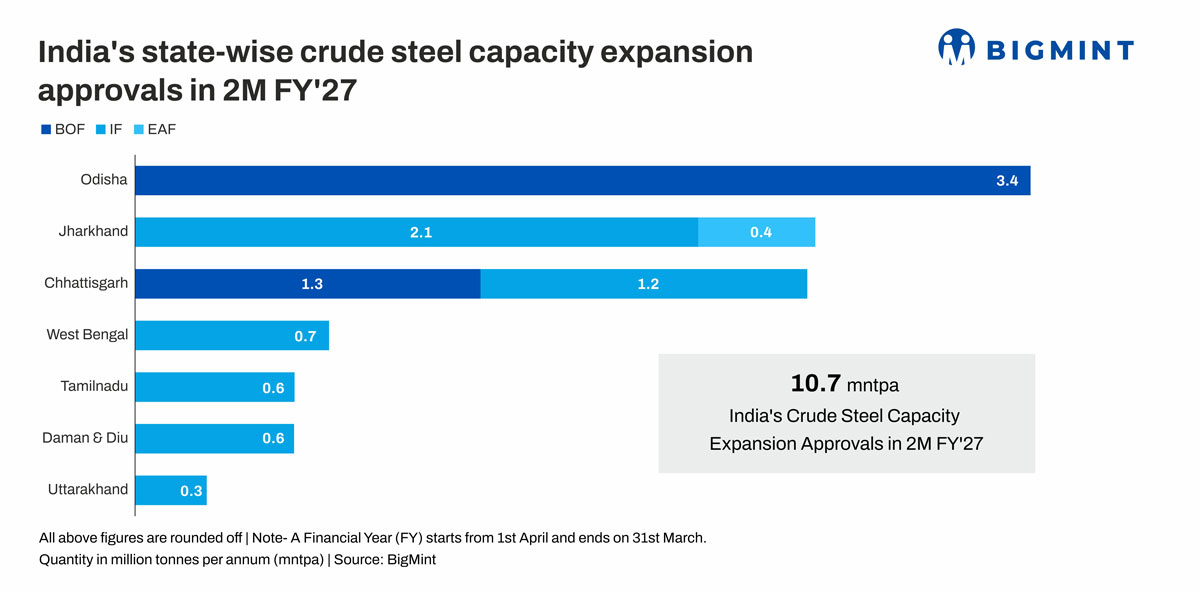
The latest approvals reinforce eastern India's position as the centre of India's steel capacity expansion. Based on cumulative approvals during April-May'26, Odisha accounted for the largest share of approved crude steel capacity at 3.37 mnt, followed by Jharkhand at 2.57 mnt and Chhattisgarh at 2.53 mnt. Together, these three states accounted for the overwhelming majority of approvals during the period.
 The concentration reflects the region's structural advantages, including proximity to iron ore reserves, established steelmaking clusters, integrated logistics infrastructure and the presence of large primary steel producers. These factors continue to make eastern India the preferred destination for both integrated and secondary steel investments.
Expansion balanced across production routes
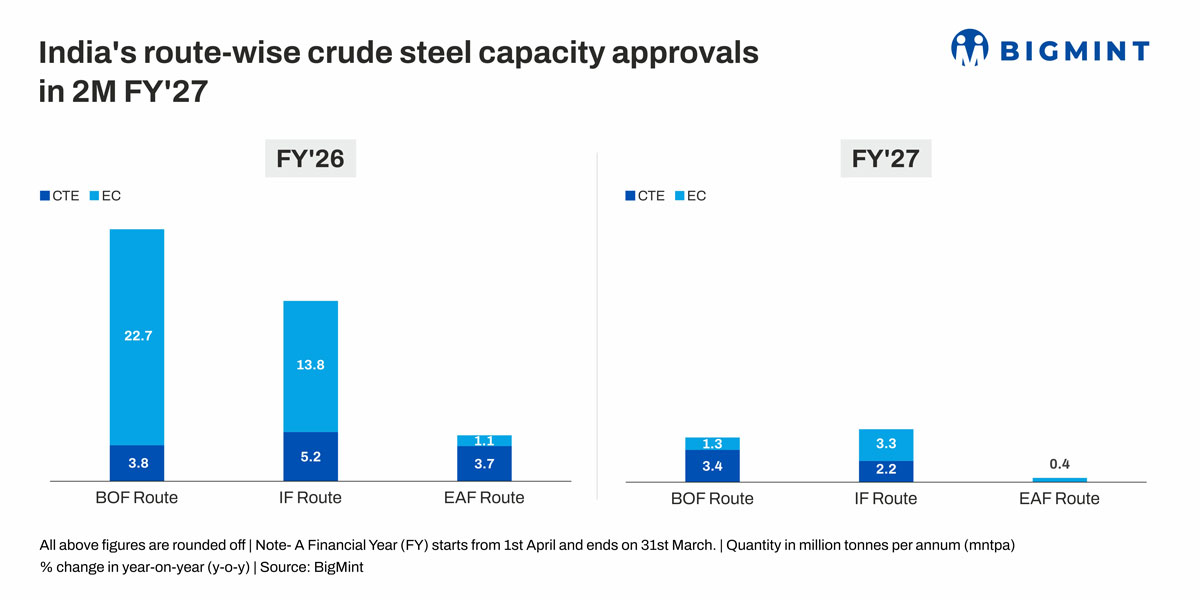
While May approvals totalled 5.8 mnt, cumulative approvals during April-May provide a clearer indication of the emerging route-wise composition of India's steel expansion pipeline. During the two-month period, induction furnace (IF)-based projects accounted for 5.54 mnt of approved crude steel capacity, marginally exceeding 4.67 mnt approved through the blast furnace-basic oxygen furnace (BF-BOF) route. Electric arc furnace (EAF) projects accounted for a comparatively modest 0.44 mnt.
 The approvals indicate that capacity growth continues to be driven by parallel investment across both production routes rather than a structural shift towards any single technology. Large integrated producers remain focused on BOF-based expansion, while induction furnace additions continue to support expansion among secondary steelmakers.
The current approval mix also suggests India's steel expansion remains evolutionary rather than transformational. BOF approvals continue to underpin capacity additions by integrated producers, while induction furnace projects account for a large share of incremental capacity among secondary mills.
With EAF approvals remaining comparatively limited, the latest pipeline does not yet indicate a significant shift in India's steelmaking technology despite the industry's increasing focus on decarbonisation and lower-carbon production routes.
Outlook
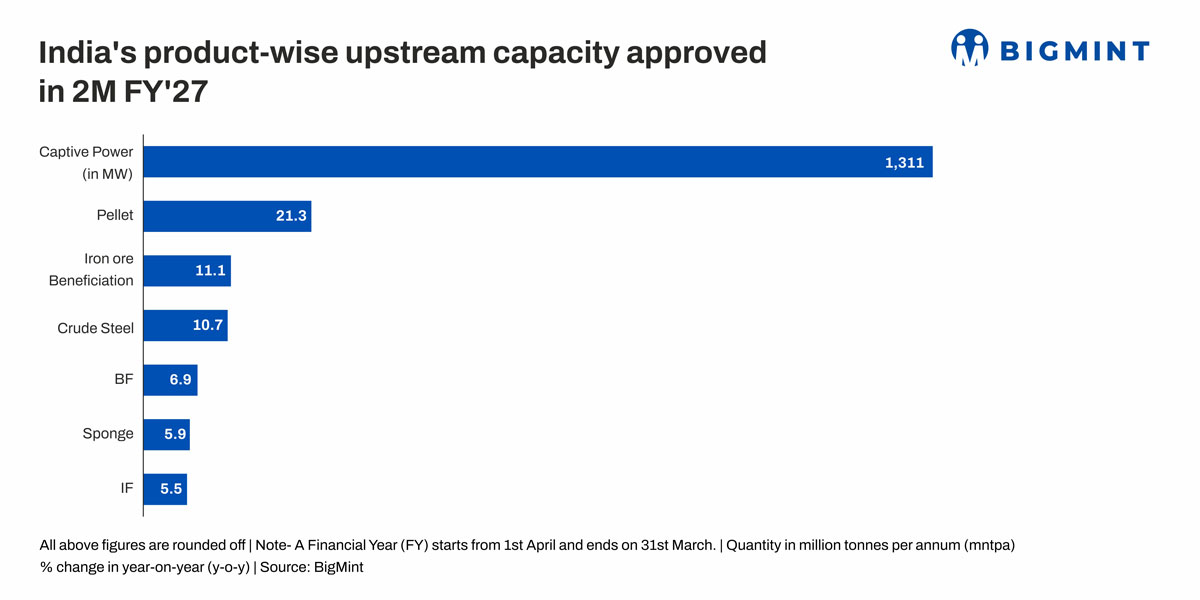
The May approvals suggest that India's steel expansion pipeline remains active, with projects continuing to progress through successive regulatory stages despite a more uncertain global steel environment. The latest approvals reinforce the broader expansion pattern observed during FY26 rather than signalling a shift in the direction of capacity creation, with eastern India continuing to dominate new investments and capacity additions remaining distributed across both integrated and secondary steelmaking routes.
As these projects move from regulatory approvals to construction and eventual commissioning over the coming years, they are expected to support incremental demand for iron ore, pellets, DRI and other upstream raw materials while reinforcing India's long-term objective of expanding crude steel capacity to 300 mnt by 2030.