India: Brass honey scrap imports rise 11% y-o-y in CY'25 amid steady Jamnagar demand
...
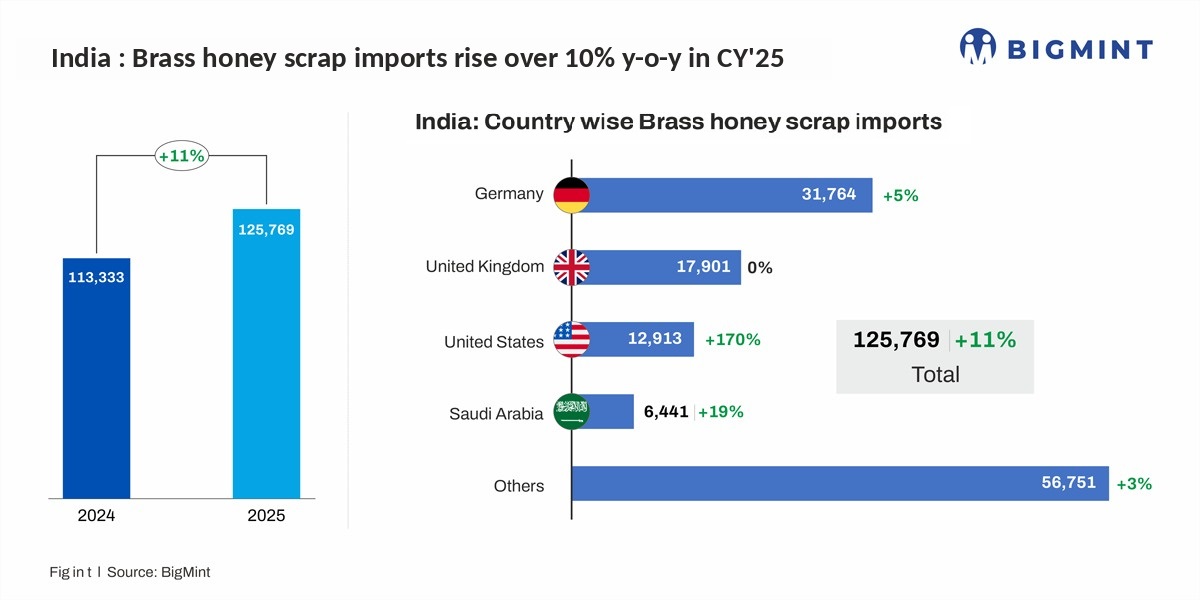

- India's fragmented, informal recycling ecosystem limits domestic generation
- Germany remains leading supplier, supported by its strong industrial base
India's imports of brass honey scrap rose 11% y-o-y to 0.13 million tonnes (mnt) in CY'25, reinforcing its position as the most imported brass scrap grade. The growth reflects sustained demand from the secondary brass industry, particularly in Jamnagar, western India, the leading brass manufacturing cluster in the country. Brass honey scrap serves as a key raw material for Jamnagar-based brass manufacturers, supported by its high recyclability and consistent quality.
The rise in imports suggests a structurally tight domestic scrap market, where consumption continues to outpace local availability, increasing reliance on overseas supply.
What is brass honey scrap?
Brass honey scrap refers to a globally standardised grade of mixed yellow brass scrap, widely traded under international specifications such as ISRI. It comprises clean, uncoated, and non-ferrous brass solids, typically derived from post-industrial and post-consumer sources.
From a metallurgical perspective, brass is a copper-zinc alloy, with honey grade material typically containing 60-70% copper (Cu) and 30-40% zinc (Zn), along with trace elements such as lead (Pb), tin (Sn), and aluminium (Al), depending on the source and scrap origin.
Brass honey scrap imports in India fall under HS Code 7404 (copper and copper alloy scrap), with a relatively low-duty structure to support the recycling ecosystem. The applicable duty includes a basic customs duty (BCD) at 0%. Like for all varieties of copper scrap, the import duty on even brass scrap was reduced from 2.5% to 0% in the Union Budget FY'25, while Integrated Goods and Services Tax (IGST) at 18% is levied on the assessable value plus duty.
As a result, the overall landed cost is largely influenced by GST, with customs duties contributing marginally. This structure supports import viability and ensures steady raw material availability, while simultaneously keeping domestic prices closely linked to global scrap trends, freight movements, and currency fluctuations.
India's brass market overview
Why is India reliant on imports for brass honey supply?
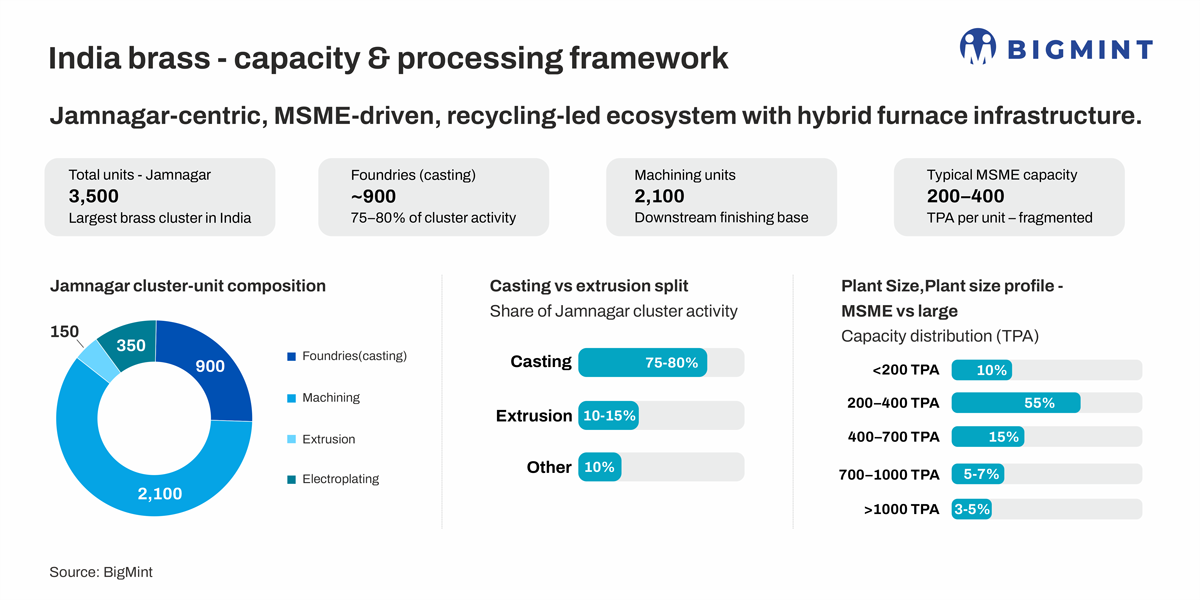
India's reliance on imports persists due to limited domestic scrap generation, with key sourcing from Europe, the US, and the Middle East. India's rising import demand for brass honey scrap is driven by expansion in downstream manufacturing and increasing scrap intensity in production, particularly in the Jamnagar cluster, which houses 3,500-5,000+ units and accounts for 80-90% of total scrap consumption.
Demand has strengthened with capacity additions in extrusion and value-added components, supported by growth in electrical, construction, automotive, and renewable energy sectors. Additionally, a fragmented and largely informal recycling ecosystem restricts efficient collection, segregation, and availability of consistent, high-quality scrap.
Country-wise sourcing
Europe remained the dominant supplier, led by Germany (0.03 mnt), supported by its strong industrial base, advanced recycling infrastructure, and high-quality scrap generation from automotive and engineering sectors. The United Kingdom (0.02 mnt) followed, driven by a mature collection network and exportable surplus, given relatively lower domestic consumption.
North America, particularly the United States (0.01 mnt), emerged as a key secondary supplier, backed by its large industrial ecosystem and significant scrap generation, with flows increasing during favourable arbitrage conditions.
In contrast, the Middle East (UAE, Saudi Arabia) contributed more volatile and trade-driven volumes, reflecting their role as transit and redistribution hubs rather than primary scrap generators.
Prices trends
Brass honey scrap pricing is primarily benchmarked to London Metal Exchange (LME) copper prices, given its high copper content. As a result, movements in LME act as the key directional driver, with scrap prices adjusting for recovery, alloy mix, and processing spreads.
Within this framework, BigMint assesses brass honey scrap at two key benchmarks -- CFR Mundra (import parity, UAE-linked) and exw-Jamnagar (domestic market). While CFR Mundra reflects landed import pricing from global suppliers, Jamnagar represents Indias core consumption hub, accounting for around 80-90% of total brass scrap imports, and serves as the primary centre for demand and price discovery.
During the period year CY'25, LME copper showed an initial strong uptrend, moving from around $9,800/t to $12,500/t, supported by tight supply and strong demand. However, from February onwards, the market corrected amid macroeconomic uncertainty and the Iran-led geopolitical disruptions, though overall sentiment remained firm.
UAE-origin scrap prices, CFR Mundra, moved closely in line with the LME, strengthening from around $7,600/t to $9,000/t. The trend was supported by firm global scrap demand and elevated replacement costs.
However, in the past 2-3 weeks, market activity has been disrupted due to the Middle East crisis, impacting trade flows and liquidity. Consequently, BigMint has temporarily suspended UAE price assessments, reflecting challenges in reliable price discovery rather than a demand slowdown.
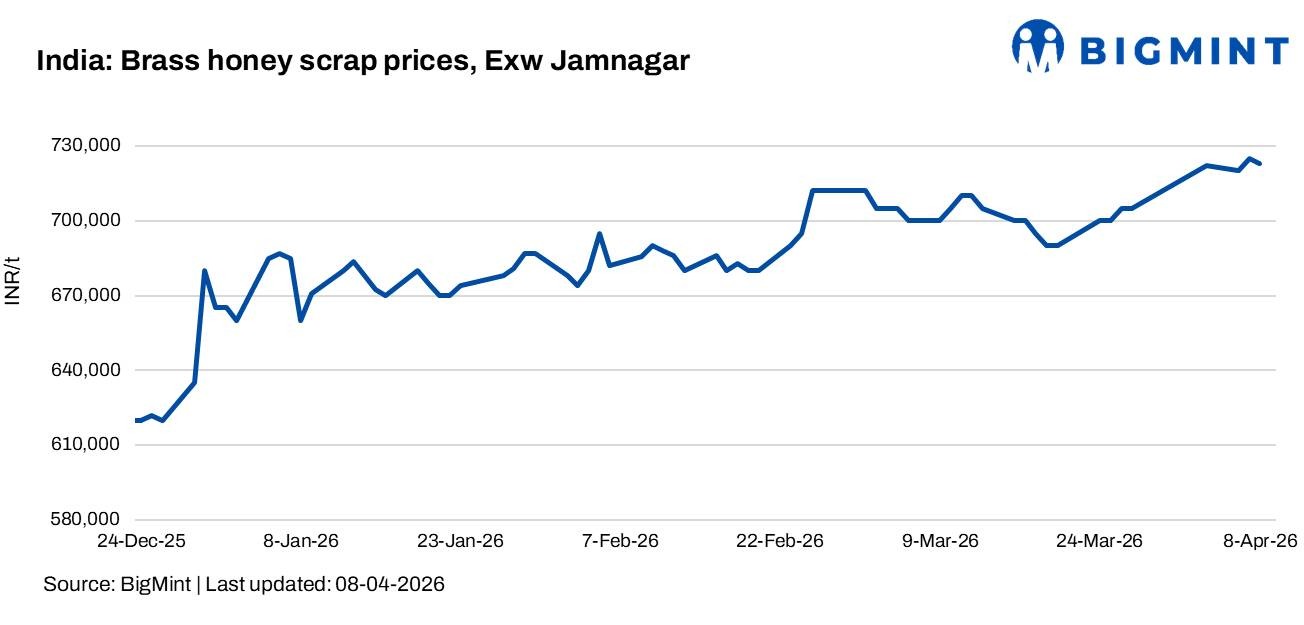
In contrast,brass honey scrap prices, exw-Jamnagar (for the Indian domestic market), followed a steady and gradual uptrend, moving from around INR 600,000/t ($7,200/t) to near INR 700,000/t ($8,400/t), supported by consistent demand from the Jamnagar cluster.
Unlike the import market, domestic prices showed limited reaction to the recent global correction, largely holding within a narrow range . This reflects a lagged and moderated transmission of global trends, backed by stable consumption and inventory-led buying in the domestic market.
Overall, in Q4 of CY'25 indicate a divergent price behaviour, with global cues shaping import trends more sharply, while the domestic market remained comparatively stable with slower adjustments. In the near term, import prices may remain volatile, while domestic prices are likely to stay firm. As trade flows normalise, the gap between import and domestic prices is expected to narrow.
Port-wise import trend
India's scrap import pattern shows a clear port-grade linkage, reflecting procurement strategies aligned with logistics efficiency and material quality requirements. The Mundra Port, due to its proximity to the Jamnagar cluster, handles a higher share of premium Honey grade imports.
In contrast, Nhava Sheva (JNPT) witnesses a relatively higher proportion of mixed and lower-grade scrap (including Ebony), supported by its role as a major containerised trade hub handling diversified cargo and blended scrap consignments.
Additionally, ports linked to UAE-origin cargo flows often reflect aggregated and re-exported scrap, comprising a mix of honey and secondary grades, while European-origin shipments routed via Mundra tend to maintain higher grade consistency and specification compliance.
Outlook
In the near term, brass honey scrap import flows into Mundra are expected to remain uneven due to continued disruptions in Middle East-origin trade, particularly impacting UAE-linked cargo aggregation and re-export channels.
However, steady buying from the Jamnagar cluster -- backed by consistent order flow from plumbing and electrical segments -- is likely to keep exw-Jamnagar prices supported in the near term. Any sharp correction in LME copper below $10,000/t could create short-term import arbitrage opportunities, potentially widening the import-domestic price gap before normalising as European supplies regain share in Q2-Q3.
Will the resumption of Middle East shipments mark a turning point in Indias brass honey scrap pricing cycle, or will strong demand from the Jamnagar cluster continue to absorb the additional supply without significant price correction?