How did US copper scrap exports reshape India's import basket in 4MCY'26?
...
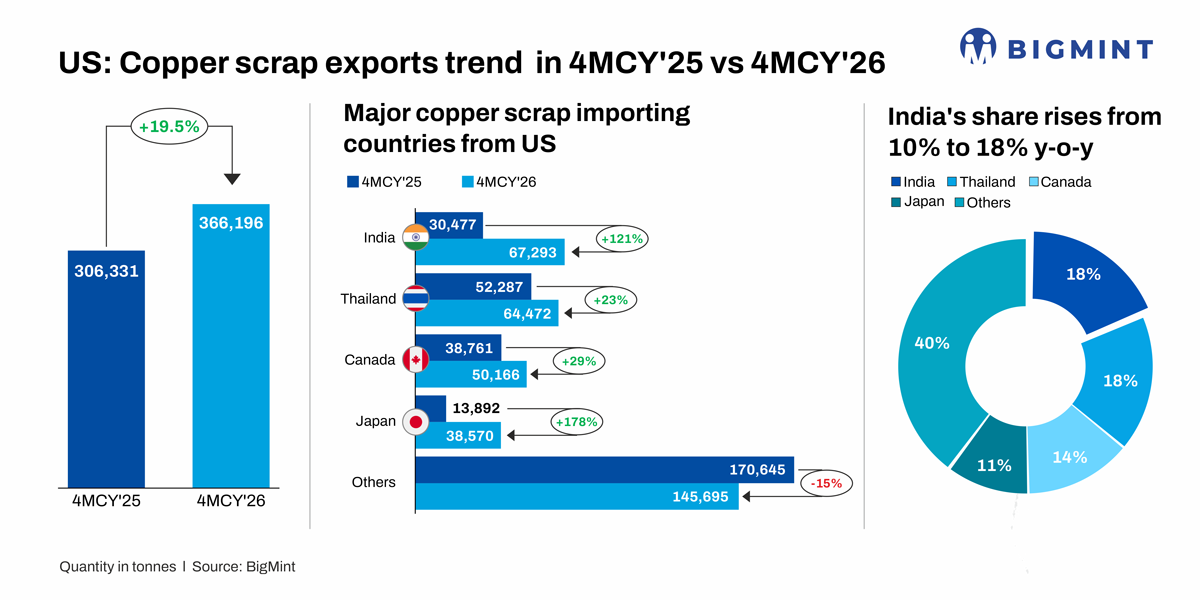

- US copper scrap shipments to India surge 76% y-o-y
- China loses top spot as sourcing shifts to ASEAN
US copper scrap exports increased by 19.5% y-o-y to 0.37 mnt during January-April 2026, compared with 0.3 mnt in the corresponding period last year, according to BigMint data. Although exports eased 12.4% m-o-m to 0.095 mnt in April from 0.011 mnt in March, overseas demand remained firm during the first four months of the year. The export landscape also witnessed a notable shift, with India emerging as the largest destination for US copper scrap shipments, overtaking Thailand.
India led the imports, with shipments increasing to 67,293 t from 30,477 t in 4MCY'25, registering a 121% y-o-y increase. Thailand retained strong buying interest, with imports rising to 64,472 t from 52,287 t, up 23% y-o-y. Other major destinations included Canada (50,166 t), Japan (38,570 t), South Korea (37,839 t) and Belgium (14,934 t) during the first four months of 2026.
Why did China's imports of US copper scrap decline?
Meanwhile, China, which was the largest importer of US copper scrap during 4MCY'25 with shipments of 80,233 t, dropped out of the leading export destinations in 4MCY'26, reflecting a significant shift in global copper scrap trade flows. The decline comes amid ongoing US-China trade tensions, China's existing tariff on US-origin copper scrap, and growing concerns over potential US export restrictions on high-grade scrap.
Additionally, China has increasingly sourced copper scrap through ASEAN countries, according to media reports, with US copper scrap exports to ASEAN increased from 170,687 t in 2024 to 222,993 t in 2025. Meanwhile China's imports from ASEAN rose from 434,176 t to 529,345 t over the same period, indicating a structural rerouting of trade flows across the region.
How did India capitalize on changing trade dynamics?
India's total copper scrap imports increased by 24% y-o-y during 4MCY'26, reflecting sustained demand from the country's expanding secondary copper industry.
India was the standout destination during the period, with imports from the US surging 121% y-o-y. Consequently, India's share in total US copper scrap exports increased to 18.4% from 10% a year earlier. Meanwhile, the US strengthened its position in India's sourcing basket, with its share in India's total copper scrap imports rising from 27% to 48% during the same period.
The sharp decline in China's direct purchases created opportunities for Indian buyers to secure larger volumes of US-origin copper scrap, enabling India to emerge as the largest export destination for US copper scrap during 4MCY'26.
Why does the US continue to have surplus copper scrap?
According to market sources, more than 50% of US end-use copper demand is now met through imported semis and finished goods, including automobiles, electrical equipment and household appliances. The growth in US end-use copper demand has increasingly been met through imports rather than an equivalent expansion in domestic manufacturing.
Consequently, the US continues to generate substantially more recoverable copper scrap than its domestic secondary manufacturing sector can absorb. This structural surplus has supported higher shipments to overseas buyers, with Indian importers increasingly capitalizing on the availability of US-origin material during 4MCY'26.
Outlook
While India has emerged as the largest destination for US copper scrap during 4MCY'26, this trade advantage may come under pressure if the United States proceeds with higher tariffs on refined copper imports.
Higher import duties on refined copper are expected to increase the value of domestically available copper units, including high-grade scrap. As US refiners, wire rod manufacturers and secondary processors compete more aggressively for scrap feedstock, exporters may find stronger returns in the domestic market than overseas.
The shift could gradually reduce US scrap exports, particularly for premium grades such as Birch, Berry and Millberry, tightening availability for import-dependent markets including India. Given that the US now accounts for over 23% of India's copper scrap imports, any reduction in export volumes could support higher import premiums and increase procurement costs for Indian recyclers and secondary copper manufacturers.
At the same time, China is unlikely to return as a major direct buyer of US-origin scrap due to ongoing trade barriers, meaning Southeast Asia and India are expected to remain the primary overseas destinations. However, the balance between domestic US demand and export economics will ultimately determine how much material continues to reach international markets.