Global steel trade flows in Q1CY'26 remain fragmented amid rising protectionism
...
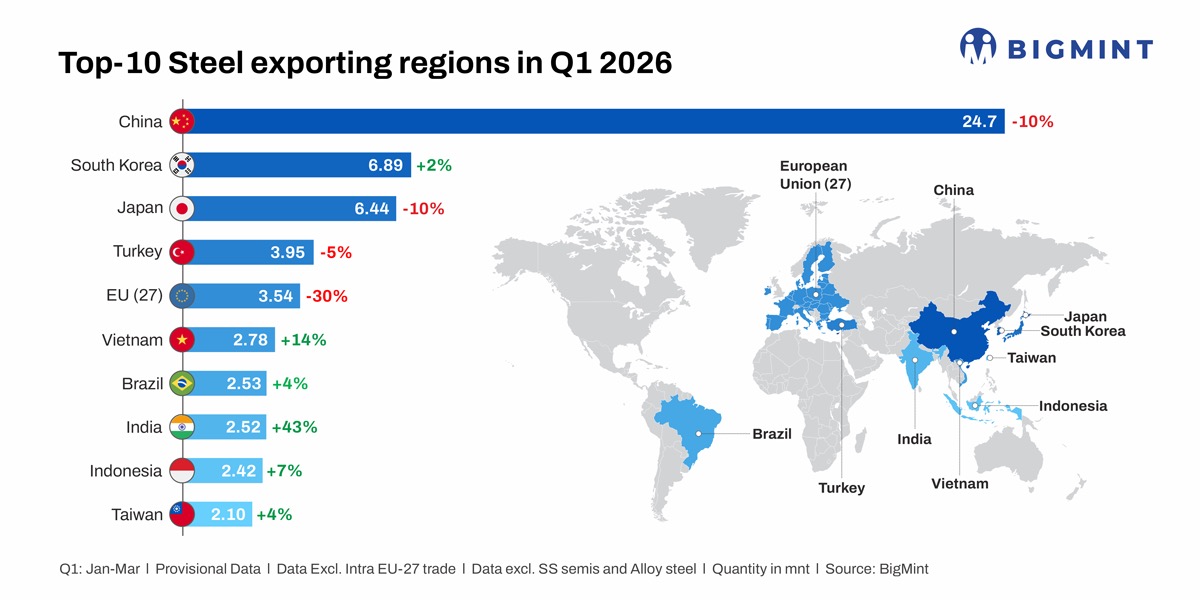

- China remains dominant exporter despite 10% y-o-y decline in shipments
- India records strongest export growth among major exporters
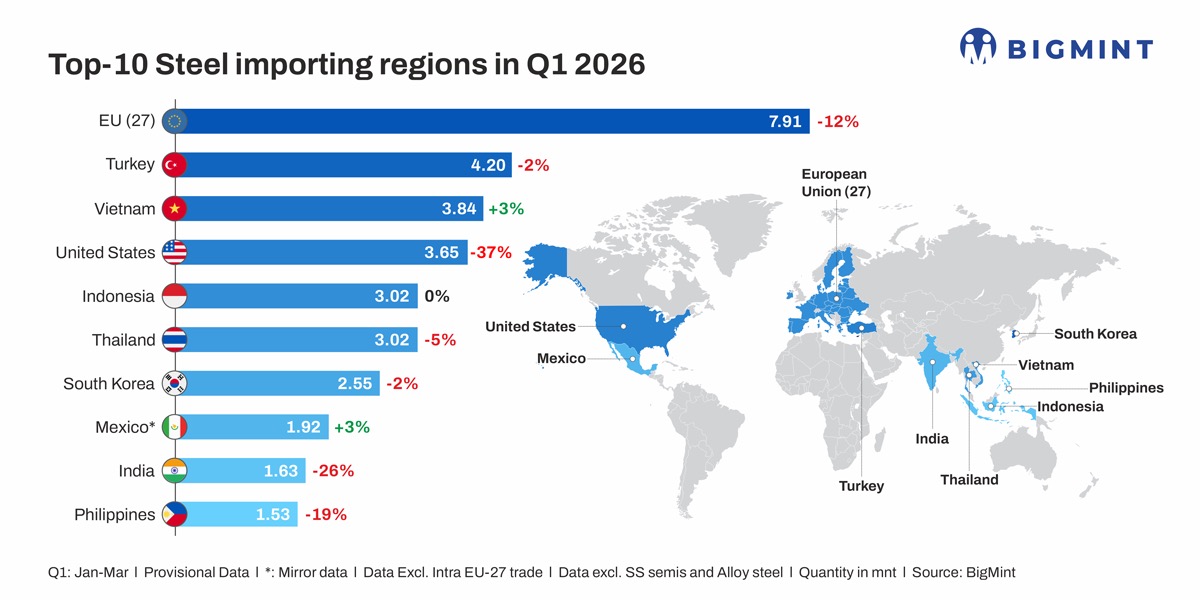
- US, India imports fall sharply as trade barriers reshape flows
Morning Brief: Global steel trade flows remained uneven in Q1CY'26 as rising protectionism and shifting regional cost structures continued to reshape export and import patterns. Steel exports from the top-10 exporting regions stood at around 57.9 million tonnes (mnt) during January-March 2026, with China retaining overwhelming dominance despite lower shipments.
At the same time, import demand weakened across several major consuming regions. Imports into the top-10 importing regions totalled around 33.27 mnt, with sharp declines in the US and India reflecting the growing impact of tariffs, safeguard measures, and import restrictions on trade flows.
The latest trade data suggests steel flows are increasingly being redirected through tariffs, quotas, and regional trade restrictions rather than broad-based demand growth, highlighting how policy intervention and widening cost differentials are becoming key drivers of global trade patterns.
China remains dominant despite lower exports
China remained the world's largest steel exporter in Q1CY'26, shipping around 24.7 mnt, although volumes declined 10% y-o-y from 27.44 mnt in the corresponding period last year.
The decline reflects growing trade barriers across key importing markets, including anti-dumping duties, safeguard measures, and quota restrictions imposed on Chinese steel products. However, despite lower volumes, China still accounted for over 40% of shipments among the top-10 exporting regions, with exports remaining more than three times higher than the next-largest exporter.
Japan's exports also declined 10% y-o-y to 6.44 mnt, reflecting weakening manufacturing activity and softer overseas demand. Turkiye's exports fell 5%, while the EU-27 recorded the steepest decline among major exporters at 30% y-o-y, highlighting the pressure faced by higher-cost producers amid subdued industrial demand and competition from lower-priced material.
India, Vietnam outperform amid shifting regional flows
India emerged as one of the strongest-performing exporters in Q1CY'26, with shipments increasing 43% y-o-y to 2.52 mnt. Vietnam also recorded robust export growth of 14%, while South Korea's exports rose marginally by 2%.
The increase reflects continued rerouting of steel flows towards Southeast Asia, the Middle East, and other emerging markets as exporters adapt to tightening trade restrictions in traditional destinations.
At the same time, India's steel imports declined sharply by 26% y-o-y to 1.63 mnt, indicating the impact of safeguard duties and import controls introduced to support domestic mills and improve capacity utilisation. The divergence between rising exports and lower imports suggests India's trade measures are beginning to alter trade flows and reduce import dependence.
US imports fall sharply as protectionism intensifies
Among importers, the EU-27 remained the largest steel importing region at 7.91 mnt, despite a 12% y-o-y decline in volumes. The sharpest fall was recorded in the United States, where imports dropped 37% y-o-y to 3.65 mnt, reflecting the escalation of steel tariffs and tighter import restrictions. Imports also declined in Thailand, South Korea, the Philippines, and India, while Vietnam and Mexico recorded marginal increases.
Outlook
We expect global steel trade flows are expected to remain fragmented through the rest of CY'26 as protectionist policies, excess steel availability, and uneven regional demand continue reshaping trade patterns.
While Chinese export volumes are expected to remain significant despite tighter trade restrictions, importing regions are likely to continue strengthening policy measures to protect domestic industries. As a result, trade growth is expected to remain moderate, with exporters increasingly redirecting material towards Southeast Asia, the Middle East, and other emerging markets.
