Global iron ore shipments rise w-o-w on Australia surge; freight market sentiment remains mixed
...
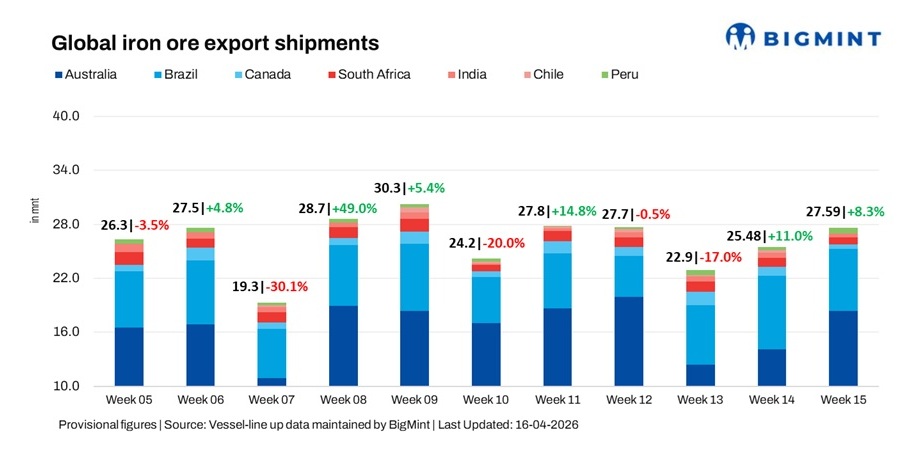

- Australia-led rebound lifts volumes; Brazil softens
- Pacific freight gains capped by oversupply, logistics constraints
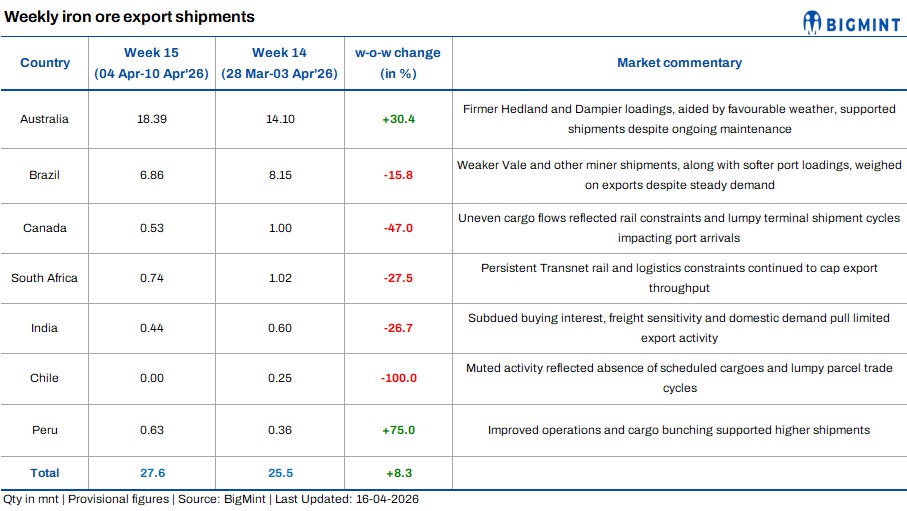
Global iron ore export shipments rose 8.3% w-o-w to 27.6 million tonnes (mnt) in the week ended 10 April, from 25.5 mnt a week earlier, according to BigMint data. Gains were driven by a sharp rebound in Australian shipments on improved port loadings and favourable weather. Brazil flows moderated, while Canada, South Africa and India remained constrained. Chile recorded no shipments, while Peru saw improved activity.
Country-wise trends
Port & shipper-wise trends
- Australia: Port Hedland handled 10.83 mnt, Walcott 3.76 mnt, and Dampier 3.33 mnt. Rio Tinto exported 7.09 mnt, BHP 5.72 mnt, and FMG 3.69 mnt, with China absorbing 13.83 mnt, followed by Japan (1.77 mnt) and South Korea (1.51 mnt).
- Brazil: Ponta da Madeira shipped 3.24 mnt, Tubarao 1.31 mnt, and Itaguai 1.06 mnt. Vale exported 3.70 mnt, while CSN shipped 2.43 mnt, with China importing 3.88 mnt.
- Canada: Sept-Iles shipped 0.35 mnt and Port Cartier 0.18 mnt, with IOC exporting 0.35 mnt and AMNS 0.18 mnt, while the Netherlands received 0.18 mnt.
- South Africa: Saldanha handled 0.74 mnt, with the Netherlands receiving 0.36 mnt.
- India: Dhamra shipped 0.25 mnt, with Rungta Sons exporting 0.17 mnt and China importing 0.20 mnt.
- Chile: No shipments were recorded during the week.
- Peru: San Nicolas shipped 0.53 mnt and Matarani 0.10 mnt, with Shougang Hierro exporting 0.53 mnt, while China imported 0.45 mnt.
Bulk iron ore freights show mixed trend
Freight rates showed a mixed trend w-o-w, with gains in the Pacific supported by stronger Australian cargoes, while the Atlantic remained balanced amid softer Brazil flows. Sentiment stayed cautious due to limited fixtures, ample vessel supply and bunker volatility.
Outlook
Shipments are likely to stay supported by strong Australian volumes, though softer Brazil flows and persistent logistical constraints in South Africa and Canada may keep movements uneven. Freight sentiment is expected to remain mixed amid vessel oversupply and bunker volatility.