Global ferrous scrap markets mixed as South Asia slows and Turkiye softens
...
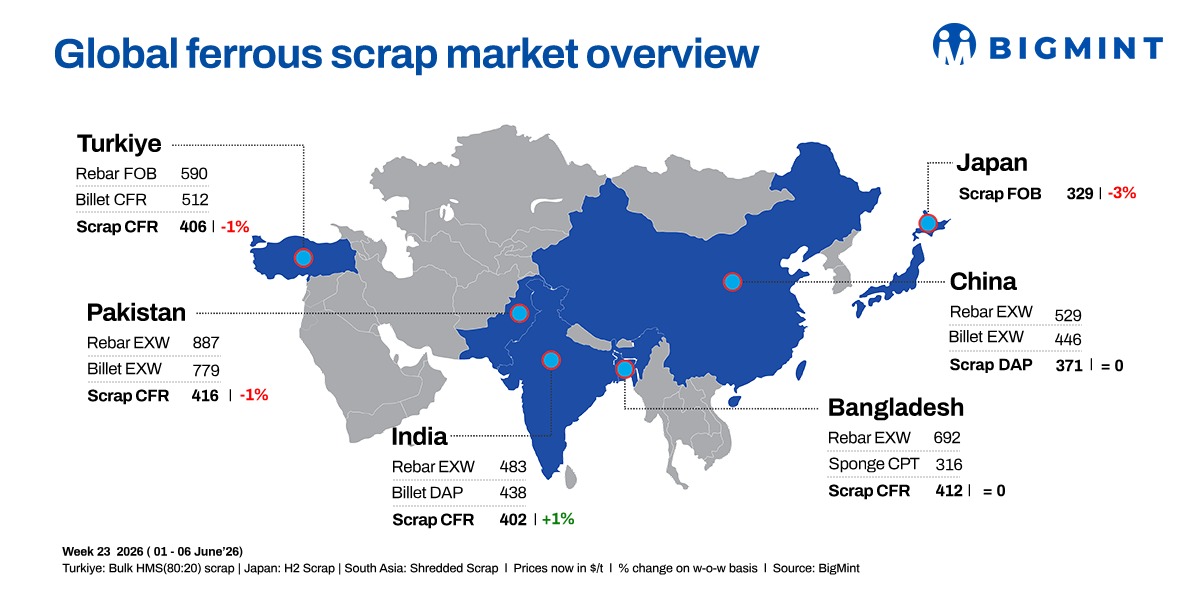

- India buyers focus on inventories over new imports
- Turkiye selling pressure grows as scrap availability rises
Global ferrous scrap markets remained mixed in the week ended 5 June 2026, with weak import demand and cautious buying weighing on sentiment across South Asia and Turkiye. Meanwhile, Japan's export prices softened, China's scrap outlook turned bearish for June, and the UAE market remained supported by balanced domestic fundamentals.
Turkiye: Deep-sea imported scrap market started the week on a relatively stable note, with trading activity remaining subdued during and immediately after the Eid holidays. Most mills stayed away from the market, while suppliers largely resisted selling below $400/t CFR despite cautious Turkish buying. As a result, benchmark HMS 80:20 values remained around $408-410/t CFR in the early part of the week.
However, sentiment weakened as the week progressed amid weak steel fundamentals, margin pressure, and increasing scrap availability. Workable levels for US-origin HMS 80:20 were heard at $400-405/t CFR, while European-origin material slipped below $400/t CFR, with a transaction reported around $397/t CFR.
India: Imported ferrous scrap market remained weak during the week, pressured by poor steel demand, weak mill margins, monsoon-related demand concerns, and the continued preference for domestic scrap and sponge iron. High freight costs and rupee depreciation further reduced import viability, keeping most buyers on the sidelines.
Trading activity remained limited, with a few spot deals reported, including Brazil-origin HMS 80:20 at around $330/t CFR India and shredded scrap at $405/t CFR Nhava Sheva. UK/EU-origin HMS 80:20 offers were heard at $345-360/t CFR, while buyers remained focused on clearing inventories and recently arrived cargoes amid weak demand and a persistent bid-offer gap.
Approximately 2,500-3,000 t of imported ferrous scrap, including HMS 80:20 and shredded grades, was heard booked into India over the past seven days.
Pakistan: Imported scrap market remained subdued during the week, with buying activity recovering only gradually after the Eid holidays. Buyers largely targeted shredded scrap around $415-420/t CFR Qasim, while a few transactions were reported, including shredded scrap at $416-420/t CFR and Malaysia-origin HMS bundles at $386/t CFR.
Meanwhile, suppliers maintained higher offer levels, with UK/EU-origin shredded scrap heard at $420-425/t CFR, Malaysia-origin GI bundles at $430/t CFR, and HMS bundles at $408/t CFR. The persistent bid-offer gap continued to limit fresh bookings and keep trading activity slow.
Bangladesh: Bangladesh's imported scrap market remained subdued during the week, with mills continuing to favour domestic scrap over imports due to better price competitiveness and weak finished steel demand. A 1,000 t Denmark-origin HMS 80:20 containerised cargo was heard sold at around $390/t CFR, while offer indications included UK-origin shredded scrap at $410-415/t CFR, HMS 80:20 at $380-385/t CFR, and Japan-origin H2 at $420-425/t CFR. Elevated PNS offers at $430-435/t CFR and local scrap prices of BDT 49,000-51,000/t ($399-415/t) continued to limit import buying interest.
Japan: H2 export prices eased by JPY 1,100/t to JPY 52,700/t amid mill maintenance, and limited export activity.
China: China's ferrous scrap market is expected to soften in June despite May prices rising 1.6% m-o-m to RMB 2,518/t, as weaker steel demand and scrap's cost disadvantage against hot metal weigh on consumption.
UAE: Ferrous scrap market stabilized in the week ended 5 June as supply and demand returned to balance following slower export activity. Despite softer exports, domestic prices remained firm, with HMS (80:20) processed scrap assessed at AED 1,002/t ($273/t) DAP Abu Dhabi, up AED 12/t w-o-w.