Global crude steel output falls in Jan-May'26 as China slowdown outweighs growth in India, US
...

- Chinese crude steel production declines 3.9% y-o-y in Jan-May
- India, US, Germany, Vietnam record robust production growth
- Weak demand in China, Russia contrasts with higher production in India, US
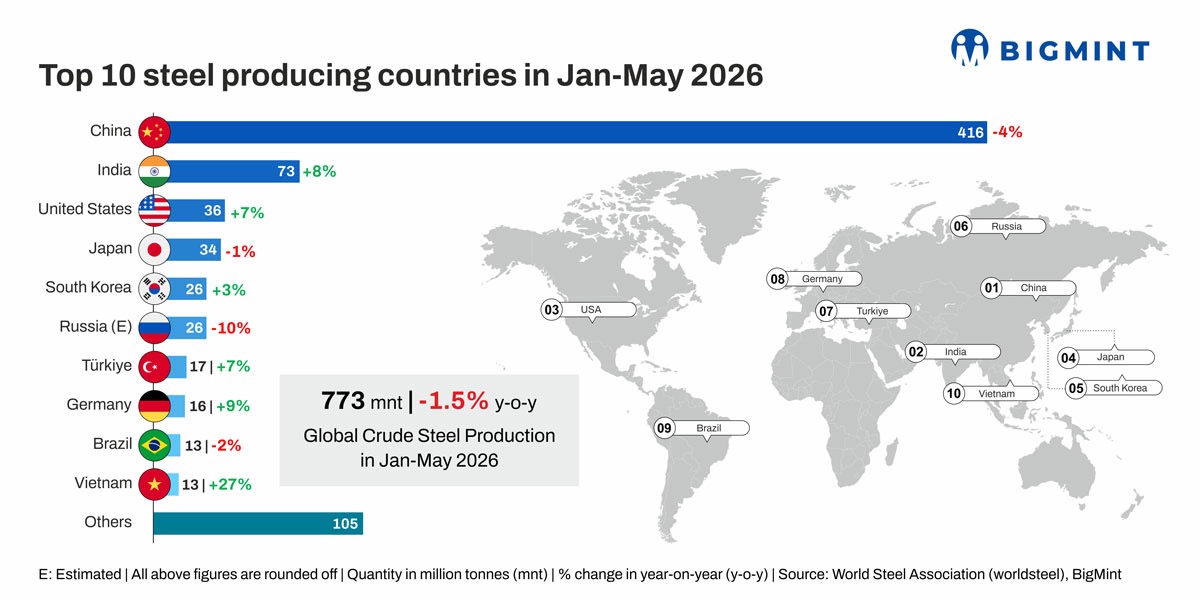
Morning Brief:Global crude steel production during January-May 2026 declined 1.5% y-o-y to 773.1 million tonnes (mnt), according to the latest data released by the World Steel Association. While the headline decline points to a softer global market, production trends across major steel-producing countries have become increasingly divergent. China's continued slowdown remained the principal drag on global output, while stronger manufacturing, infrastructure and industrial demand supported higher steel production in India, the United States, Germany and several other economies.
The January-May data suggest the global steel industry is no longer moving through a synchronised cycle. Instead, regional demand conditions are increasingly determining production trends, with China's structural slowdown continuing to outweigh growth across other major steel-producing nations.
How did major steel producing countries perform?
China's crude steel production declined 3.9% y-o-y during January-May, continuing to exert the largest influence on global output. Although several mills implemented modest production cuts during May, inventories continued to rise as domestic demand weakened faster than supply adjustments. Softer activity across the property and construction sectors, together with persistent oversupply concerns, continued to weigh on steel prices and production decisions. Given China's share of global steel production, relatively small changes in its output continue to shape worldwide production trends.
Indiaremained among the strongest-performing major producers, with crude steel production increasing 7.8% during the first five months of the year. Production continued to be supported by resilient infrastructure spending, construction activity, manufacturing growth and robust domestic steel consumption. Ongoing capacity additions by primary steelmakers also continued to support higher output, reinforcing India's position as the fastest-growing large steel-producing economy.
The United Statesrecorded a 6.8% increase in crude steel production during January-May, supported by stronger manufacturing, construction and energy sector activity. Market conditions were reflected in an 11.2% m-o-m increase in finished steel imports during May, with shipments of hot-rolled sheets, steel plates, oil country tubular goods (OCTG), hot-rolled bars and reinforcing bars rising sharply. The increase suggests healthy downstream industrial demand, encouraging domestic steelmakers to maintain higher production levels.
Japan's crude steel production remained subdued, declining 0.7% during January-May, reflecting continued weakness in both domestic and export demand. Although production stabilised in May, demand from key steel-consuming sectors remained soft, limiting any meaningful recovery in output.
South Korea, by contrast, recorded a modest recovery, with crude steel production increasing 2.7% during the review period. Improving manufacturing activity and relatively stable domestic demand helped support output despite continued competition from Chinese steel exports across regional markets. Korea's formulation of an antidumping mechanism to contain Chinese imports is expected to support production further.
Russiaremained among the weakest-performing major producers, with crude steel production declining 10% y-o-y. Weak domestic demand, reduced export opportunities, sanctions and the continued strength of the rouble weighed on steelmakers, limiting both production and profitability.
Germany emerged as one of Europe's stronger performers, with crude steel production increasing 8.8% during January-May despite the broader European Union recording a 1.5% decline. The increase was driven primarily by stronger blast furnace output, although producers remain cautious amid subdued industrial demand and continued uncertainty surrounding manufacturing activity across the region.
Vietnamcontinued to post the fastest production growth among major steel-producing countries, with crude steel output increasing 26.8% y-o-y. The expansion reflects continued investment in steelmaking capacity alongside firm manufacturing activity, further highlighting the increasingly uneven nature of global steel production.
Outlook
The January-May data suggest global crude steel production is becoming increasingly fragmented rather than uniformly weaker. While China's slowdown continues to determine the direction of global output, stronger manufacturing, infrastructure and industrial activity across India, the United States and several other economies is providing an important counterbalance.
For steel markets, the remainder of 2026 will depend largely on whether China's production discipline strengthens sufficiently to rebalance domestic supply with demand. At the same time, resilient industrial activity outside China should continue to support steel production and raw material demand, limiting the downside to global output despite persistent weakness in the world's largest steel-producing nation.
