Daily round-up: LME base metals strengthen amid continued warehouse drawdowns
...
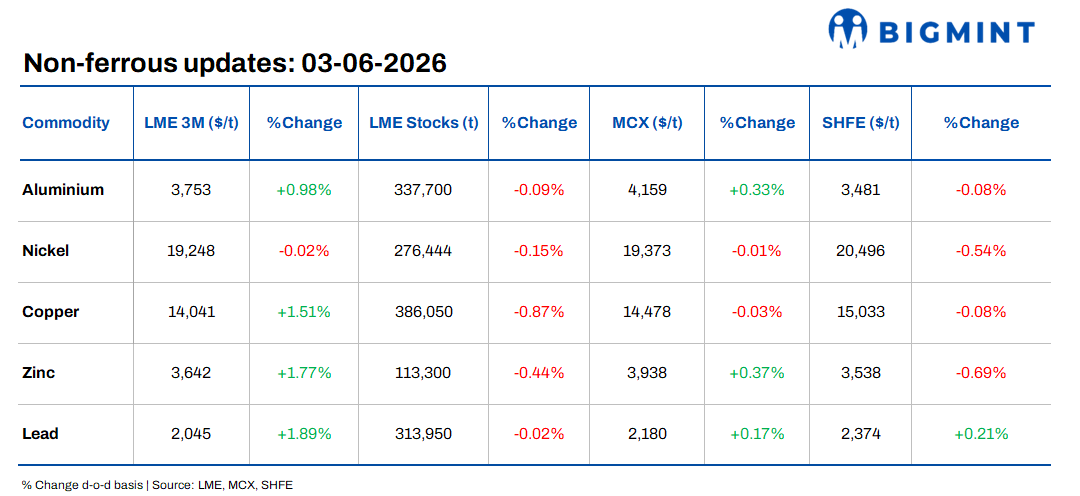

- LME copper crosses $14,000/t, lead records steepest gain
- Gulf tensions, tighter availability support base metals prices
Base metals prices on the London Metal Exchange (LME) traded mostly higher on 2 June 2026. Lead recorded the strongest gain, rising 1.89% d-o-d to $2,045/t, followed by zinc, which increased 1.77% to $3,642/t. Copper also moved higher by 1.51% to $14,041/t, while aluminium gained 0.98% to $3,753/t. In contrast, nickel edged marginally lower by 0.02% to $19,248/t.
On the inventory side, copper stocks registered the sharpest decline of 0.87% d-o-d to 386,050 t, followed by zinc inventories, which declined 0.44% to 113,300 t. Nickel and aluminium inventories also edged lower by 0.15% and 0.09% to 276,444 t and 337,700 t, respectively, while lead stocks remained broadly stable at 313,950 t, indicating continued drawdowns across LME warehouses.
Domestic market overview
India's non-ferrous scrap market displayed mixed trends d-o-d. Aluminium tense scrap (loose), ex-Chennai, declined by INR 1,000/t or 0.3% d-o-d to INR 308,000/t from INR 309,000/t, while aluminium taint tabor scrap (loose), ex-Delhi, remained unchanged at INR 260,000/t, indicating stable market conditions amid balanced regional demand.
Meanwhile, copper armature scrap (Cu 99%), ex-Delhi, increased by INR 20,000/t or 1.6% d-o-d to INR 1,270,000/t from INR 1,250,000/t, supported by stronger copper market trends and improved spot buying sentiment.
Other market updates
New Zealand launches safeguard probe into aluminium extrusion imports
New Zealand has initiated a safeguard investigation into aluminium extrusion imports following concerns over a sharp rise in inbound shipments and potential injury to domestic manufacturers. The probe will assess whether increasing import volumes have negatively impacted the local aluminium extrusion industry through pricing pressure and market share losses.
Authorities will examine import trends, domestic industry performance, and potential links between rising overseas supplies and weakening local market conditions. The investigation could lead to temporary trade protection measures, including safeguard duties or import restrictions, if material injury to domestic producers is established.
Oil holds firm as geopolitical tensions drive market volatility
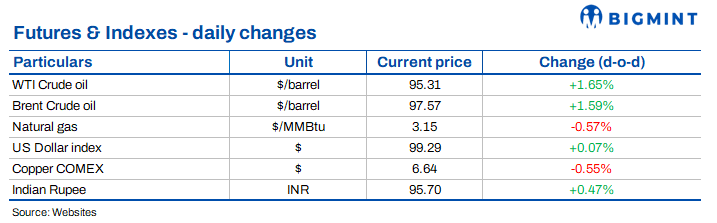
Global markets remained volatile on 3 June as continued Middle East tensions and uncertainty surrounding US-Iran negotiations supported oil prices and broader commodity market sentiment. Brent Crude remained near $97/bbl amid concerns over potential disruptions to Gulf energy flows and Strait of Hormuz shipping routes.
Meanwhile, stronger US economic data and persistent inflation concerns continued to influence broader financial market sentiment, keeping investors cautious despite ongoing support from technology and AI-linked sectors.
