Daily round-up: Base metals track inventory declines; oil volatility returns
...

- Guinea targets 7 mnt alumina capacity by 2030
- Copper slips toward $13,600/t amid Fed rate concerns
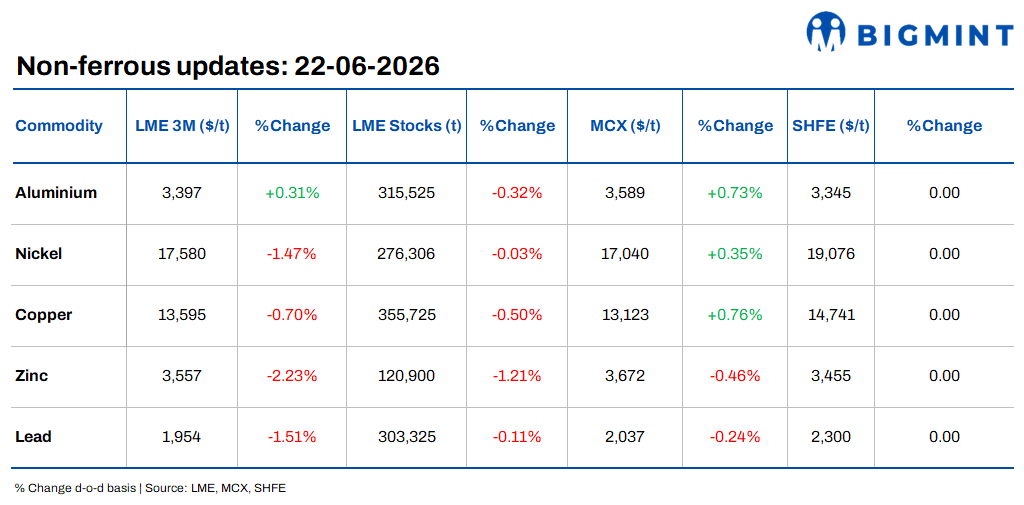
Base metals on the London Metal Exchange (LME) traded mostly lower on 19 June 2026, with aluminium being the only major gainer. Aluminium rose 0.31% d-o-d to $3,397/t, supported by continued inventory drawdowns. In contrast, zinc recorded the sharpest decline, falling 2.23% to $3,557/t, followed by lead, nickel, and copper, which dropped 1.51%, 1.47%, and 0.70% to $1,954/t, $17,580/t, and $13,595/t, respectively.
On the inventory side, exchange stocks declined across all major metals, indicating continued supply tightness. Zinc inventories recorded the largest fall, down 1.21% d-o-d to 120,900 t, followed by copper stocks, which decreased 0.50% to 355,725 t. Aluminium inventories declined 0.32% to 315,525 t, while lead and nickel stocks edged lower by 0.11% and 0.03% to 303,325 t and 276,306 t, respectively. The broad-based inventory decline suggests that underlying physical demand remains supportive despite weaker price performance.
Domestic market overview
India's non-ferrous scrap market remained largely stable on 19 June amid subdued buying activity and mixed global cues. Aluminium tense scrap (loose), ex-Delhi, remained unchanged at INR 290,500/t, while ex-Chennai prices were also steady at INR 295,000/t, reflecting balanced market conditions.
Meanwhile, copper armature scrap (Cu 99%), ex-Delhi, declined by INR 10,000/t, or around 0.81% d-o-d, to INR 1,230,000/t. The decline reflected cautious procurement activity as domestic buyers continued to monitor global copper price trends.
Oil prices rebound as concerns over Iran deal resurface
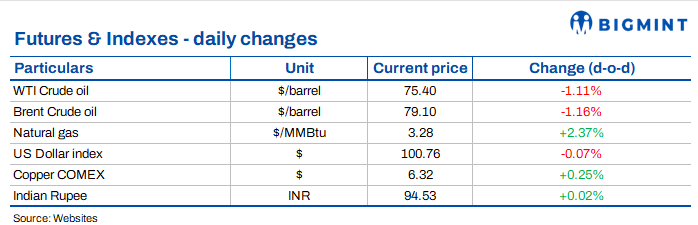
Global crude oil prices moved lower on 22 June 2026, with Brent crude declining 1.16% d-o-d to $79.10/bbl and WTI falling 1.11% to $75.40/bbl. Natural gas prices, however, rose 2.37% to $3.28/MMBtu, reflecting lingering uncertainty in global energy markets.
Market sentiment remained highly volatile as doubts emerged over the durability of the US-Iran peace agreement. Reports indicated that Iran had again restricted activity through the Strait of Hormuz, reviving concerns over global supply disruptions and pushing oil prices briefly back above $80/bbl.
The International Energy Agency estimates that disruptions in the Gulf have affected roughly 14 million bpd of global supply, while concerns remain over depleted inventories and the pace of recovery. Meanwhile, JPMorgan warned that a prolonged disruption to Hormuz could potentially push oil prices toward $150/bbl, underscoring the market's sensitivity to developments in the region.
Other updates
Aluminium market avoids major supply crisis
The aluminium market has largely avoided the severe supply crisis feared during the Iran conflict, despite disruptions affecting a region that accounts for nearly 10% of global aluminium supply. Middle Eastern smelters managed to sustain operations through alternative alumina sourcing routes, while higher exports from China and rising production in Indonesia helped offset supply losses.
Analysts remain divided on the market outlook, with JPMorgan stating that a move toward $4,000/t is taking longer than expected due to strong Asian supply and inventory drawdowns, while Goldman Sachs expects prices to move closer to $3,000/t over the next year from current levels near $3,400/t. Chinese production has exceeded its official 45 mnt capacity cap, reaching an annualized rate of around 47 mnt, while Indonesia continues to emerge as a major supply source. Although hidden inventories have helped ease immediate shortages, several analysts warn that sustained deficits could eventually tighten visible stocks if demand remains strong.
Higher-for-longer US rates pressure copper market
Copper prices edged lower, with LME copper slipping toward $13,600/t, as markets reassessed expectations for US monetary policy after Federal Reserve officials signalled that interest rates could remain elevated for longer. The stronger dollar and concerns over slower industrial activity weighed on sentiment despite copper still trading near historically high levels.
Guinea seeks greater control over aluminium supply chain
Guinea, now the world's largest bauxite producer, accounts for around 40% of global bauxite output and 70% of the seaborne bauxite trade, while exports surged 25% y-o-y to 183 million tonnes in 2025. China, which imported 149 million tonnes of Guinean bauxite last year, remains heavily dependent on the country for feedstock.
Guinea is also targeting 7 million tonnes/year of alumina refining capacity by 2030, supported by projects such as Chalco's $1 billion refinery investment. The shift could reduce the availability of seaborne bauxite while increasing global alumina exports, potentially reshaping aluminium supply chains and China's refining sector.